


Autumn is one of the most beautiful times of the year in Ontario. As the leaves change colour and temperatures begin to fall, homeowners across Milton, Mississauga, Oakville, and surrounding communities start preparing their properties for winter. Gardens need cleaning, patio furniture needs storing, and lawns become covered in fallen leaves.
For many families, fall cleanup becomes a weekend tradition. You head outside with a rake, a few paper yard-waste bags, and the intention of finishing everything before the afternoon is over. Several hours later, your back feels stiff, your shoulders are tired, and even standing upright after filling another bag of leaves feels uncomfortable.
Raking leaves may not seem like strenuous exercise, but it involves repetitive movements, prolonged standing, reaching, bending, pulling, and lifting. When these activities are performed for longer than your body is accustomed to, they can contribute to muscle fatigue and musculoskeletal discomfort.
At The Muscle and Joint Clinic, we encourage patients to stay active and enjoy seasonal activities. Yard work can be a useful form of physical activity, but understanding how to manage the workload may help you avoid unnecessary discomfort.
The good news is that most people do not need to avoid raking, gardening, or lifting altogether. With a little preparation, sensible pacing, and a few simple adjustments, fall cleanup can be much more manageable.
Why Does Raking Leaves Cause Back Pain?
Raking leaves involves more physical effort than many people realize.
Each time you pull a rake toward your body, muscles in your shoulders, arms, abdomen, and back work together to control the movement. Your legs help maintain balance, while the muscles surrounding your spine help you bend, rotate, and return to standing.
A few minutes of raking may feel easy. However, repeating similar movements hundreds of times over an afternoon creates a much greater physical demand.
Many people also spend long periods reaching forward, bending to collect leaves, and lifting bags filled with yard waste. When these movements are combined with fatigue, the muscles supporting the back may become sore or less tolerant of additional activity.
The problem is not necessarily that bending or twisting is dangerous. Both movements are normal functions of a healthy spine. Instead, discomfort often develops when the amount of work exceeds what the body is currently accustomed to doing.
For example, someone who works at a desk throughout the week may suddenly spend three hours raking, digging, and carrying bags on Saturday. Even if they are generally healthy, this represents a significant change in physical activity.
The lower back, shoulders, hips, and legs may all feel the effects the following day.
The Three Main Reasons Your Back May Hurt After Yard Work
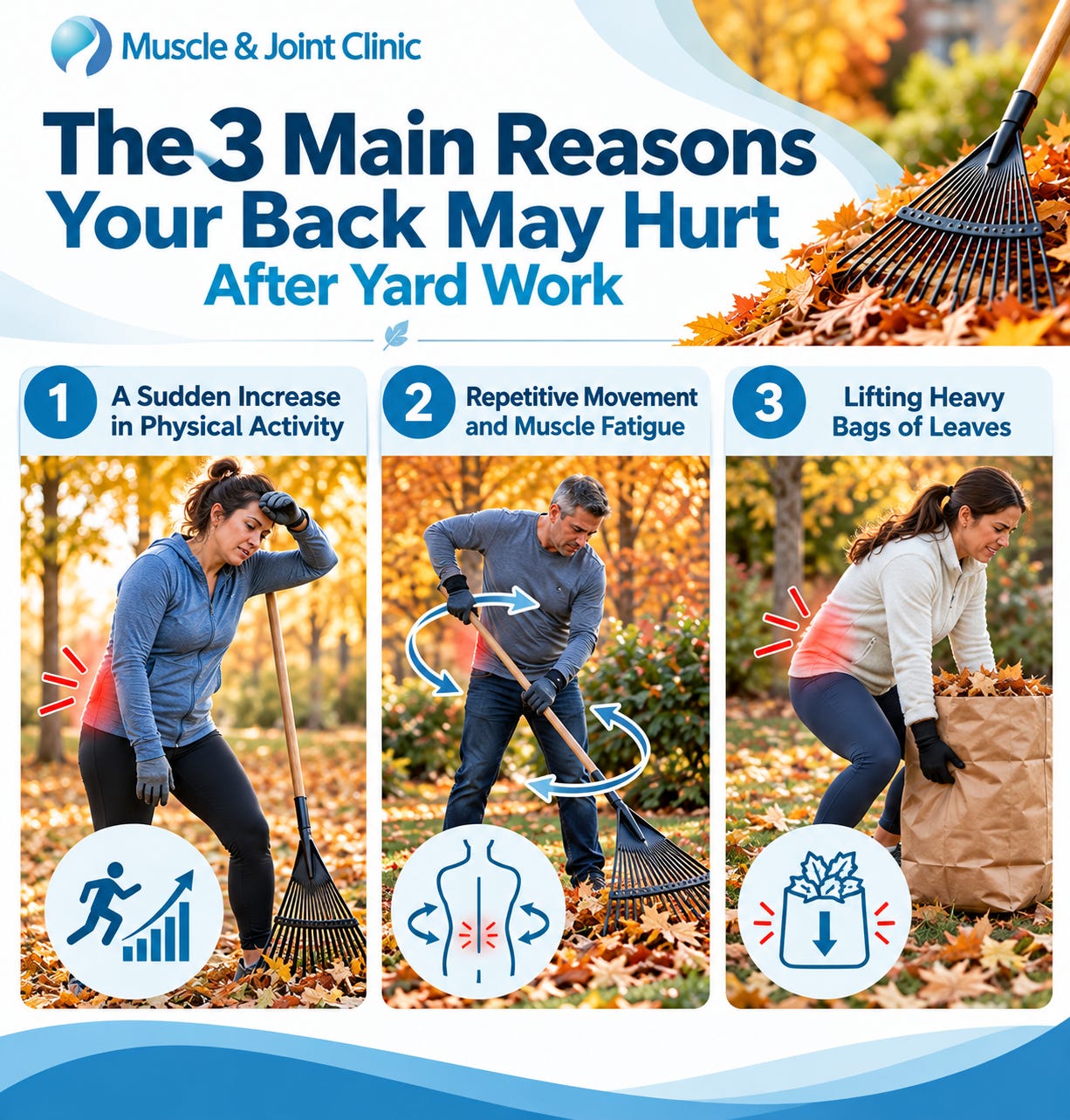
A Sudden Increase in Physical Activity
One of the most common contributors to soreness after yard work is doing too much too quickly.
During the summer, you may spend time walking, cycling, or gardening, but that does not necessarily prepare your muscles for several hours of continuous raking and lifting.
Fall cleanup often involves repetitive pulling, carrying awkward objects, and spending time in positions you do not use regularly.
When your body encounters an unfamiliar workload, temporary muscle soreness can develop.
This does not automatically indicate a serious injury. Sometimes, it simply reflects the difference between your usual activity level and the demands of the task.
A more manageable approach is to divide the work into shorter sessions and gradually increase the amount you accomplish.
Repetitive Movement and Muscle Fatigue
Raking often involves repeating the same pulling movement in the same direction.
Many people naturally use their dominant arm and maintain the same hand position on the rake throughout the task.
Over time, this can create uneven muscle fatigue in the shoulders, arms, and back.
Switching which hand is positioned at the top of the rake, changing your stance, and occasionally moving to a different task can help distribute the workload.
Cleveland Clinic recommends alternating hand positions and taking regular breaks because raking involves substantial repetitive activity (Cleveland Clinic, 2024).
The objective is not to maintain perfect posture throughout the afternoon. It is to give your body opportunities to move in different ways rather than repeating the same motion continuously.
Lifting Heavy Bags of Leaves
Collecting leaves is only part of fall cleanup. Once the leaves are gathered, they need to be placed into bags, containers, or compost bins.
Dry leaves are relatively lightweight, but wet leaves can become surprisingly heavy. A large paper bag filled with damp leaves may be much more difficult to lift than expected.
These bags are also awkward because their size can make them difficult to hold close to your body.
Repeatedly lifting heavy bags from the ground, carrying them across the yard, and placing them near the curb increases the physical demand on the lower back, hips, and arms.
Instead of filling one bag until it becomes difficult to move, use several smaller loads.
If a bag feels too heavy or awkward, divide its contents or ask someone to help.
Is Bending Your Back Actually Dangerous?
For many years, people were told that they needed to keep their backs perfectly straight whenever lifting or bending.
Although controlling heavier loads and avoiding sudden, awkward movements can be useful, modern approaches to back pain increasingly recognize that the spine is designed to move.
Bending, twisting, and lifting are normal activities. They are not inherently damaging simply because the spine moves out of a perfectly straight position.
The more important considerations are the amount of weight being handled, the person’s physical capacity, how often the movement is repeated, and whether symptoms are developing.
This broader understanding of back pain is reflected in research examining movement confidence and rehabilitation.
A randomized clinical trial published in The Lancet in 2023 investigated cognitive functional therapy for people living with chronic, disabling lower back pain. The study, known as the RESTORE trial, included 492 adults and found that individualized treatment addressing movement behaviours, pain-related beliefs, and physical activity was more effective than usual care for improving activity limitations (Kent et al., 2023).
Although this study did not specifically investigate raking leaves or lifting yard-waste bags, it reinforces the importance of helping people move with confidence rather than encouraging unnecessary fear of normal spinal movements.
For fall cleanup, the practical lesson is straightforward: move naturally, keep loads manageable, vary your movements, and avoid suddenly attempting more work than your body can comfortably tolerate.
How to Rake Leaves Without Overworking Your Back
The way you organize your yard work can make a meaningful difference in how tired or sore you feel afterward.
Begin With a Short Warm-Up
Before spending an afternoon raking, take a few minutes to prepare your body for movement.
A short walk around the yard, gentle arm circles, comfortable trunk rotations, and a few easy squats can help you transition from resting to more demanding activity.
You do not need a lengthy stretching routine or a complicated series of exercises.
The goal is simply to begin moving before attempting prolonged repetitive work.
A warm-up may improve comfort and readiness for activity, although stretching alone has not been proven to prevent every back injury.
Choose a Rake That Fits Your Height
Using a rake that is too short can require excessive reaching, while an unnecessarily heavy rake may increase fatigue in the shoulders and arms.
Choose a lightweight rake with a handle that allows you to work comfortably without constantly reaching far away from your body.
Ergonomic handles may be helpful for people who experience hand or wrist discomfort, although the best tool is the one you can use comfortably and control effectively.
People with existing arthritis or limited grip strength may also benefit from tools with larger or padded handles.
Keep the Rake Within a Comfortable Reach
When raking leaves, try to work within a comfortable distance rather than repeatedly extending the rake as far as possible.
Take small steps toward the leaves as you move across the yard. This allows your legs and body position to contribute to the movement instead of relying entirely on prolonged reaching.
When changing direction, reposition your feet as needed.
You do not need to eliminate trunk rotation. Instead, avoid repeatedly forcing the same movement when a small change in position would make the task easier.
Alternate Your Grip and Change Tasks
If you always rake with your right hand at the top of the handle, try switching occasionally so the opposite arm shares more of the work.
You can also alternate between raking, collecting leaves, walking bags to the curb, and performing lighter garden tasks.
Changing activities gives different muscle groups an opportunity to work and may reduce prolonged repetitive loading.
This is particularly helpful for people with a history of shoulder discomfort, tennis elbow, or wrist pain.
Take Regular Breaks
One of the simplest ways to reduce fatigue is to stop periodically instead of working continuously until the entire yard is finished.
Consider taking a short break after approximately 20 to 30 minutes of activity, adjusting that interval according to your fitness level and symptoms.
Stand up, walk around, drink water, and move your arms and back comfortably.
If you begin feeling increasingly tired, reduce the workload rather than trying to finish everything in one effort.
There is no medical requirement to complete the entire yard in one day.
Spreading the work across multiple afternoons is often a more sensible approach, particularly for people who are not accustomed to prolonged physical activity.
How to Lift and Carry Yard-Waste Bags More Comfortably
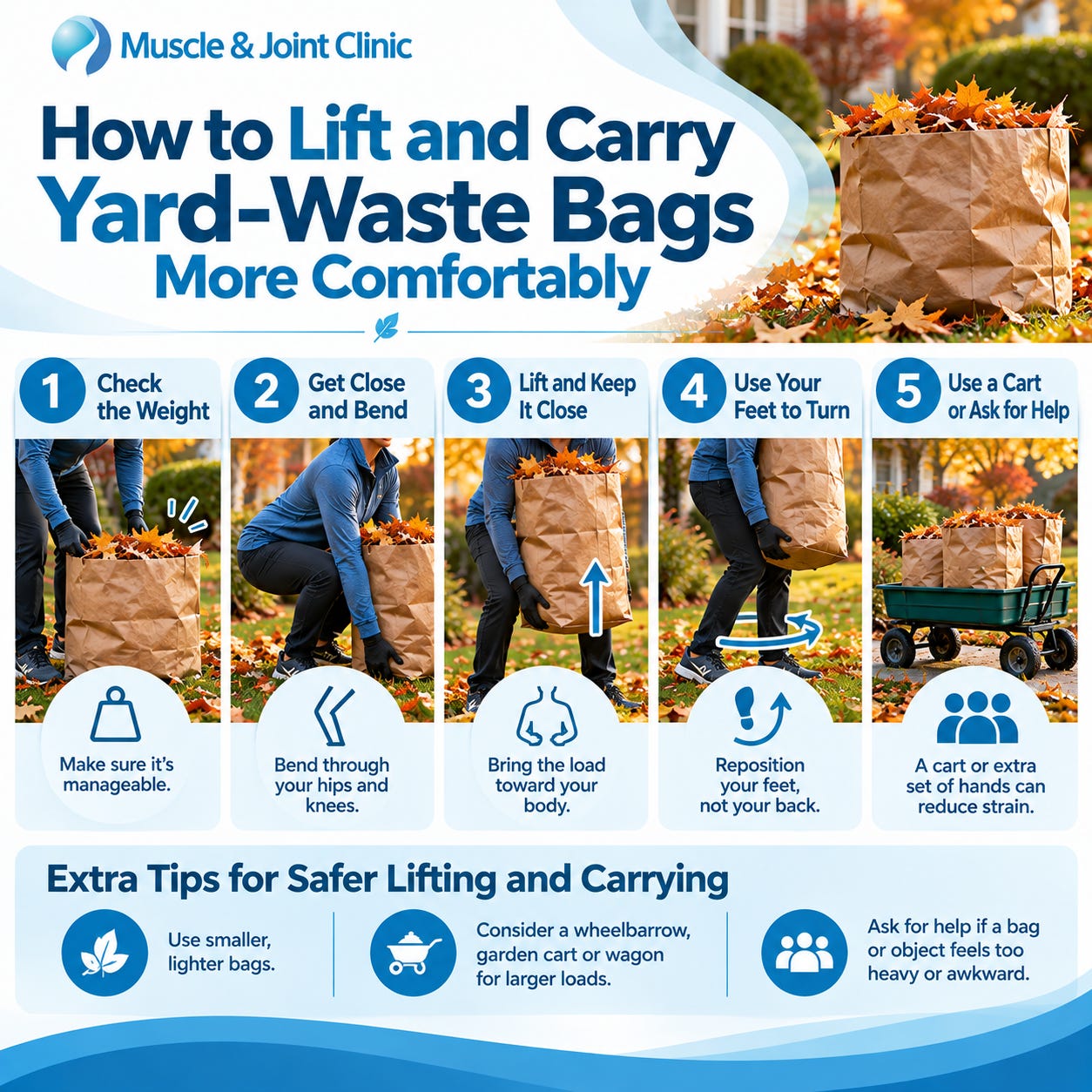
Once the leaves have been collected, lifting and carrying them can become the most demanding part of fall cleanup.
Before picking up a bag, consider how heavy it is, whether you can grip it securely, and how far you need to carry it.
Position yourself close to the bag and use a comfortable combination of hip and knee bending to reach it.
Bring the load toward your body before standing, and avoid lifting something so heavy that you struggle to control it.
There is no single lifting posture that is ideal for every person and every object. However, keeping heavier loads manageable and avoiding rushed movements can make the task easier.
If you need to change direction while carrying a heavy bag, reposition your feet rather than making a sudden twisting movement.
For larger gardens, a wheelbarrow, garden cart, or wagon may reduce the number of trips required.
Wet leaves, soil, mulch, and large planters can become particularly heavy. If an object is difficult to move, asking for help is preferable to struggling through the task.
Five Gentle Stretches to Try Before or After Fall Yard Work
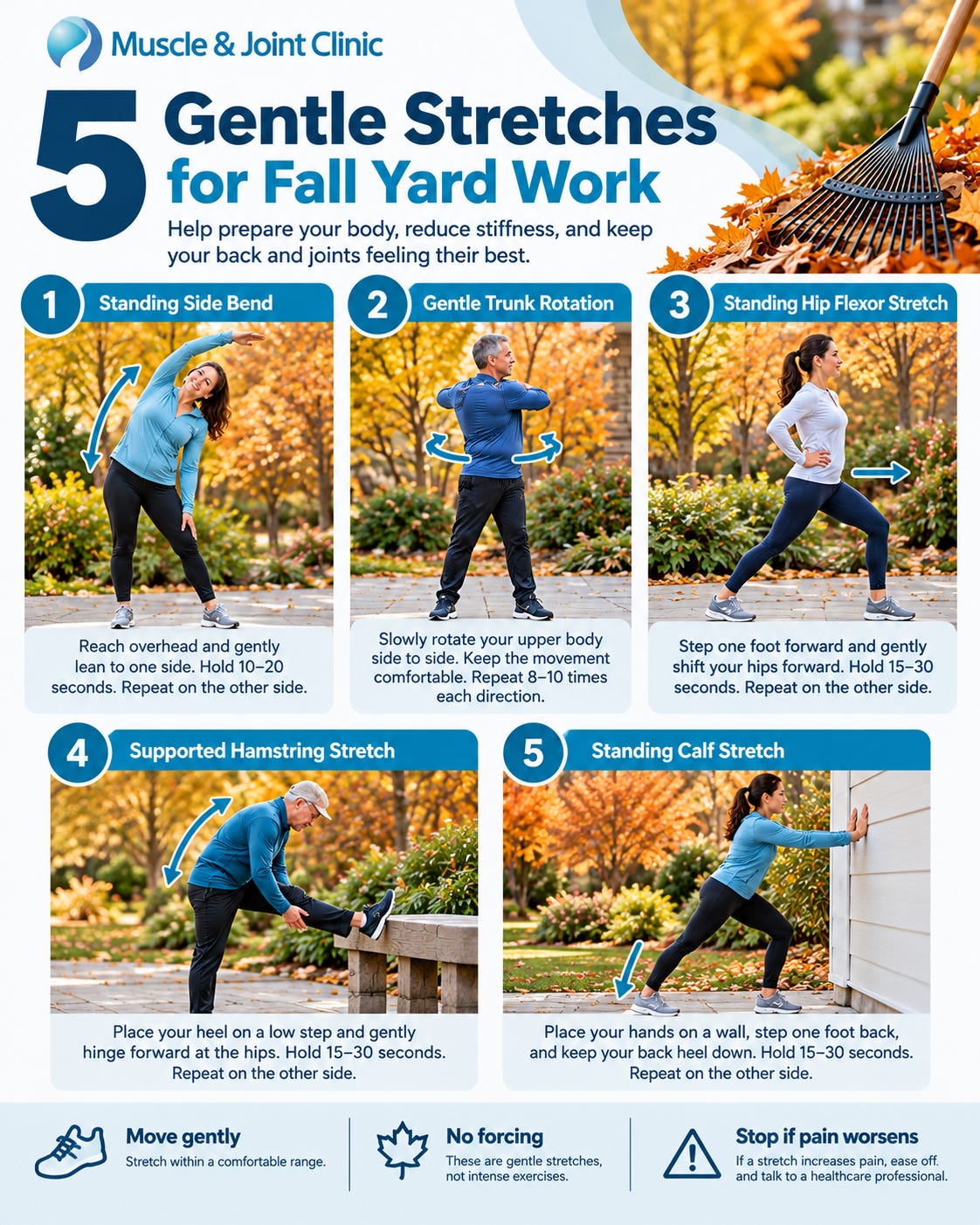
A short mobility routine can be a comfortable way to begin yard work or ease feelings of stiffness afterward.
These five stretches focus on areas commonly involved in raking, lifting, and prolonged standing: the lower back, hips, hamstrings, and calves.
They are intended as general movement options rather than exercises proven to prevent injury. Stretching should feel comfortable, and no movement should be forced.
1. Standing Side Bend
Standing side bends gently move the trunk and may help reduce the sensation of tightness along the sides of the body and lower back.
Stand with your feet approximately shoulder-width apart. Allow one arm to rest beside your body while raising the opposite arm overhead.
Slowly lean to one side until you feel a gentle stretch along your trunk. Keep your movement controlled and avoid forcing yourself into a deeper position.
Hold the position for approximately 10 to 20 seconds, return to standing, and repeat on the opposite side.
You can perform two or three gentle repetitions per side.
This movement can be useful after spending time raking in one direction or performing repetitive reaching tasks.
2. Gentle Standing Trunk Rotation
Raking and collecting leaves involve movement through the trunk and spine. Gentle standing rotations can help you become comfortable with this movement before beginning work.
Stand with your feet comfortably apart and relax your shoulders.
Place your hands across your chest or keep your arms relaxed at your sides.
Slowly rotate your upper body toward one side, allowing your hips to move naturally if needed. Return to the middle before turning toward the opposite side.
Perform approximately 8 to 10 comfortable repetitions in each direction.
The goal is not to twist as far as possible. It is to move within a range that feels natural and controlled.
If rotation causes sharp pain or worsening leg symptoms, stop the exercise and seek individualized advice.
3. Standing Hip Flexor Stretch
The hip flexors are muscles located toward the front of the hip. They contribute to movements such as walking, climbing stairs, and bending at the hip.
A gentle hip flexor stretch may help people who feel tightness around the front of the hips after prolonged sitting or activity.
Stand in a staggered position with one foot in front of the other. Bend your front knee slightly while keeping your back foot planted.
Gently shift your pelvis and body forward until you feel a comfortable stretch at the front of the back hip.
Avoid excessively arching your lower back.
Hold for approximately 15 to 30 seconds and then switch legs.
Repeat once or twice on each side.
This stretch may be particularly comfortable after spending time crouching, gardening, or repeatedly bending to collect leaves.
4. Supported Hamstring Stretch
The hamstrings are muscles located along the back of the thighs. They assist with walking, bending, and controlling hip movement.
A supported hamstring stretch can be performed using a low, stable step or bench.
Place one heel on the support, keeping the knee comfortably straight or slightly bent.
With your back in a comfortable position, gently hinge forward through your hips until you feel a mild stretch along the back of your thigh.
There is no need to reach for your toes or force the knee completely straight.
Hold for approximately 15 to 30 seconds before changing legs.
Repeat once or twice per side.
If elevating your foot feels uncomfortable, an alternative is to place one heel on the ground slightly ahead of you and gently hinge forward from the hips.
5. Standing Calf Stretch
The calf muscles work throughout yard cleanup, particularly when walking on uneven ground, standing for long periods, or pushing a wheelbarrow.
To stretch them, stand facing a stable wall and place your hands against it for support.
Step one foot backward while keeping the heel on the ground.
Bend the front knee gently and shift your weight forward until you feel a stretch in the calf of the back leg.
Hold the position for approximately 15 to 30 seconds before switching sides.
Repeat once or twice per leg.
Avoid bouncing or forcing the movement. A gentle stretch is sufficient.
How Often Should You Perform These Stretches?
These exercises can be performed before yard work, during a break, or after finishing, depending on what feels helpful.
Before starting more demanding activity, gentle dynamic movements such as walking, trunk rotations, and arm circles are often useful. Longer static stretches may be more comfortable afterward or during breaks.
You do not need to perform every exercise if you are short on time or if certain movements are uncomfortable.
For people with existing spinal stenosis, recent injuries, significant osteoporosis, or other medical conditions, some positions may need modification.
A chiropractor or physiotherapist can help determine which movements are appropriate for your individual symptoms.
Yard Work Is Exercise—And Your Body May Need Time to Adapt
One reason people become sore after fall cleanup is that they underestimate how physically demanding yard work can be.
Raking, carrying, digging, pushing a wheelbarrow, and repeatedly getting up from the ground all require muscle strength and endurance.
For someone who regularly exercises, these activities may be relatively manageable.
For someone who has been less active, the same tasks can create a substantial workload.
This does not mean that yard work should be avoided. In fact, it can be a valuable opportunity to remain active outdoors.
The important consideration is matching the amount of work to your current abilities.
If you normally spend only short periods gardening, begin with a manageable cleanup session rather than working continuously for several hours.
As your physical capacity improves, you may find that you can complete more work without experiencing as much fatigue.
Regular walking, resistance training, and general physical activity throughout the year can also make seasonal yard work easier.
What About Older Adults and People With Arthritis?
Fall yard work can be more challenging for individuals living with osteoarthritis, balance difficulties, reduced muscle strength, or previous musculoskeletal injuries.
Someone with knee osteoarthritis may find repeated squatting and standing uncomfortable. A person with hip arthritis may have difficulty bending to collect leaves, while someone with shoulder problems may struggle with repetitive raking.
These limitations do not automatically mean that the person must stop participating in yard work.
Instead, the task can often be modified.
For example, a long-handled rake may reduce the amount of reaching required. A garden cart may reduce lifting and carrying. A sturdy gardening stool or kneeling pad may make certain tasks more comfortable.
People with balance difficulties should also be cautious when working on uneven or wet surfaces.
Leaf-covered sidewalks and grass can conceal holes, stones, and other hazards.
For older adults with cardiovascular disease, yard work may also represent a significant cardiovascular demand. If strenuous activity causes chest discomfort, unusual shortness of breath, dizziness, or faintness, stop immediately and seek appropriate medical attention.
Sudden or severe chest symptoms require emergency care.
The goal is to help people continue participating in meaningful activities while managing the physical demands involved.
Why You May Feel Sore the Day After Raking Leaves
It is common to feel relatively comfortable during an activity but notice muscle soreness later that evening or the following morning.
One possible explanation is delayed-onset muscle soreness, commonly called DOMS.
This occurs after unfamiliar or unusually demanding physical activity and may involve muscle tenderness, stiffness, and discomfort during movement.
Symptoms commonly develop within several hours and can become more noticeable over the next one or two days.
For someone who has spent an afternoon raking, soreness may be felt in the lower back, shoulders, thighs, or arms.
Mild soreness usually improves gradually over several days.
Gentle walking, comfortable movement, and temporarily reducing strenuous activity may help manage symptoms.
However, not every episode of pain after yard work is ordinary muscle soreness.
Pain that is sharp, severe, progressively worsening, or associated with substantial weakness or neurological symptoms may require assessment.
What Should You Do if Your Back Hurts After Yard Work?
If your lower back becomes sore after raking leaves, it may be tempting to spend the entire following day resting on the couch.
However, for uncomplicated lower back pain, prolonged bed rest is generally not recommended.
Remaining gently active, within your tolerance, can help maintain mobility and reduce the effects of inactivity.
A short walk, comfortable movement, or changing positions regularly may help.
Some people find heat therapy useful for muscle tightness, while others prefer cold therapy for temporary symptom relief.
It may also be sensible to reduce heavy lifting or repetitive yard work briefly while symptoms settle.
The goal is to continue moving without repeatedly aggravating the painful area.
If symptoms are not improving, regularly return with similar activities, or interfere with sleep, work, or walking, a musculoskeletal assessment may be helpful.
Urgent medical attention is warranted for new loss of bladder or bowel control, numbness around the groin or saddle region, or significant or progressive leg weakness.
How The Muscle and Joint Clinic Can Help With Back Pain After Yard Work
At The Muscle and Joint Clinic, we frequently assess patients experiencing lower back pain, neck discomfort, shoulder pain, and other musculoskeletal complaints associated with everyday activities.
A patient may develop lower back discomfort after carrying heavy yard-waste bags, notice shoulder pain following repeated raking, or experience stiffness after spending several hours gardening.
Our approach begins with understanding how the symptoms developed, which movements aggravate them, and how the discomfort is affecting daily activities.
A physical assessment may include spinal and joint range of motion, muscle strength, neurological screening when indicated, and evaluation of functional movements.
The goal is to identify the most likely contributors to the symptoms and determine whether conservative care is appropriate.
Chiropractic Care
Chiropractic care may be appropriate for certain forms of lower back pain, neck pain, and associated joint or muscle discomfort.
Depending on the assessment findings, treatment may include spinal manipulation or mobilization, soft tissue techniques, mobility exercises, and education about maintaining comfortable movement.
For someone experiencing back pain after raking, care may focus on reducing discomfort, addressing movement limitations, and helping the patient return to normal activity.
Chiropractic treatment is not necessary for every episode of soreness, and the treatment approach should be matched to the individual’s condition.
Physiotherapy
Physiotherapy may help patients experiencing muscle strains, recurrent back pain, movement limitations, or reduced tolerance for lifting and other physical activities.
A physiotherapist can assess strength, mobility, movement control, and physical capacity before developing an individualized rehabilitation program.
Treatment may include progressive strengthening, mobility exercises, education, and gradual exposure to activities such as bending, lifting, and carrying.
For people who experience back pain every time they perform seasonal yard work, improving strength and endurance may be particularly valuable.
Massage Therapy
Massage therapy may provide short-term relief for muscle soreness or tension associated with repetitive yard work.
Someone who has spent several hours raking may experience discomfort in the upper back, shoulders, or lower back muscles.
Massage therapy may help improve comfort and relaxation, although it does not replace an appropriate assessment or rehabilitation program when a significant injury is suspected.
For some patients, a combination of symptom management, exercise, and practical activity advice may be appropriate.
The Take-Home Message: Rake the Leaves, Not Your Back
Fall yard work is a normal and often enjoyable part of preparing your home for the colder months.
Raking leaves, collecting debris, gardening, and carrying yard-waste bags can also provide valuable physical activity.
However, these tasks may involve more repetition and physical effort than expected, particularly when someone tries to complete everything in a single afternoon.
The best approach is not to fear bending or twisting, but to manage the overall workload.
Start with a short warm-up, choose comfortable tools, change positions regularly, use manageable loads, and take breaks before fatigue becomes excessive.
Gentle mobility exercises may help you feel more comfortable before or after activity, while regular strengthening and aerobic exercise throughout the year can improve your capacity for seasonal tasks.
If you develop persistent lower back pain, shoulder discomfort, or another musculoskeletal problem after yard work, The Muscle and Joint Clinic can help assess your symptoms and discuss appropriate treatment and rehabilitation options.
Book Your Free Consultation at The Muscle and Joint Clinic
Enjoy the beautiful fall colours, spend time outdoors, and prepare your home for winter while keeping your body moving comfortably.
References
Cleveland Clinic. (2024). 12+ tips to avoid back pain from raking leaves. https://health.clevelandclinic.org/the-right-way-to-rake-all-those-leaves-in-your-yard-without-hurting-your-back
Cleveland Clinic. (2025, November 3). How to avoid back pain when raking leaves.https://newsroom.clevelandclinic.org/2025/11/03/how-to-avoid-back-pain-when-raking-leaves
Kent, P., Haines, T., O’Sullivan, P., Smith, A., Campbell, A., Schutze, R., Attwell, S., Caneiro, J. P., Laird, R., O’Sullivan, K., McGregor, A., Hartvigsen, J., Lee, D.-C. A., Vickery, A., & Hancock, M. (2023). Cognitive functional therapy with or without movement sensor biofeedback versus usual care for chronic, disabling low back pain (RESTORE): A randomised, controlled, three-arm, parallel group, phase 3, clinical trial. The Lancet, 401(10391), 1866–1877. https://doi.org/10.1016/S0140-6736(23)00441-5
Morales, A. (2026, October 13). ‘Rake, don’t ache.’ Doctors offer advice for a healthier fall cleanup. WBAY.
This article is intended for general patient education and does not replace individualized medical advice, assessment, diagnosis, or treatment.