


Halloween is one of the most exciting times of the year for families. Children look forward to dressing up as their favourite characters, collecting candy, visiting decorated houses, and exploring their neighbourhoods after dark. Parents are often just as involved, spending hours preparing costumes, decorating the house, carving pumpkins, and accompanying their children from door to door.
With all the excitement, it is easy to forget how physically demanding Halloween can be. What begins as a fun afternoon of decorating can involve repeated bending, lifting heavy pumpkins, reaching overhead, and carrying boxes from the basement. Later in the evening, families may spend an hour or more walking around their neighbourhood while carrying candy bags, pushing strollers, or lifting tired children.
For families in Milton, Mississauga, Oakville, and surrounding communities, Halloween also brings the challenges of unpredictable October weather, wet leaves, uneven sidewalks, and reduced visibility after sunset.
At The Muscle and Joint Clinic, we encourage families to remain physically active and enjoy seasonal traditions. Halloween can be a great opportunity to get outside, walk together, and create memories. However, a little preparation can help reduce unnecessary aches, muscle strains, falls, and other injuries.
Whether you are planning an elaborate haunted-house display or simply taking your children trick-or-treating, a few practical strategies can help make Halloween more comfortable and enjoyable for everyone.
Why Halloween Can Be Surprisingly Hard on Your Body
Most people do not think of Halloween as a physically demanding event, but many of the activities involved are different from what we do during a normal day.
Consider a parent who spends much of the workweek sitting at a computer. On Halloween weekend, that same person may spend several hours carrying decorations, assembling outdoor displays, bending over pumpkins, and walking through the neighbourhood. These activities may require more physical effort than their body is accustomed to, particularly if they already experience back pain, knee discomfort, or muscle stiffness.
For some people, lifting and carrying are the biggest challenges. For others, it is prolonged standing, repeated bending, or walking farther than usual. People with plantar fasciitis may experience sore heels after trick-or-treating, while those with knee osteoarthritis may notice discomfort after climbing numerous front steps. Someone with an existing shoulder problem may find overhead decorating particularly uncomfortable.
These activities are not inherently dangerous, and avoiding movement altogether is not the answer. Our bodies are designed to move and adapt to physical demands. However, suddenly increasing the amount or intensity of activity can lead to temporary soreness or aggravate an existing condition.
The most useful approach is to prepare for the activities ahead, pace yourself when necessary, and recognize when a task has become more demanding than expected.
Picking Up Pumpkins Without Straining Your Back
Visiting a pumpkin patch is a favourite fall tradition, but pumpkins can be surprisingly awkward to lift. Their round shape makes them difficult to grip securely, and larger pumpkins can weigh considerably more than they appear. Because they usually sit directly on the ground, picking them up often involves bending forward, squatting, or reaching away from the body.
When lifting a pumpkin, try to position yourself close to it rather than reaching from a distance. Bend comfortably through your hips and knees, establish a secure grip, and bring the pumpkin close to your body as you stand. If you need to turn, reposition your feet instead of twisting sharply while holding a heavy load.
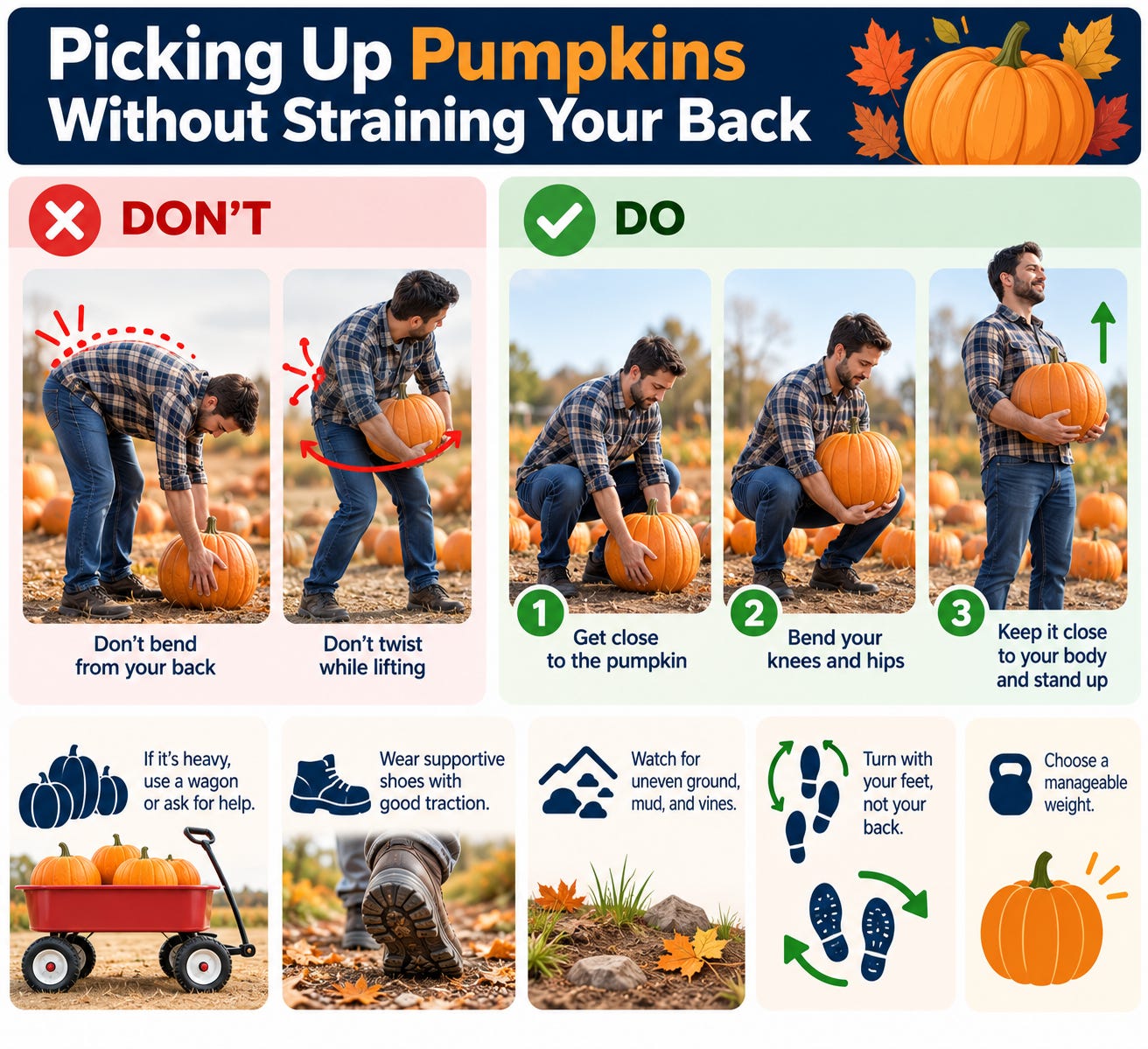
There is no single perfect lifting technique that guarantees an injury will never occur. What matters most is choosing a controlled movement, keeping the load manageable, and avoiding unnecessary strain when lifting something heavy or awkward.
If the pumpkin is particularly large, using a wagon or asking another person to help is often the simplest solution. The same principles apply when loading pumpkins into the car, carrying them into the house, or arranging them on the front porch.
Families visiting pumpkin patches should also be mindful of uneven ground. Mud, tangled vines, rocks, and wet grass can increase the risk of slipping, particularly when carrying a pumpkin that obstructs your view. Comfortable shoes with suitable traction can help make the experience safer.
Why Pumpkin Carving Can Cause Neck, Shoulder, and Wrist Discomfort
Pumpkin carving may seem like a relatively relaxing activity, but spending an extended period looking down at a table can leave the neck and shoulders feeling uncomfortable.
When someone leans forward to carve a detailed design, the neck and upper-back muscles remain active to support the head and upper body. Although there is nothing inherently harmful about looking down, holding one position for a prolonged period can contribute to muscle fatigue and stiffness.
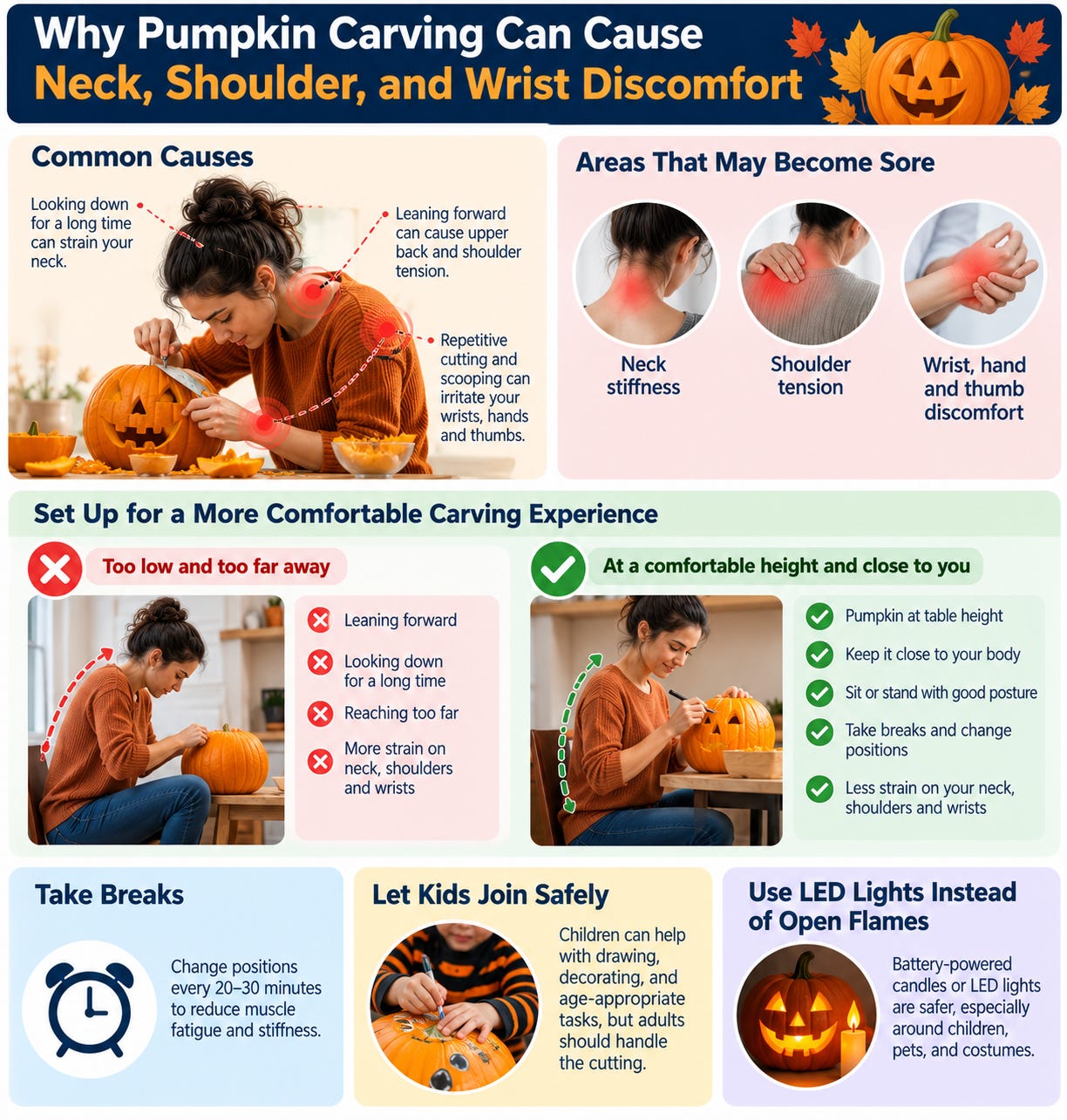
Carving also involves repetitive gripping, cutting, and scooping. For individuals with existing hand arthritis, wrist pain, or thumb problems, these movements may become uncomfortable, particularly when working with large or difficult pumpkins.
A comfortable setup can make a difference. Try placing the pumpkin on a stable table at a height that allows you to work without excessive reaching. Move the pumpkin closer rather than leaning farther forward, and change your sitting or standing position occasionally.
If you are carving several pumpkins, consider spreading the activity over multiple sessions instead of completing everything at once. Short breaks can help reduce muscle fatigue and give your hands and shoulders an opportunity to rest.
It is also important to consider safety when children are involved. Health Canada recommends that adults handle pumpkin carving because sharp tools can cause serious cuts. Younger children can participate by drawing designs, decorating the outside of pumpkins, or helping with age-appropriate activities.
When displaying finished pumpkins, battery-powered candles or LED lights are a safer alternative to open flames, particularly around children, pets, and costumes.
Decorating Your Home Without Overworking Your Muscles and Joints
Halloween decorations have become increasingly elaborate. What once involved a few pumpkins and artificial cobwebs may now include giant skeletons, inflatable characters, fog machines, outdoor lights, and elaborate haunted-house displays.
Although decorating can be enjoyable, assembling and installing these displays may involve considerable physical effort. Reaching overhead to hang decorations can fatigue the shoulders and upper back, while repeatedly crouching to secure lawn decorations can place additional demands on the knees and hips.
Large decorations can also be awkward to handle even when they are relatively lightweight. Their shape and size may make them difficult to balance, especially when working outside in windy conditions.
Whenever possible, assemble larger decorations at ground level before raising them into position. If an item is bulky or difficult to control, ask another person to help. For decorations that require reaching higher areas, use a stable ladder or step stool rather than balancing on furniture or stretching beyond a comfortable distance.
Instead of decorating the entire house in one afternoon, consider dividing the work into shorter sessions. Alternating between tasks can also help. For example, after spending time crouching to position decorations on the lawn, switch to an activity that allows you to stand and move comfortably.
Remember that taking decorations down can be just as physically demanding as putting them up. Carrying multiple storage bins, reaching overhead, and repeatedly walking up and down basement stairs can become tiring. Making several manageable trips is usually easier than trying to carry everything at once.
Keep Your Walkways Safe for Trick-or-Treaters
While decorations are intended to make Halloween exciting, they should not create unnecessary hazards for visitors.
Health Canada recommends keeping walkways clear of obstacles and using adequate outdoor lighting so families can safely approach homes. Extension cords, pumpkins, inflatable decorations, and other objects should be positioned away from the main walking path.
Wet leaves, uneven stones, and poorly lit steps can also increase the risk of falls. Taking a few minutes to inspect the walkway before Halloween evening can help prevent avoidable accidents.
Battery-operated lights are preferable to open flames in areas where children may be walking. They provide a similar festive effect without creating the same risk of burns or costume fires.
Choosing a Halloween Costume That Is Comfortable and Safe
A Halloween costume may look impressive in photographs, but wearing it for several hours can be another matter.
Long capes, oversized accessories, heavy costumes, restrictive clothing, and poorly fitting shoes can interfere with comfortable movement. For children, costumes that drag on the ground may increase the risk of tripping, particularly when climbing steps or walking on uneven sidewalks.
Masks can also create problems if they interfere with peripheral vision. A child who cannot clearly see curbs, stairs, or approaching vehicles may be more likely to stumble or become involved in an accident.
Health Canada recommends choosing costumes that fit properly, using bright or reflective materials to improve visibility, and considering face paint instead of masks when appropriate. Costume accessories should be soft and flexible rather than hard or sharp.
Footwear deserves particular attention. Trick-or-treating often involves much more walking than children anticipate, and uncomfortable costume shoes may quickly lead to sore feet.
Shoes that are too narrow, slippery, or poorly fitted can also contribute to discomfort in the ankles, knees, and lower back. For children and adults with existing foot conditions, such as plantar fasciitis or ankle instability, unsuitable footwear may aggravate symptoms.
Comfortable running shoes or well-fitting walking shoes are often a better option than costume-specific footwear. If special shoes are important to the costume, consider wearing them for photographs before switching to something more practical for the evening.
Preparing for Cold and Unpredictable October Weather
Anyone who has experienced Halloween in Ontario knows that the weather can be unpredictable. Some years bring relatively mild temperatures, while others involve cold winds, rain, or even the possibility of snow.
For children who are excited about collecting candy, the temperature may not seem important when they first leave home. However, spending an extended period outdoors without adequate clothing can quickly become uncomfortable.
Parents should check the forecast and plan costumes that allow warm layers to be worn underneath. Gloves, warm socks, insulated footwear, and flexible clothing can help children stay comfortable without restricting their movement.
Rain can present additional challenges. Wet leaves, slippery surfaces, and puddles may make walking more difficult, particularly in the dark. Waterproof footwear and outer layers may be helpful if wet conditions are expected.
For people with existing arthritis or other musculoskeletal conditions, cold temperatures may also make joints feel stiffer or more uncomfortable. Although research has not established that cold weather directly causes joint deterioration, some individuals report changes in pain and stiffness during colder or damp conditions.
Dressing warmly and remaining active can help make outdoor activities more manageable.
Trick-or-Treating Is a Great Opportunity for Family Exercise
One of the positive aspects of Halloween is that it encourages families to get outside and walk together.
Children may spend much of their day sitting in classrooms, completing homework, or using screens. Trick-or-treating provides an opportunity to participate in physical activity while enjoying a community tradition.
Walking supports cardiovascular fitness, muscle endurance, bone health, and general well-being. It is also an accessible activity that families can enjoy together without requiring specialized equipment.
However, the distance covered during trick-or-treating may be greater than expected, particularly for younger children and adults who are not accustomed to walking for extended periods.
A child who normally walks short distances may become tired after visiting several streets. Parents may also find the evening more demanding when carrying bags, managing younger siblings, or travelling up and down numerous front steps.
Planning a realistic route can make the experience more enjoyable. Younger children may be comfortable visiting a few nearby streets, while older children may be able to travel farther. There is no need to visit every house in the neighbourhood or turn the evening into a competition to collect the most candy.
Families should feel comfortable taking breaks, returning home early, or adjusting their plans if someone becomes tired.
The objective is to enjoy the activity and spend time together, not to reach a particular walking distance.
Carrying Candy Bags and Tired Children Without Overloading Your Back
As the evening progresses, candy bags become heavier. What starts as a small collection of treats can gradually become an awkward load, particularly for younger children carrying everything in one hand.
Holding a heavy bag on one side for an extended period can cause temporary discomfort in the shoulders, arms, or back. This may become more noticeable toward the end of the evening when children are already tired.
A lightweight backpack with two comfortable straps can help distribute the weight more evenly. Another option is to periodically transfer candy into a larger bag carried by a parent, allowing children to continue using a smaller container.
Parents should also be mindful of how much they are carrying. It is common to begin the evening holding a jacket or flashlight and eventually end up carrying multiple candy bags, costume accessories, and a tired child.
For parents of younger children, carrying becomes particularly demanding when little legs have had enough walking.
Holding a child on one hip for a long period may place uneven demands on the lower back, hips, and shoulders. When possible, alternate carrying positions, share carrying duties with another adult, or use a stroller or wagon that is appropriate for the child’s age and size.
When picking up a child, bring them close to your body and choose a stable, comfortable lifting position.
If you expect your child to become tired, bringing a wagon from the beginning may be easier than carrying them home after an hour of trick-or-treating.
Avoiding Slips, Trips, and Falls While Trick-or-Treating
One of the most important Halloween safety concerns is visibility, particularly when children are walking near roads after sunset.
Excited children may become distracted by decorated houses, friends, or the anticipation of collecting candy. They may move quickly between homes without paying close attention to curbs, driveways, steps, or approaching vehicles.
Wet leaves and uneven sidewalks can create additional hazards. Costumes that restrict vision or drag on the ground can make these obstacles harder to navigate.
Health Canada recommends that children remain on sidewalks or designated walking paths whenever possible and cross roads at intersections or marked crossings. Families should avoid crossing between parked vehicles, which can make it difficult for drivers to see pedestrians.
Flashlights, reflective materials, and brightly coloured clothing can improve visibility. Young children should always be accompanied by an adult, while older children should travel in groups and follow a planned route with a clear return time.
Parents should also remind children to visit homes with exterior lights on and never enter an unfamiliar person’s home or vehicle.
Although Halloween should be exciting and enjoyable, a few simple road-safety habits can substantially reduce unnecessary risks.
What About All That Halloween Candy?
Halloween and candy naturally go together, and enjoying treats is part of the tradition for many families.
However, it can be helpful to approach the evening with a little balance rather than allowing candy to replace regular meals.
Children may be so excited about trick-or-treating that they want to leave immediately after school and skip dinner. Eating a balanced meal beforehand can help provide the energy needed for walking and reduce the likelihood of relying entirely on candy throughout the evening.
A meal containing protein, carbohydrates, vegetables, and some healthy fats can be a practical option. For example, chicken with rice and vegetables, pasta with a protein source, or a homemade sandwich with fruit may provide a satisfying meal before heading outdoors.
There is no need to make Halloween overly restrictive or turn candy into something children should fear. Instead, parents can encourage moderation, establish reasonable routines, and help children understand that treats can be enjoyed as part of an overall balanced diet.
After returning home, Health Canada recommends that parents inspect the candy collected by children and discard treats that are opened, damaged, unwrapped, or appear unsafe. Young children should also avoid candies that present choking hazards.
For children with food allergies, checking ingredient labels is particularly important because miniature or seasonal versions of familiar candies may differ from their regular packaging.
What Should You Do if Your Back, Neck, or Legs Feel Sore After Halloween?
After an evening of walking, lifting, decorating, or carrying children, some people may notice mild muscle soreness or stiffness the following morning.
This does not automatically indicate an injury.
If someone has walked farther than usual or performed unfamiliar activities, temporary soreness may reflect the additional physical demands placed on their muscles.
For mild discomfort, gentle movement may help. A short walk, comfortable stretching, or changing positions regularly can reduce the stiffness that develops after prolonged sitting or inactivity.
Some people find warmth helpful for muscle tightness, while others prefer cold therapy for an irritated area. Either may provide temporary relief, depending on the symptoms and individual preference.
It may also be sensible to temporarily reduce activities that significantly aggravate discomfort while gradually returning to normal movement as symptoms improve.
However, pain that is severe, worsening, persistent, or interfering with everyday activities should be properly assessed. New numbness, significant weakness, or symptoms following a fall may require prompt medical attention.
It is important not to dismiss concerning symptoms simply because they occurred after a busy Halloween evening.
How The Muscle and Joint Clinic Can Help
Halloween-related aches and pains can involve several areas of the body, including the lower back, neck, shoulders, hips, knees, ankles, and feet.
At The Muscle and Joint Clinic, our multidisciplinary team provides chiropractic care, physiotherapy, and massage therapy for a wide range of musculoskeletal complaints.
When a patient develops discomfort after lifting decorations, walking for an extended period, or performing unfamiliar activities, an assessment can help identify which tissues and movements may be contributing to their symptoms.
Chiropractic Care for Back, Neck, and Joint Pain
Chiropractors assess and manage musculoskeletal conditions affecting the spine and other joints.
For someone experiencing back pain after lifting decorations or neck discomfort following prolonged pumpkin carving, a chiropractic assessment may help identify movement restrictions, muscle tenderness, and other contributing factors.
Depending on the condition, treatment may include joint mobilization, selected manual therapy techniques, soft tissue treatment, mobility exercises, and advice on modifying aggravating activities.
The aim is to help manage symptoms and support a comfortable return to normal activity rather than suggesting that every episode of soreness requires an adjustment.
Physiotherapy for Muscle Strains and Movement Problems
Physiotherapy may be particularly helpful when discomfort is associated with weakness, reduced mobility, difficulty walking, or a recent musculoskeletal injury.
A physiotherapist can assess strength, joint movement, and functional limitations before developing an individualized rehabilitation plan.
Treatment may include progressive strengthening, mobility exercises, balance training, walking progression, and strategies for safely returning to normal activities.
For people who regularly experience pain after relatively ordinary activities, physiotherapy can also help improve physical capacity so that lifting, walking, and other everyday tasks become more manageable.
Massage Therapy for Muscle Tension and Discomfort
Massage therapy may help individuals experiencing temporary muscle tension or soreness after a physically demanding weekend.
For example, someone who spends several hours walking may notice tightness in the calves and thighs, while another person may experience upper-back and shoulder discomfort after decorating.
Massage therapy may provide short-term symptom relief and help patients feel more comfortable, although it does not replace assessment or rehabilitation when a significant injury is present.
Our goal is to determine which type of care, if any, is appropriate for each patient’s symptoms and circumstances.
The Take-Home Message: Have a Safe and Healthy Halloween
Halloween is meant to be fun, memorable, and a little spooky. It should not leave families dealing with unnecessary injuries or significant aches and pains.
Lifting pumpkins, decorating the house, carving, walking through neighbourhoods, and carrying tired children can all place additional demands on the body. Most people can participate in these activities safely, but preparation and sensible pacing can make the experience more comfortable.
Choosing supportive footwear, wearing warm clothing, keeping walkways clear, using safe lifting habits, and planning realistic trick-or-treating routes can help families enjoy the evening while reducing avoidable risks.
Just as importantly, Halloween provides an opportunity to be active, enjoy the outdoors, and spend meaningful time together.
At The Muscle and Joint Clinic, we encourage families to keep moving, stay active, and enjoy the traditions that make each season special.
If you experience persistent back pain, neck stiffness, muscle discomfort, or joint pain after Halloween, our chiropractic, physiotherapy, and massage therapy teams can help assess your symptoms and discuss appropriate treatment options.
Book Your Free Consultation at The Muscle and Joint Clinic
From our team to your family, have a safe, active, and happy Halloween!
References
Health Canada. (2026, September 24). Halloween safety. Government of Canada. https://www.canada.ca/en/health-canada/services/home-safety/halloween-safety.html
Lanoue, S. (2026, October 13). Halloween without the aches: A parent’s guide to pain-free fun. Dr. Serge Lanoue Chiropractic. https://www.drlanoue.ca/blog/halloween-without-the-aches-a-parents-guide-to-pain-free-fun
Shields Chiropractic. (2019, October 29). Tricks and tips for a healthier Halloween.https://www.shieldschiropractic.net/blog
This article is intended for general health education and does not replace individualized medical advice, assessment, or treatment.