


Low back pain is so common that many people almost treat it as a normal part of life. It shows up after long hours at a desk, during physically demanding work, after lifting something awkwardly, after a poor night’s sleep, or sometimes for no clear reason at all. For some people, it is a short-term annoyance. For others, it becomes a recurring problem that affects work, exercise, family life, sleep, mood, and confidence with movement.
Globally, low back pain is not a small issue. The World Health Organization describes low back pain as the leading cause of disability worldwide, estimating that about 619 million people were affected in 2020. Cases are projected to rise to approximately 843 million by 2050, largely because populations are growing and aging.
Because low back pain is so widespread, people often reach for whatever is familiar: pain medication, rest, stretching, massage, chiropractic care, physiotherapy, exercise, ice, or heat. Each option may have a place depending on the situation, but one simple and inexpensive therapy deserves more attention than it often receives: superficial heat therapy.
Superficial heat therapy means applying warmth to the surface of the body through methods such as a heat wrap, heating pad, hot pack, warm towel, hot bath, shower, hot water bottle, or wheat bag. It is not new. In fact, heat has been used for pain relief for centuries. What is interesting is that modern research continues to suggest that heat may have a practical role in low back pain care, especially when used safely and as part of a broader plan that includes movement, education, and appropriate clinical care.
Why Low Back Pain Is So Common
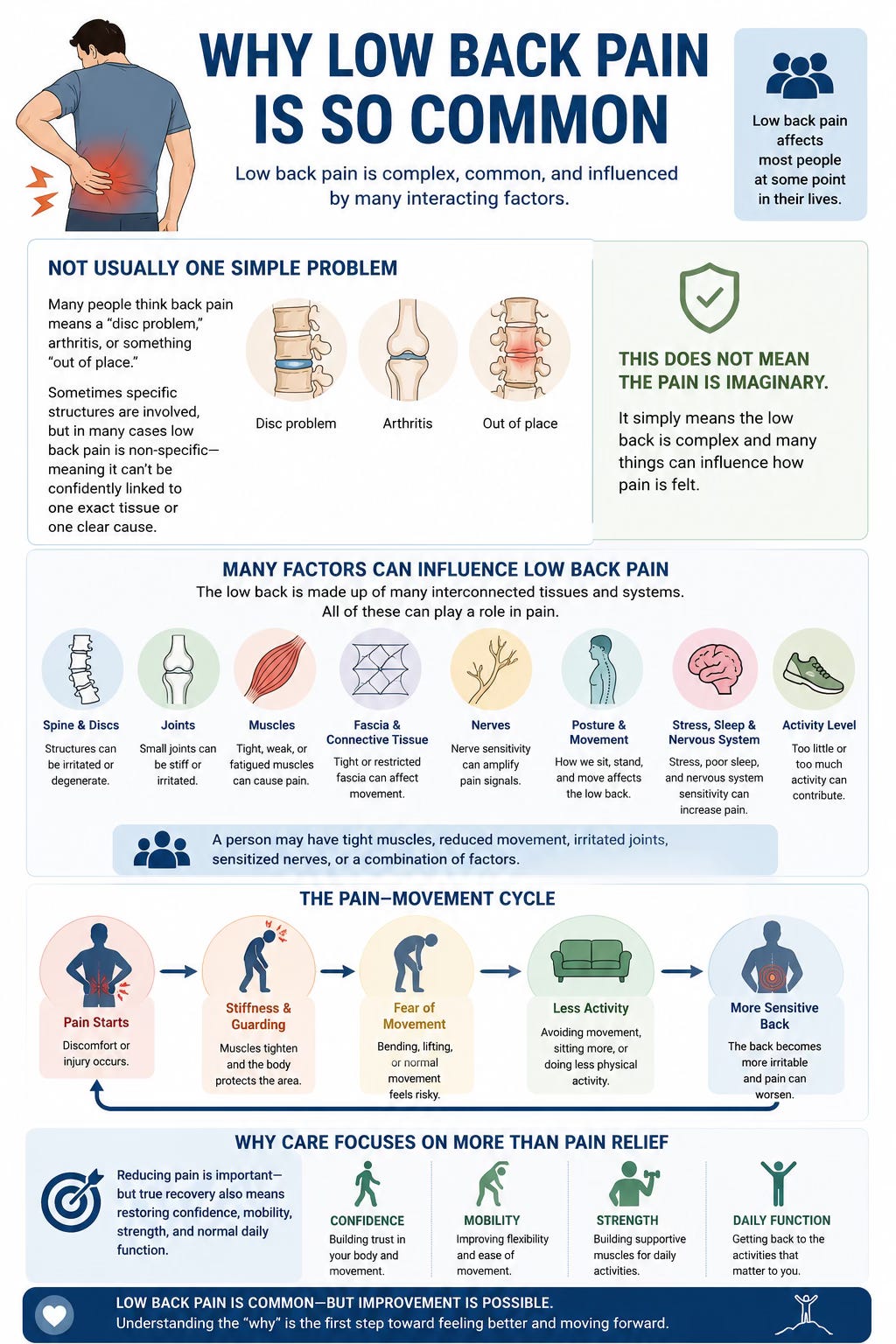
Low back pain is not usually caused by one single structure. Many people assume that back pain always means a “disc problem,” arthritis, or something being “out of place.” Sometimes specific structures are involved, but in many cases low back pain is described as non-specific, meaning the pain cannot be confidently linked to one exact tissue or one clear anatomical cause.
This does not mean the pain is imaginary. It simply means the low back is complex. The spine, discs, joints, ligaments, muscles, fascia, nerves, posture, stress, sleep, physical activity, and nervous system sensitivity can all influence how pain is felt. A person may have tight muscles, reduced movement, irritated joints, sensitized nerves, or a combination of factors.
Low back pain can also change how people move. When pain starts, many people naturally guard the area. They may stiffen the back, avoid bending, stop walking as much, or become nervous about normal movement. This can sometimes create a cycle: pain leads to stiffness and fear of movement, stiffness reduces activity, and reduced activity can make the back feel even more sensitive.
This is why low back pain care often focuses not only on reducing pain, but also on restoring confidence, mobility, strength, and normal daily function.
Where Heat Therapy Fits In
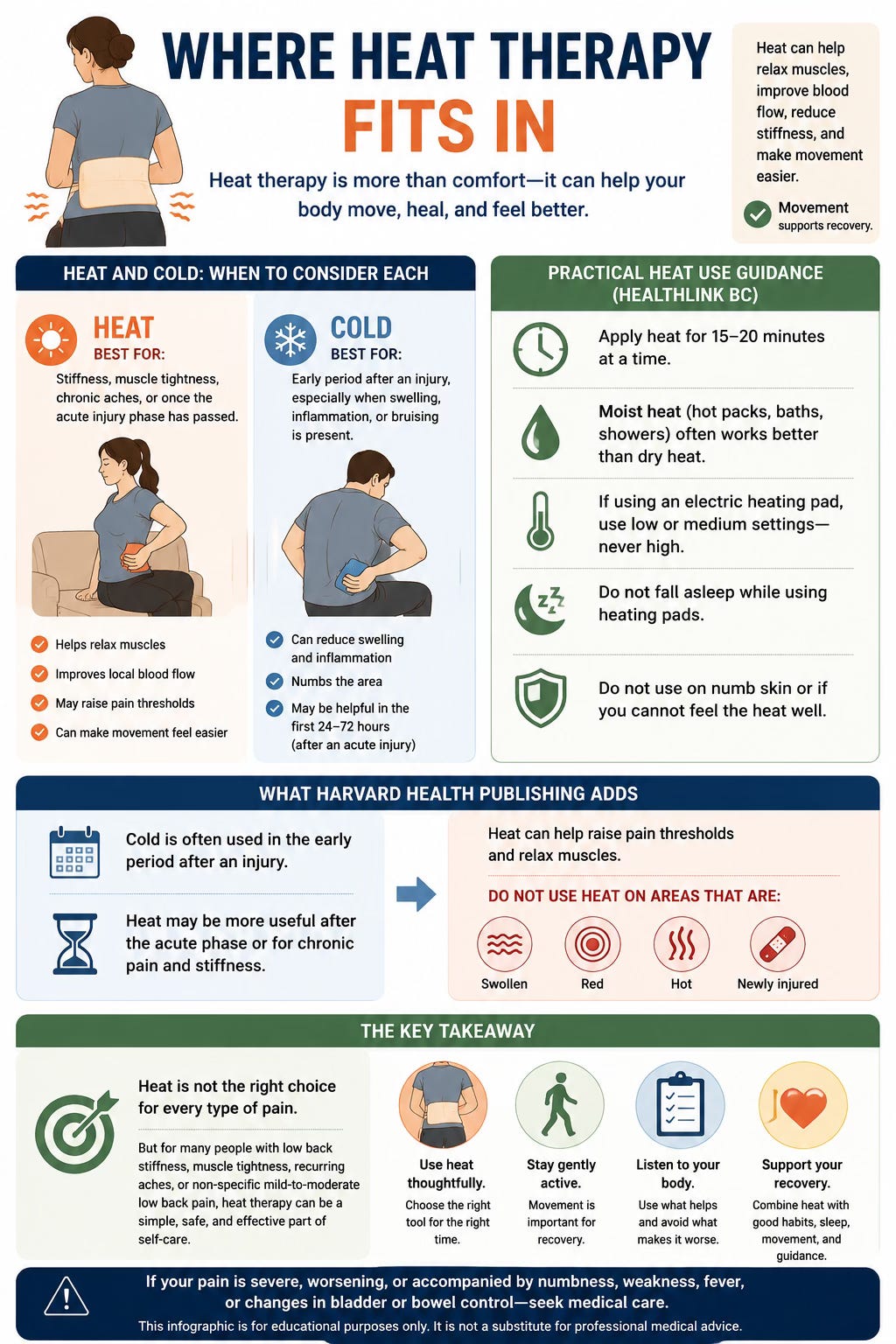
Heat therapy is often viewed as a comfort measure, but it may do more than simply feel good. Heat can help relax muscles, improve local blood flow, reduce stiffness, and make movement feel easier. For many people, that can be valuable because movement is often part of recovery.
HealthLink BC notes that there is some evidence that heat can help decrease low back pain, while evidence for cold is less clear, although some people do find either heat or cold helpful. Their practical guidance recommends applying heat for 15 to 20 minutes at a time, with moist heat such as hot packs, baths, or showers often working better than dry heat. They also advise caution with electric heating pads, including avoiding falling asleep while using them and using low or medium settings rather than high.
Harvard Health Publishing similarly explains that cold is often used in the early period after an injury, especially when swelling and inflammation are present, while heat may be more useful after the acute phase or for chronic pain and stiffness. Heat can help raise pain thresholds and relax muscles, but it should not be used on an area that is swollen, red, hot, or newly injured.
That distinction matters. Heat is not automatically the right choice for every pain. But for many people with low back stiffness, muscle tightness, recurring aches, or non-specific mild-to-moderate low back pain, heat may be a reasonable and helpful part of self-care.
How Heat May Help the Low Back
A 2021 narrative review by Freiwald and colleagues looked specifically at superficial heat therapy for non-specific, mild-to-moderate low back pain. The authors concluded that continuous, low-level heat therapy can provide pain relief, improve muscular strength, and increase flexibility. They described it as an effective, safe, easy-to-use, and cost-effective non-pharmacological option for low back pain care.
The possible benefits of heat are partly mechanical and partly neurological. When heat is applied to the low back, it can increase local tissue temperature. This may help blood vessels widen, improving blood flow to the area. Improved circulation may support tissue comfort by bringing oxygen and nutrients while helping remove irritating by-products from local tissue stress.
Heat may also reduce muscle tone. When people have back pain, the surrounding muscles may tighten in an attempt to protect the area. That protective response can be useful in the short term, but if it continues, it may add to stiffness and discomfort. Heat may help reduce this guarding, allowing the person to move more naturally.
The review also discusses how heat may affect pain processing. Warmth activates temperature-sensitive nerve endings, and this sensory input may help reduce the transmission or perception of pain signals. In simpler terms, the nervous system receives a competing signal from the warmth, which may help calm the pain response.
There may also be effects on fascia and connective tissue. The thoracolumbar fascia, a broad sheet of connective tissue in the low back, can be involved in stiffness and altered movement. Heat may help improve tissue extensibility and gliding, which may partly explain why some people feel looser after a warm shower, heat pack, or heat wrap.
The Important Detail: Not All Heat Is Used the Same Way
When people think of heat, they may picture a hot water bottle or heating pad used while lying on the couch. That can be helpful for some people, but much of the research discussed in the literature focuses on continuous low-level heat wraps. These wraps are designed to provide gentle, steady heat over a longer period while allowing the person to keep moving.
This is important because low back pain recovery is usually not about staying still. It is often about finding ways to keep moving safely. A wearable heat wrap may help a person walk, work, or complete gentle activity with less stiffness. In that sense, heat is not just passive relief; it may be a bridge back to movement.
The 2021 review noted that continuous low-level heat wrap therapy has been studied in acute and chronic low back pain. In several trials, heat wrap therapy was associated with reduced pain, improved flexibility, reduced stiffness, and better function. Some studies also found that combining heat with exercise produced better outcomes than either approach alone.
This does not mean a heat wrap is magic. It also does not mean heat replaces assessment, exercise, rehabilitation, or treatment when needed. But it does suggest that heat may be more useful when it is applied thoughtfully, especially when paired with movement rather than used only as a short passive treatment.
The Research Gap: Clinicians May Not Recommend Heat Often Enough
A newer 2026 study by McCann and colleagues examined how chiropractors and osteopaths in Australia use superficial heat for low back pain. This was an observational cross-sectional survey of 341 practitioners. The study found that although superficial heat is recognized as a non-pharmacological option for low back pain, its use in practice was limited.
Only 44.6% of practitioners reported using superficial heat for low back pain in the previous 12 months. At the same time, 71.3% of respondents acknowledged that superficial heat has a role in low back pain management, and 66.0%regarded it as an adjunct to spinal manipulation. Despite this, only 34.1% of chiropractors and 28.4% of osteopathsrecommended superficial heat for patient self-management.
That is the key issue: many clinicians appear to recognize that heat has value, but fewer are actually recommending it to patients in a structured way.
The study also found differences in how heat was used. Chiropractors were more likely to use superficial heat for chronic low back pain, while osteopaths were more likely to use it for acute low back pain. The authors pointed out that this may reflect a mismatch between guideline recommendations and clinical habits, since guidelines tend to support superficial heat more strongly for acute low back pain.
Another interesting finding was the method of heat application. The study reported that wheat bags were commonly used, while continuous low-level heat wraps were less frequently used. This matters because much of the evidence supporting heat therapy comes from studies involving heat wraps, not necessarily wheat bags or other forms of heat. The authors suggested this may represent an evidence-practice gap: clinicians may be using heat, but not always in the way most aligned with the research.
Why Might Heat Be Underused?
One reason may be that heat seems too simple. In modern healthcare, treatments that are simple, inexpensive, and available at home can sometimes be taken less seriously than more advanced interventions. Patients may assume that if something can be bought at a pharmacy or done at home, it must not be very important. Clinicians may also forget to discuss it in detail because it feels basic.
Another reason is that clinical guidelines are not always consistent. Some guidelines recommend superficial heat, but they may not clearly explain the best type of heat, how long to apply it, when to use it, or how to combine it with movement. This leaves room for uncertainty.
A third reason is safety. Heat is generally safe when used properly, but it is not risk-free. Burns can occur, especially with high heat, prolonged use, sleeping on heating pads, microwaveable packs that are overheated, or reduced skin sensation. People with diabetes-related nerve changes, poor circulation, spinal cord injury, multiple sclerosis, or other conditions that affect sensation should be especially careful and should seek professional guidance before using heat.
Finally, clinicians may focus more on treatments delivered in the clinic and less on what patients can do between visits. But for low back pain, what happens between visits often matters a great deal. Teaching patients how to safely use heat before walking, gentle mobility, stretching, or prescribed exercises could help them stay active and reduce fear of movement.
Heat, Ice, or Both?
The heat-versus-ice question is one of the most common questions people ask when they have low back pain. The answer is not always one or the other.
Cold may be more useful immediately after a sudden injury, especially if there is swelling, redness, or a clear inflammatory response. It can reduce pain by numbing the area and may help limit swelling early on. Harvard Health recommends not placing cold directly on the skin and limiting cold application to no more than 20 minutes at a time.
Heat may be more helpful when the main complaint is stiffness, muscle spasm, tightness, or chronic aching. It may also be useful before activity because it can make movement feel easier. HealthLink BC suggests heat for 15 to 20 minutes at a time and notes that some people may also try alternating heat and cold, using heat first and then ice a few hours later.
A practical approach is to pay attention to the response. If heat makes the back feel looser and helps the person move better, it may be useful. If heat makes the area throb, feel more inflamed, or worsen, it should be stopped. If ice helps calm a new flare-up, it may be appropriate. The goal is not to follow a rigid rule; the goal is to use the right tool at the right time.
How Patients Can Use Heat More Safely
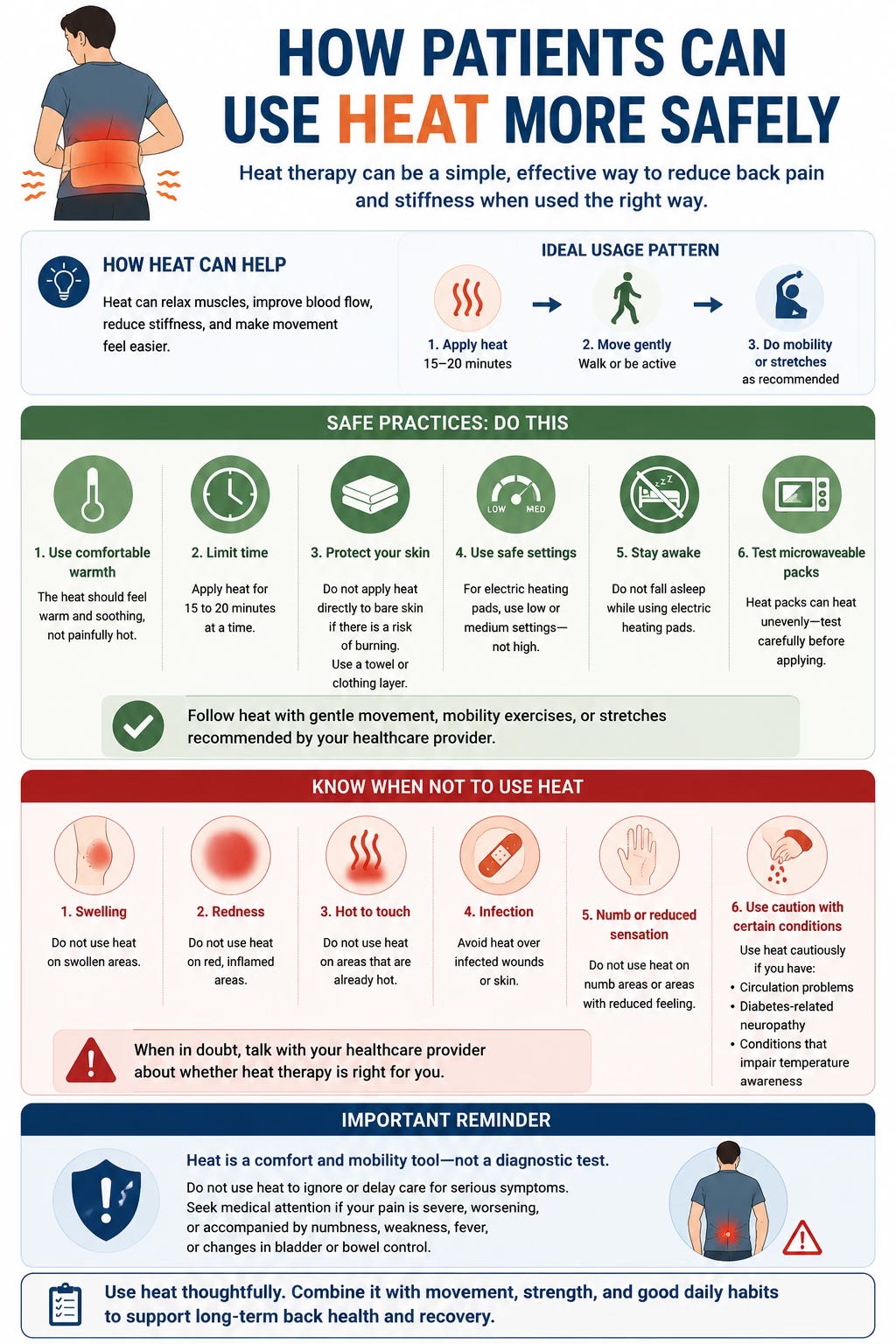
For mild-to-moderate low back stiffness or non-specific low back pain, heat can often be used as part of a simple self-management routine. A person might apply comfortable warmth for 15 to 20 minutes, then follow it with gentle walking, mobility exercises, or stretches recommended by a healthcare provider.
The heat should feel warm and soothing, not painfully hot. It should not be applied directly to bare skin if there is a risk of burning. A towel or clothing layer can help protect the skin, depending on the heat source. Electric heating pads should be used on low or medium settings, and people should not fall asleep while using them. Microwaveable packs should be tested carefully before use because they can heat unevenly.
Heat should be avoided over areas that are swollen, red, hot, infected, numb, or lacking normal sensation. It should also be used cautiously by people with circulation problems, diabetes-related neuropathy, or conditions that impair temperature awareness.
Most importantly, heat should not be used as a way to ignore serious symptoms. It is a comfort and mobility tool, not a diagnostic test.
When Low Back Pain Should Be Assessed
Most low back pain is not dangerous, but some symptoms should be assessed promptly. A person should seek medical care if low back pain is associated with significant trauma, fever, unexplained weight loss, history of cancer, progressive leg weakness, numbness in the groin or saddle area, loss of bladder or bowel control, severe unrelenting night pain, or pain that is worsening despite appropriate care.
People should also seek assessment if the pain travels down the leg with weakness, if symptoms are not improving, or if the pain is interfering with work, sleep, or daily function. Heat may still be part of care, but it should not replace a proper evaluation when symptoms suggest something more serious.
Why This Matters for Clinical Practice
The conversation around low back pain has shifted over the years. Many guidelines now emphasize non-pharmacological care, education, reassurance, staying active, exercise, and avoiding unnecessary imaging or over-medicalization for uncomplicated low back pain. Within that broader approach, heat therapy can be a practical tool.
The 2026 survey of chiropractors and osteopaths highlights an important point: even when clinicians believe heat has value, they may not consistently recommend it. This is a missed opportunity. Patients often want simple things they can do safely at home. Heat therapy, when explained properly, gives patients an active role in managing symptoms.
A better clinical recommendation would not simply be, “Try heat.” It would be more specific: “Use comfortable heat for 15 to 20 minutes, avoid sleeping with a heating pad, use low or medium settings, and then try a short walk or your prescribed mobility exercises. Stop if symptoms worsen or the area feels irritated.”
That kind of guidance is simple, practical, and empowering.
The Takeaway
Low back pain is one of the most common and disabling health conditions in the world. While there is no single solution for every case, superficial heat therapy deserves a more serious place in the conversation.
Research suggests that heat can reduce pain, improve flexibility, reduce stiffness, and support movement in people with mild-to-moderate non-specific low back pain. Continuous low-level heat wraps appear to have particularly relevant evidence, especially when used as part of a broader approach that includes activity and exercise.
At the same time, recent research suggests that heat may be underused or under-recommended by some clinicians, despite being recognized as helpful. That gap matters because patients need safe, accessible, low-cost tools they can use between appointments.
Heat therapy is not a cure-all. It is not appropriate for every injury or every person. But for many people with low back pain, it may be a simple, evidence-informed step that helps them move with less discomfort and more confidence.
Sometimes good care does not need to be complicated. Sometimes it starts with warmth, movement, and the right advice.
References
Freiwald, J., Magni, A., Fanlo-Mazas, P., Paulino, E., Sequeira de Medeiros, L., Moretti, B., Schleip, R., & Solarino, G. (2021). A role for superficial heat therapy in the management of non-specific, mild-to-moderate low back pain in current clinical practice: A narrative review. Life, 11(8), 780. https://doi.org/10.3390/life11080780
Harvard Health Publishing. (2025, August 12). Cold versus heat for pain relief: How to use them safely and effectively. Harvard Medical School.
HealthLink BC. (2022, November 9). Use heat or ice to relieve low back pain. Province of British Columbia.
McCann, P. J., McGlynn, P. J., Vitiello, A. L., Fernandez, M., & de Luca, K. (2026). The use of superficial heat in the management of low back pain by chiropractors and osteopaths in Australia: An observational cross-sectional survey. Chiropractic & Manual Therapies. Advance online publication. https://doi.org/10.1186/s12998-026-00648-w
World Health Organization. (2023, June 19). Low back pain. World Health Organization.