


It sounds simple, but pillow choice can make a noticeable difference for some people with neck pain, headaches, shoulder tension, or morning stiffness. The right pillow is not about buying the most expensive one or choosing the one with the most impressive marketing label. It is about finding a pillow that supports your neck in a position your body can tolerate through the night.
At The Muscle and Joint Clinic, we often see patients who wake up with neck stiffness, tension headaches, upper back tightness, or discomfort that seems worse first thing in the morning. In some cases, the pillow is not the only cause, but it can be one piece of the puzzle.
Why Your Pillow Matters
Your neck is not meant to be held in an awkward position for hours at a time. During sleep, the goal is to keep the neck reasonably supported so it is not excessively bent forward, tilted sideways, rotated, or extended backward.
If a pillow is too high, the neck may be pushed upward or forward. If it is too low, the head may drop down toward the mattress. If it loses shape during the night, the neck may start in a supported position but end up strained by morning.
This is why some people feel fine when they fall asleep but wake up with stiffness, aching, or a headache.
Research on pillows is not perfect, and no single pillow works for everyone. A systematic review and meta-analysis published in Clinical Biomechanics found that pillow design may influence neck pain, waking symptoms, neck disability, and pillow satisfaction. The review suggested that spring and rubber pillows may perform better than feather pillows for some people with chronic neck pain, but it also found that pillow design did not clearly improve sleep quality overall.
In other words, the pillow can matter, but it is not a guaranteed cure.
Start With Your Sleep Position
One of the most important factors is how you sleep.
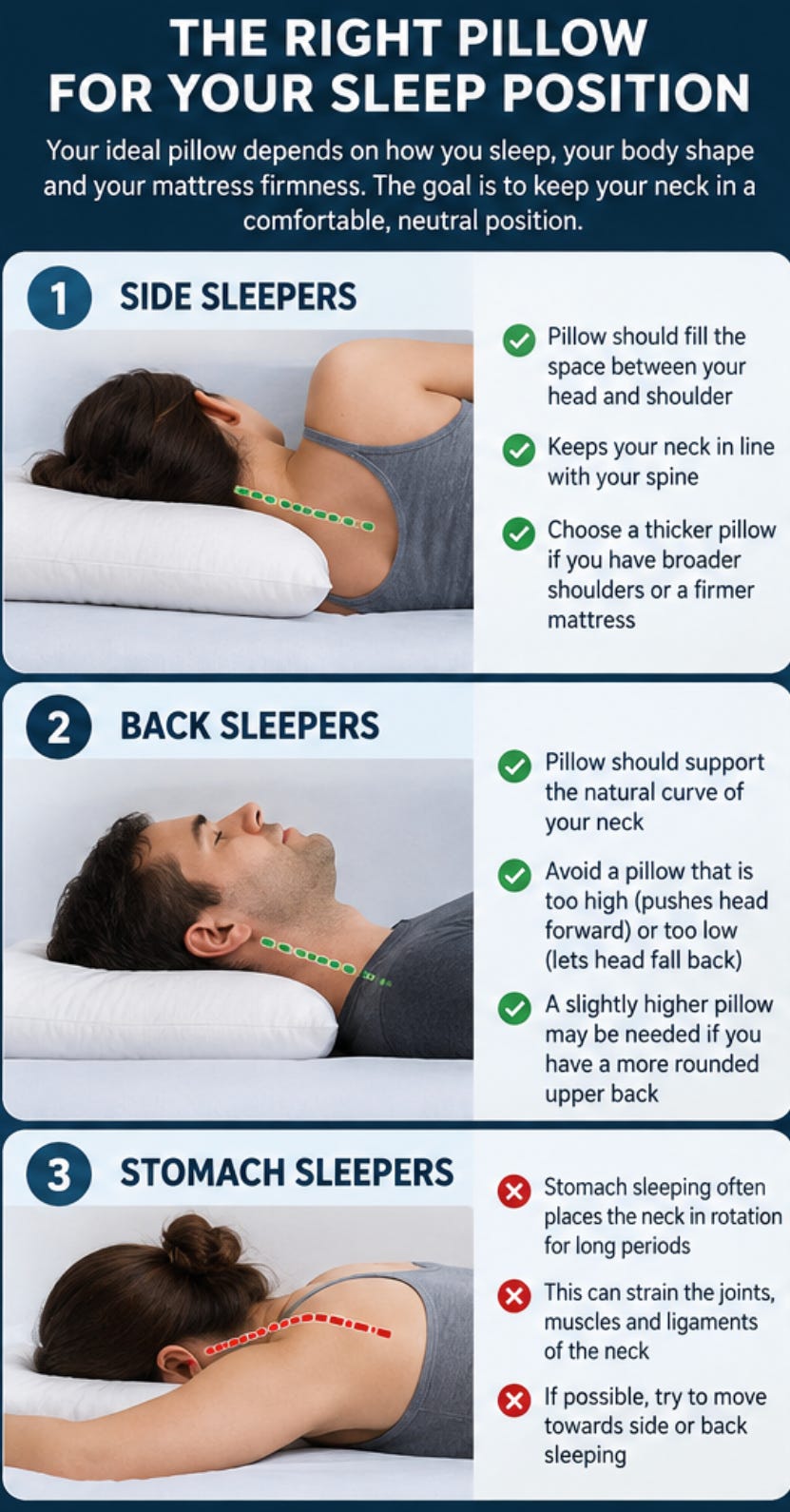
Side sleepers, back sleepers, and stomach sleepers usually need different levels of support. The goal is not to force everyone into the same “perfect” posture. The goal is to reduce unnecessary strain on the neck.
Side Sleepers
For side sleepers, pillow height is especially important. The pillow needs to fill the space between the side of the head and the mattress so the neck stays relatively level.
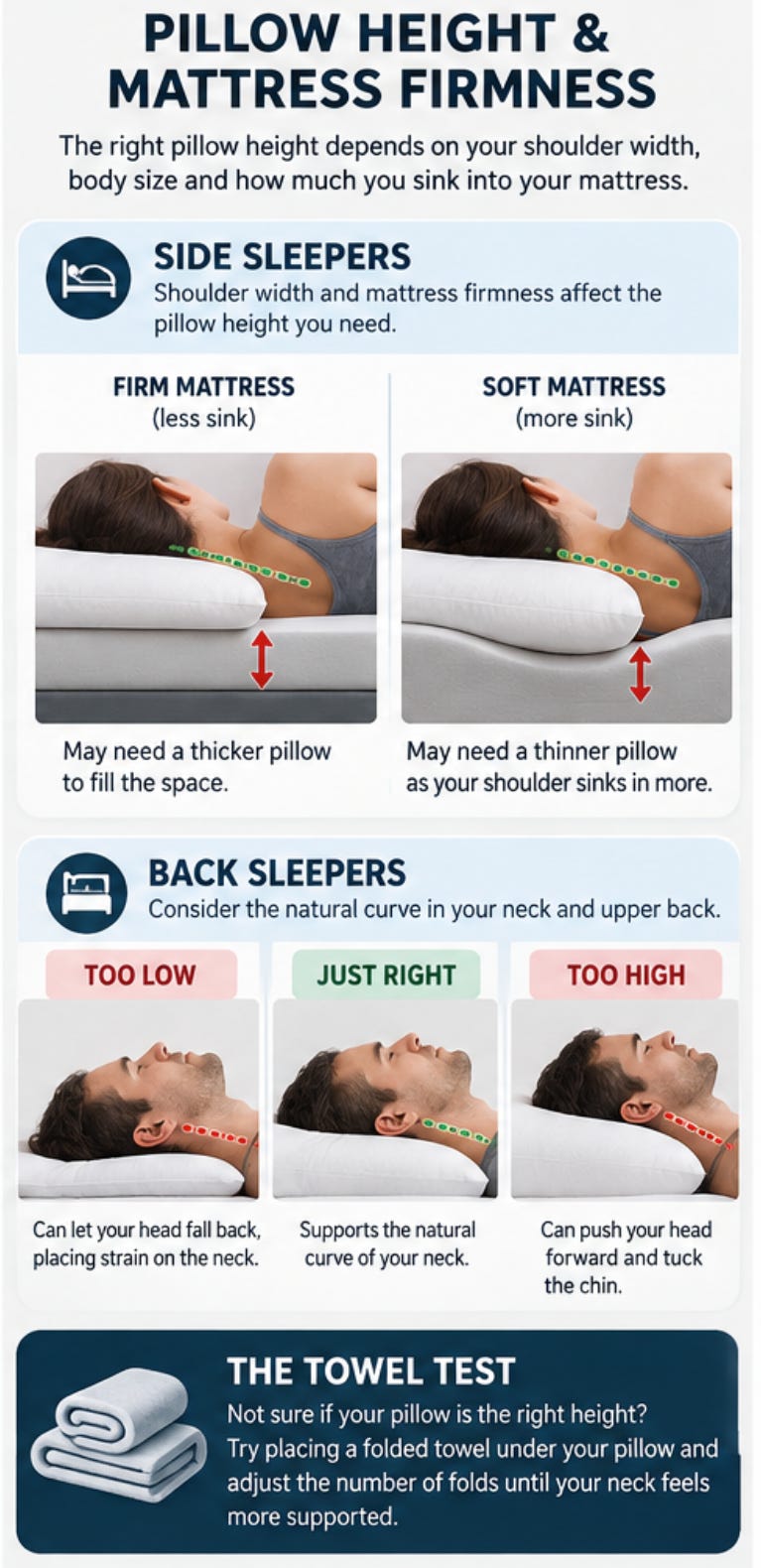
A person with broader shoulders usually needs a thicker pillow, especially if sleeping on a firm mattress. If the pillow is too thin, the head may drop downward. If the pillow is too thick, the head may be pushed upward.
Mattress firmness also matters. On a softer mattress, the shoulder may sink in more, which can reduce the amount of pillow height needed. On a firmer mattress, the shoulder may not sink much, so a thicker pillow may be needed to keep the neck supported.
A useful rule is this: when lying on your side, your nose, chin, breastbone, and spine should feel roughly lined up rather than twisted or tilted.
Back Sleepers
Back sleepers usually need a pillow that supports the natural curve of the neck without pushing the head too far forward.
Some people have a more rounded upper back or a more forward head position, especially as they age or after years of desk work. These patients may feel more comfortable with slightly more support. Others with a flatter upper back may need a lower pillow.
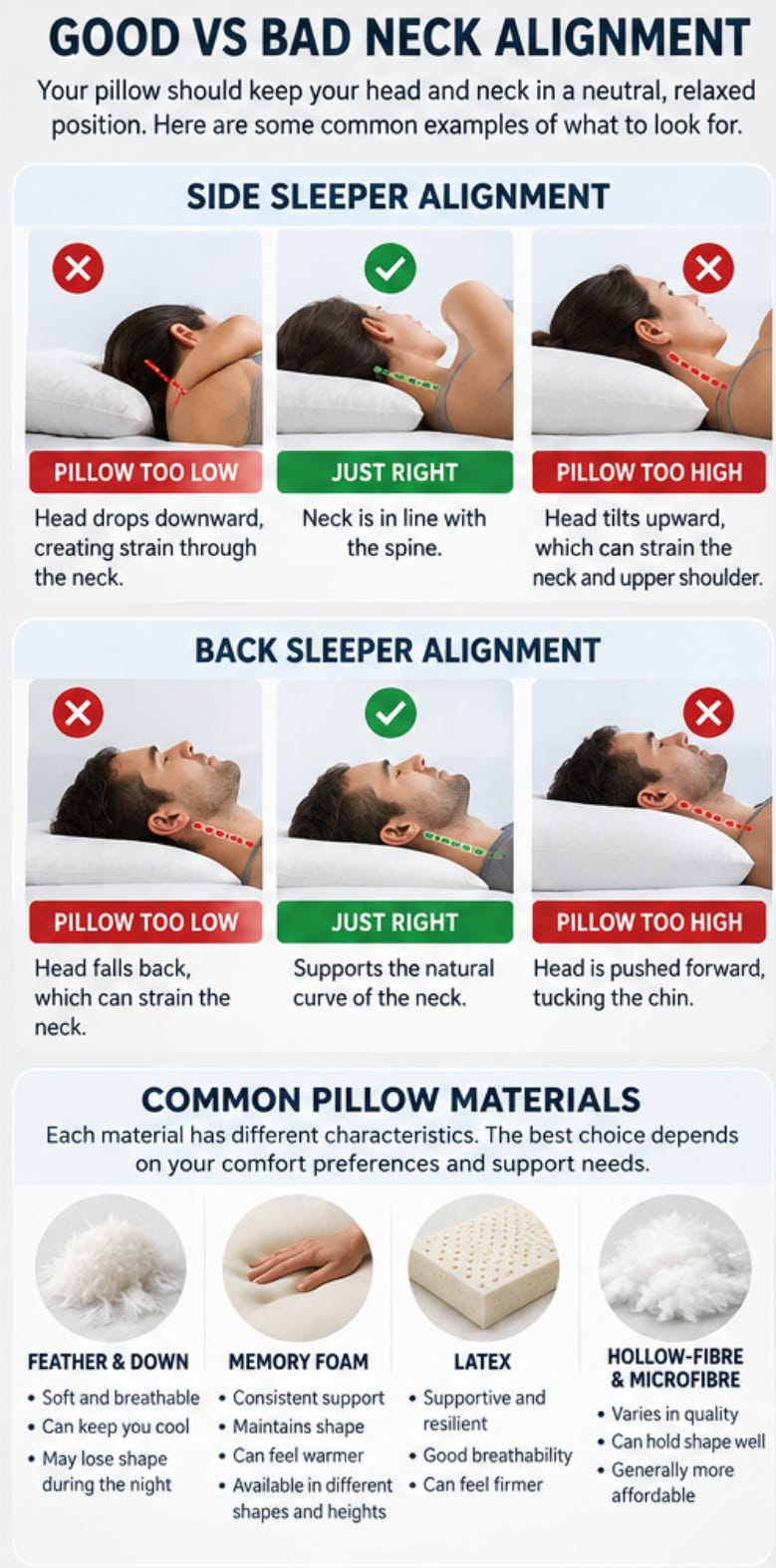
If you sleep on your back and wake up with your chin tucked toward your chest, the pillow may be too high. If your head feels like it falls backward, the pillow may be too low or not supportive enough under the neck.
Stomach Sleepers
Stomach sleeping is often the hardest position on the neck. This is because the head is usually turned to one side for a long period of time. That sustained rotation can irritate muscles, joints, ligaments, and nerves in the neck.
For people with recurring neck pain, headaches, or shoulder tension, stomach sleeping may be worth reconsidering. Changing sleep position can be difficult, but even gradually shifting toward side sleeping may reduce strain for some people.
The Mattress Changes the Pillow
A pillow cannot be judged separately from the mattress.
If your mattress is soft, your body sinks in more. If your mattress is firm, your body stays higher. This changes the distance between your head and the bed, especially when lying on your side.
This is why the same pillow may feel perfect on one bed and terrible on another. It also explains why hotel pillows can feel uncomfortable even when they look thick and soft.
A Simple Test: The Towel Trick
Before buying a new pillow, try a simple experiment.
If your pillow feels too low, place a folded towel underneath it. Adjust the number of folds until your neck feels more supported. If you are a side sleeper, you can also try placing a small rolled towel near the lower edge of the pillow so it supports the curve of the neck.
This is not meant to be a permanent solution for everyone. It is a way to test whether pillow height or neck support is part of the problem before spending money on a new pillow.
If a small height change makes your morning neck pain noticeably better, that is useful information.
What About Contoured, Orthopedic, or Ergonomic Pillows?
Many pillows are marketed as orthopedic, ergonomic, cervical, or contoured. Some patients do well with them. Others find them uncomfortable.
A contour can be helpful if it supports the neck without forcing the head into an awkward position. But the label itself does not guarantee that the pillow is right for you. The shape, height, firmness, your sleeping position, your body size, and your mattress all matter.
For side sleepers, a pillow with slightly more support under the neck may help. For back sleepers, a pillow with a gentle neck support area and a slight head cradle may feel comfortable. But if the pillow feels restrictive or forces your posture, it may not be the right match.
Feather, Foam, Latex, or Fibre?
Different materials behave differently.
Feather and down pillows can feel soft and cool, but they may lose shape during the night. If the pillow bunches up, the neck may end up kinked or unsupported.
Foam and latex pillows tend to hold their shape better. Some people like the consistent support. Others find them too firm or too warm.
Microfibre and hollow-fibre pillows may be a middle ground. They can provide support and are often more affordable, but quality varies.
The best material depends on what your neck tolerates, whether you sleep hot, and whether the pillow maintains its shape through the night.
Signs Your Pillow May Not Be Working for You
Your pillow may be contributing to symptoms if you regularly wake up with neck stiffness, headaches, shoulder tension, upper back tightness, numbness or tingling in the arm, or pain that is worse first thing in the morning.
That does not automatically mean the pillow is the only problem. Neck pain can come from joints, discs, muscles, nerves, posture, stress, workstation setup, previous injuries, and other health factors. But the pillow is worth considering, especially if symptoms are consistently worse after sleep.
When Neck Pain Needs Assessment
If neck pain is persistent, worsening, or associated with arm pain, numbness, tingling, weakness, dizziness, balance changes, fever, unexplained weight loss, trauma, or severe headache, it should be assessed by a healthcare professional.
For many patients, a proper assessment can help determine whether symptoms are mainly mechanical, posture-related, nerve-related, headache-related, or linked to another cause.
How Chiropractic Care May Help
At The Muscle and Joint Clinic, we assess more than just where the pain is. We look at neck mobility, joint irritation, muscle tension, posture, shoulder mechanics, nerve symptoms, headache patterns, sleeping habits, workstation setup, and daily activities.
Treatment may include hands-on care, soft tissue therapy, mobilization or adjustment when appropriate, stretching, strengthening, posture advice, ergonomic recommendations, and practical guidance on sleep positioning.
For some patients, improving pillow setup helps. For others, the bigger issue is neck mobility, muscle tension, stress, desk posture, or weakness in the upper back and shoulder region. The key is figuring out what is actually driving the symptoms.
The Bottom Line
There is no perfect pillow for everyone.
The right pillow depends on your sleeping position, shoulder width, neck shape, mattress firmness, body size, comfort preference, and symptoms. A good pillow should help your neck feel supported without forcing it into an awkward position.
If you are waking up with neck pain, headaches, or shoulder tension, your pillow may be part of the problem, but it should not be the only thing you consider.
At The Muscle and Joint Clinic, we help patients with neck pain, headaches, upper back tension, shoulder discomfort, and sleep-related stiffness. If you are unsure whether your pillow, posture, or neck mechanics are contributing to your symptoms, we can assess the area and help you build a practical plan.
References
Pang, J. C.-Y., Tsang, S. M.-H., & Fu, A. C.-L. (2021). The effects of pillow designs on neck pain, waking symptoms, neck disability, sleep quality and spinal alignment in adults: A systematic review and meta-analysis. Clinical Biomechanics, 85, 105353. https://doi.org/10.1016/j.clinbiomech.2021.105353
Sandeman, G. (2026, September 28). How to find your perfect pillow — according to an expert. BBC News.
Hurwitz, E. L., Carragee, E. J., van der Velde, G., Carroll, L. J., Nordin, M., Guzman, J., Peloso, P. M., Holm, L. W., Côté, P., Hogg-Johnson, S., Cassidy, J. D., & Haldeman, S. (2008). Treatment of neck pain: Noninvasive interventions: Results of the Bone and Joint Decade 2000–2010 Task Force on Neck Pain and Its Associated Disorders. Spine, 33(4 Suppl), S123–S152.