


Inflammatory bowel disease, often called IBD, is usually thought of as a digestive condition. That makes sense because IBD causes chronic inflammation in the digestive tract and includes Crohn’s disease and ulcerative colitis. Crohn’s disease can affect different parts of the gastrointestinal tract, while ulcerative colitis most often affects the large intestine. But IBD can also affect life far beyond digestion, including energy, sleep, mood, joints, bones, and daily function.
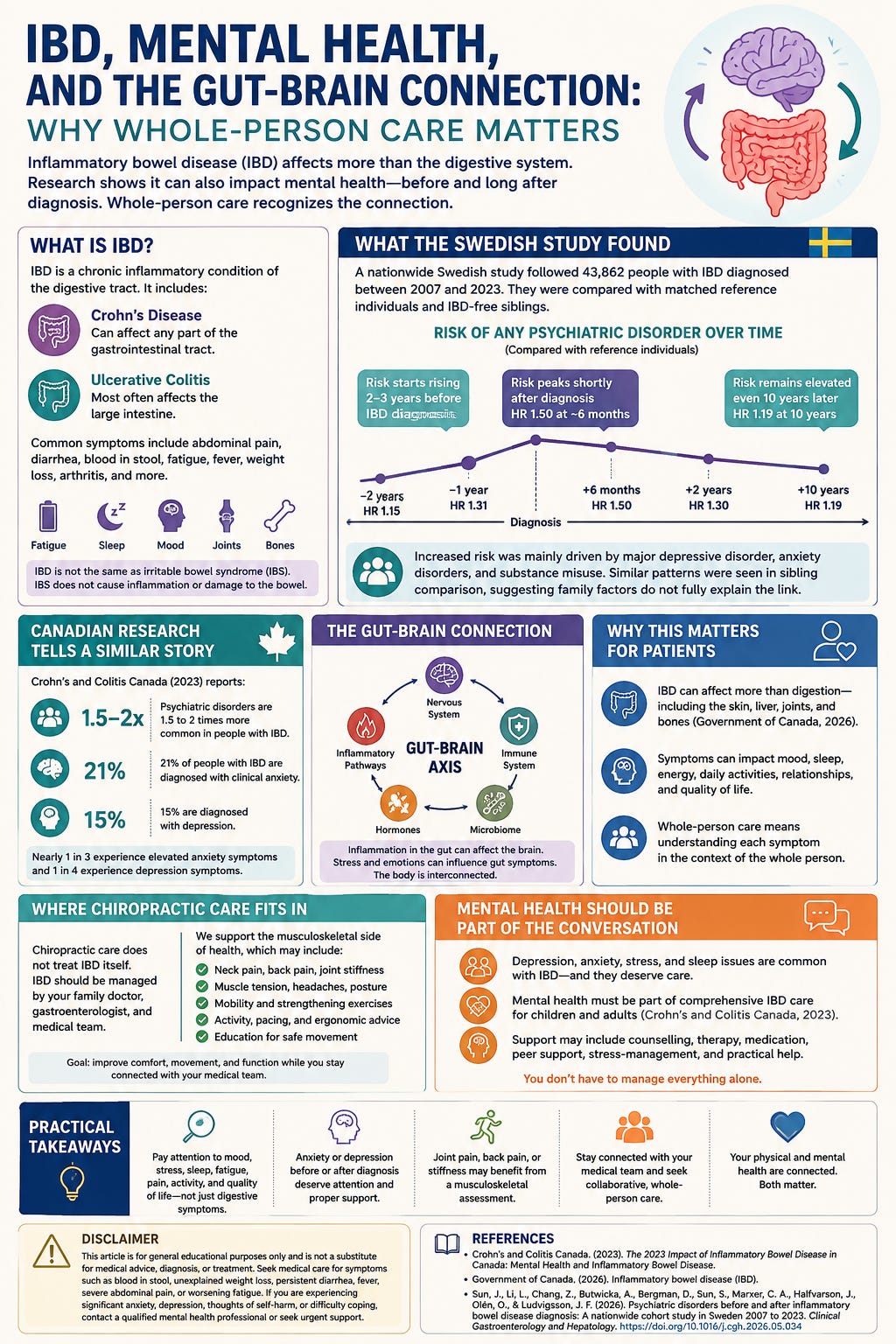
A new nationwide Swedish study adds to a growing body of research showing that people with IBD face a higher risk of psychiatric disorders before and after diagnosis. The study followed 43,862 people with IBD diagnosed between 2007 and 2023 and compared them with matched reference individuals and IBD-free siblings. Researchers found that the risk of any psychiatric disorder began to rise about two to three years before IBD diagnosis, peaked shortly after diagnosis, and remained elevated even 10 years later.
This finding is important because it reinforces something many patients and clinicians already recognize: chronic inflammatory conditions do not affect only one body system. They can affect the whole person.
What Is Inflammatory Bowel Disease?
IBD is not the same as irritable bowel syndrome, or IBS. IBS can cause abdominal discomfort and bowel changes, but it does not cause the same inflammatory damage to the bowel. IBD involves inflammation and can lead to symptoms such as abdominal pain, cramping, chronic diarrhea, blood in the stool, fatigue, fever, appetite changes, weight loss, mouth ulcers, arthritis, and growth concerns in children.
Because IBD can affect everyday activities, it can also affect emotional health. Living with unpredictable symptoms, fatigue, pain, urgency, dietary concerns, medical appointments, medication decisions, and uncertainty about flares can create a significant psychological burden.
What the Swedish Study Found
The Swedish study looked at psychiatric disorders before and after IBD diagnosis. The researchers found that the risk began rising before the official diagnosis. At two years before diagnosis, the hazard ratio for any psychiatric disorder was 1.15, meaning the risk was already higher compared with reference individuals. The risk peaked shortly after diagnosis, with a hazard ratio of 1.50 at about six months after diagnosis. Even 10 years after diagnosis, the risk remained elevated, with a hazard ratio of 1.19.
The increased risk was mainly driven by major depressive disorder, anxiety disorders, and substance misuse. The researchers also performed a sibling comparison, which helped account for shared genetic and early-life environmental factors. Similar patterns were still observed, suggesting the relationship could not be fully explained by family background alone.
The study does not prove that IBD directly causes psychiatric disorders, or that psychiatric disorders directly cause IBD. However, it does show a meaningful association over time, including during the years before diagnosis.
Canadian Research Tells a Similar Story
The Swedish findings are consistent with Canadian research and patient-care priorities. Crohn’s and Colitis Canada reports that psychiatric disorders are 1.5 to 2 times more common in people with IBD than in the general population. Their 2023 Impact of IBD in Canada report estimates that 21% of people with IBD are diagnosed with clinical anxiety and 15% are diagnosed with depression. It also notes that nearly one third experience elevated anxiety symptoms and one quarter experience depression symptoms.
Crohn’s and Colitis Canada also notes that depression and generalized anxiety disorders are twice as likely in people with IBD compared with those without IBD, and that mental health, diet, and nutrition needs are often not included in regular IBD care plans.
This matters because mental health is not separate from physical health. Depression, anxiety, stress, fatigue, poor sleep, pain, and inflammation can interact in ways that affect quality of life, function, activity levels, and recovery.
The Gut-Brain Connection
The gut and brain communicate through what is often called the gut-brain axis. This includes the nervous system, immune system, hormones, inflammatory pathways, the microbiome, and stress-response systems. When the digestive tract is inflamed, the effects may not stay limited to the bowel.
For someone living with IBD, a flare can affect more than digestion. It may change sleep, appetite, energy, concentration, mood, social activity, and confidence. At the same time, emotional stress can make symptoms feel harder to manage. This does not mean symptoms are “all in someone’s head.” It means the body is interconnected.
The Swedish study supports the idea that mental health should be considered early, even during the diagnostic workup for IBD. The researchers emphasized the importance of mental health awareness and integrating psychological care into IBD management.
Why This Matters for Patients
Many people with chronic health conditions feel pressure to separate their symptoms into categories. Digestive symptoms go to one doctor. Joint pain goes to another provider. Stress and mood are treated as separate issues. But patients do not experience their health in separate compartments.
A person with IBD may also experience joint pain, back pain, muscle tension, fatigue, reduced activity, poor sleep, stress, and changes in daily function. Canada’s public health information notes that IBD can affect other parts of the body, including the skin, liver, joints, and bones.
This is why whole-person care matters. It does not mean every symptom has the same cause. It means each symptom deserves to be understood in context.
Where Chiropractic Care Fits In
Chiropractic care does not treat IBD itself. IBD is a medical condition that should be managed by a family doctor, gastroenterologist, and appropriate medical specialists. Medications, investigations, colonoscopy, imaging, bloodwork, and medical monitoring are outside the role of chiropractic care.
However, chiropractors often support patients with musculoskeletal symptoms that may occur alongside chronic health conditions. At The Muscle and Joint Clinic, this may include helping patients with neck pain, back pain, joint stiffness, muscle tension, headaches, posture-related discomfort, reduced mobility, or activity limitations.
For patients living with chronic illness, conservative musculoskeletal care may help improve comfort, movement, confidence, and day-to-day function. Care may include assessment, spinal or joint treatment when appropriate, soft tissue therapy, mobility exercises, strengthening exercises, posture and ergonomic advice, pacing strategies, and education around safe movement.
The goal is not to replace medical IBD care. The goal is to support the musculoskeletal side of health while encouraging patients to remain connected with the appropriate medical team.
Mental Health Should Be Part of the Conversation
One of the most important messages from this research is that mental health should not be treated as an afterthought. If someone with IBD is experiencing anxiety, depression, stress, sleep disruption, low motivation, social withdrawal, or difficulty coping, those concerns deserve care.
Crohn’s and Colitis Canada’s 2023 report states that mental health must be addressed as part of comprehensive IBD care for children and adults, and that multidisciplinary IBD clinics with mental health specialists are a recommended model.
Patients should feel comfortable speaking with their family physician, gastroenterologist, psychologist, psychotherapist, or other qualified mental health professional. Support can include counselling, psychological therapy, medication when appropriate, peer support, education, stress-management strategies, and practical help with daily routines.
Practical Takeaways
If you or someone you know lives with IBD, it may be helpful to think beyond digestive symptoms alone. Pay attention to mood, stress, sleep, fatigue, pain, activity levels, and quality of life.
If anxiety or depression symptoms appear before or after an IBD diagnosis, they should not be dismissed. They may be part of the broader health picture and deserve proper support.
If joint pain, back pain, stiffness, or muscle tension is limiting daily activity, a musculoskeletal assessment may help determine whether conservative care is appropriate.
Most importantly, patients should not feel that they have to manage everything alone. IBD can be complex, and care is often strongest when it is collaborative.
The Bottom Line
IBD is more than a digestive condition. Research from Sweden and Canada shows a strong association between IBD and mental-health challenges, especially anxiety and depression. The Swedish study is particularly important because it found increased psychiatric risk starting two to three years before IBD diagnosis and lasting up to 10 years afterward.
For patients, the message is clear: physical health and mental health are connected. Digestive symptoms, inflammation, pain, fatigue, stress, sleep, and movement all matter. Good care should recognize the whole person, not just one diagnosis.
Disclaimer
This article is for general educational purposes only and is not a substitute for medical advice, diagnosis, or treatment. Inflammatory bowel disease should be assessed and managed by a qualified medical doctor and, when appropriate, a gastroenterologist. If you have symptoms such as blood in the stool, unexplained weight loss, persistent diarrhea, fever, severe abdominal pain, or worsening fatigue, seek medical care. If you are experiencing significant anxiety, depression, thoughts of self-harm, or difficulty coping, please contact a qualified mental health professional or seek urgent support.
References
Crohn’s and Colitis Canada. (2023). The 2023 impact of inflammatory bowel disease in Canada: Mental health and inflammatory bowel disease. https://pmc.ncbi.nlm.nih.gov/articles/PMC10478810/
CTV News. (2026). Swedish study reinforces what Canadian IBD experts have been seeing for years. https://apple.news/AdpqB5jlIQ46nNaK2iGK8jA
Government of Canada. (2026). Inflammatory bowel disease. https://www.canada.ca/en/public-health/services/chronic-diseases/inflammatory-bowel-disease.html
Sun, J., Li, L., Chang, Z., Butwicka, A., Bergman, D., Sun, S., Marxer, C. A., Halfvarson, J., Olén, O., & Ludvigsson, J. F. (2026). Psychiatric disorders before and after inflammatory bowel disease diagnosis: A nationwide cohort study in Sweden 2007 to 2023. Clinical Gastroenterology and Hepatology. https://doi.org/10.1016/j.cgh.2026.05.034