


Pelvic floor physiotherapy is now being offered at The Muscle and Joint Clinic, and it is an important addition to the way we support patients with pain, movement, recovery, and function.
Many people have heard of pelvic floor exercises, often called Kegels, but pelvic floor therapy is much more than simply “doing Kegels.” The pelvic floor is a group of muscles, connective tissues, nerves, and supporting structures at the base of the pelvis. These muscles help support the bladder, bowel, pelvic organs, hips, low back, and core. They also play an important role in continence, sexual function, pregnancy, postpartum recovery, breathing mechanics, and spinal stability.
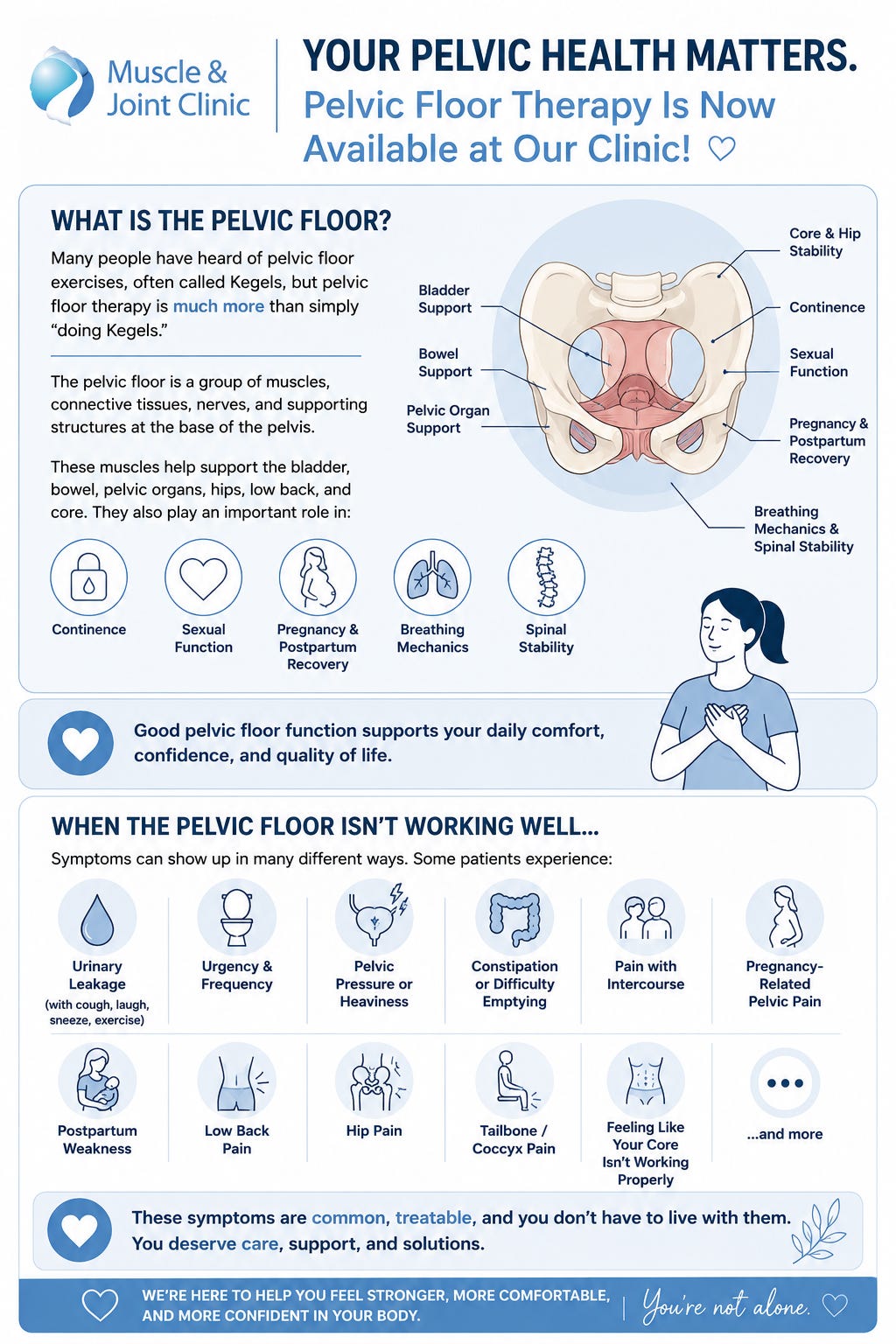
When the pelvic floor is not functioning well, symptoms can show up in many different ways. Some patients experience urinary leakage, urgency, frequency, pelvic pressure, constipation, pain with intercourse, pregnancy-related pelvic pain, postpartum weakness, low back pain, hip pain, tailbone pain, or a feeling that the core is not working properly. Because these symptoms can feel private or embarrassing, many people delay asking for help. But pelvic floor concerns are common, treatable, and deserve proper care.
What Is the Pelvic Floor?
The pelvic floor is often described as a hammock or sling of muscles that sits at the bottom of the pelvis. These muscles help support the bladder, uterus or prostate, rectum, and surrounding pelvic organs. They also work with the diaphragm, abdominal muscles, deep back muscles, and hips to help control pressure through the trunk and pelvis.
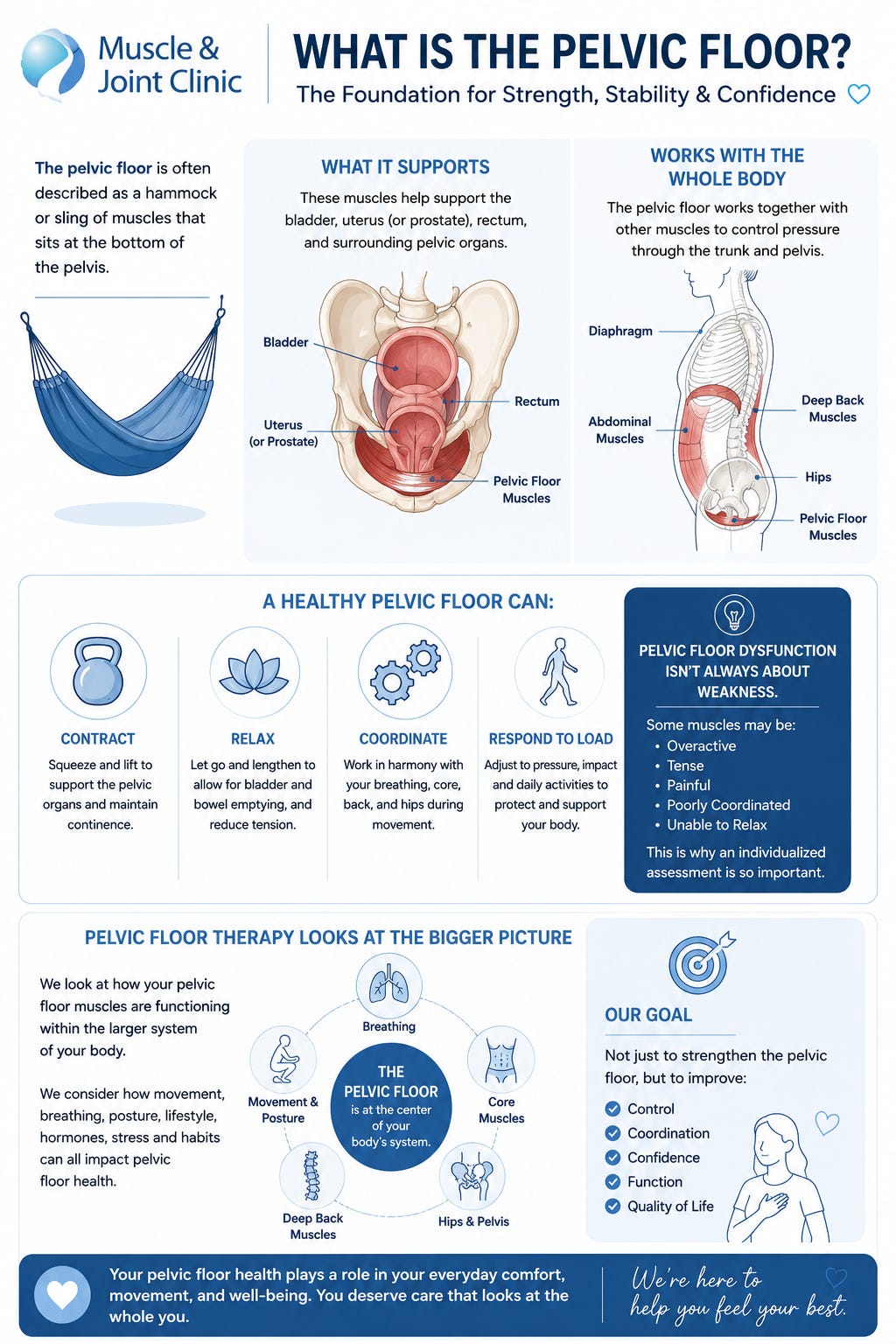
A healthy pelvic floor needs to be able to contract, relax, coordinate, and respond to load. This is important because pelvic floor dysfunction is not always about weakness. Some patients do need strengthening, but others may have pelvic floor muscles that are overactive, tense, painful, poorly coordinated, or unable to relax properly. That is why an individualized assessment is so important.
Pelvic floor therapy looks at how these muscles are functioning within the larger system of the body. The goal is not only to strengthen the pelvic floor, but to improve control, coordination, confidence, and function.
Who Can Benefit From Pelvic Floor Physiotherapy?
Pelvic floor physiotherapy may help people experiencing bladder, bowel, pelvic, pregnancy, postpartum, hip, or low back concerns. One of the most common reasons patients seek pelvic floor therapy is urinary incontinence. This may include leakage with coughing, laughing, sneezing, jumping, running, lifting, or exercise. This is often called stress urinary incontinence.
Pelvic floor therapy may also help with urgency and frequency, where a person feels the need to urinate often or has difficulty delaying the urge to go. It may help patients with mixed urinary incontinence, where both stress leakage and urgency symptoms are present. It may also support people with pelvic pain, pain with intercourse, postpartum recovery concerns, diastasis recti, pelvic organ prolapse symptoms, constipation, tailbone pain, hip pain, and certain types of low back pain.
The important point is that pelvic floor therapy is not only for postpartum patients. It can be helpful for women at many stages of life, including pregnancy, postpartum, perimenopause, menopause, and beyond. It may also be relevant for athletes, active individuals, desk workers, and people recovering from surgery or managing chronic pain.
Pelvic Floor Therapy and Urinary Incontinence
Pelvic floor muscle training is considered a first-line conservative treatment for urinary incontinence. A Cochrane review by Dumoulin, Cacciari, and Hay-Smith (2018) found that women with stress urinary incontinence who completed pelvic floor muscle training were much more likely to report cure or improvement compared with women who received no treatment or inactive control treatment. The strongest evidence is for stress urinary incontinence, although pelvic floor muscle training may also help urgency and mixed incontinence symptoms.
This is important because urinary leakage is common, but it should not be dismissed as normal. Many people are told that leakage after childbirth, with aging, or during exercise is just something they have to accept. While it is common, it is not something patients simply need to tolerate.
Pelvic floor physiotherapy can help patients understand why leakage is happening. For some people, the issue may be pelvic floor weakness. For others, the issue may involve poor timing, poor pressure control, breathing mechanics, hip and core weakness, constipation, scar tissue, or muscle overactivity. A proper assessment helps guide the right plan.
Stress Incontinence, Urgency, and Mixed Symptoms
Stress urinary incontinence refers to leakage with pressure or impact, such as coughing, laughing, sneezing, lifting, jumping, or running. This is where pelvic floor muscle training appears to have the strongest benefit. Reviews have found that structured pelvic floor muscle training can improve symptoms, especially when the exercises are supervised and performed consistently over time (Dumoulin et al., 2018; Wu, 2021).
Urgency and overactive bladder symptoms are different. These symptoms may include a sudden strong urge to urinate, frequent urination, or difficulty delaying urination. Pelvic floor muscle training may help by improving the ability to calm bladder urgency through what is sometimes described as a guarding reflex, where pelvic floor contraction can help inhibit unwanted bladder contractions. However, research suggests results for urgency symptoms are more variable than for stress urinary incontinence (Bø et al., 2020).
For urgency and frequency, pelvic floor physiotherapy may also include bladder training. Bladder training can involve scheduled voiding, urge suppression strategies, fluid and caffeine education, and gradually increasing the time between bathroom visits when appropriate. A Cochrane review on bladder training supports its use as a conservative treatment for overactive bladder symptoms (Funada et al., 2023).
Mixed incontinence includes both stress leakage and urgency symptoms. In these cases, treatment often needs to address both pelvic floor muscle function and bladder habits. Pelvic floor therapy is helpful because it can be individualized to the person’s symptom pattern rather than relying on one generic exercise.
Pelvic Floor Therapy and Low Back Pain
Pelvic floor therapy can also be relevant for some patients with low back pain. The pelvic floor does not work alone. It functions with the diaphragm, abdominal wall, deep spinal muscles, hips, and pelvis. When this system is not coordinating well, some patients may experience difficulty with core control, pelvic stability, breathing, lifting, or returning to exercise.
A systematic review and meta-analysis by Kazeminia, Rajati, and Rajati (2023) examined randomized clinical trials on pelvic floor muscle-strengthening exercises and low back pain. The review included 19 randomized clinical trials and found that pelvic floor muscle-strengthening exercises significantly reduced low back pain intensity compared with control groups. The authors concluded that these exercises may be considered as part of a low back pain management plan.
The results were especially notable in postpartum and pregnant populations, although the authors cautioned that the studies had high heterogeneity. This means the findings are promising, but they should be interpreted carefully. Pelvic floor exercises are not a magic fix for all low back pain, but they may be an important part of care for selected patients, especially when symptoms involve pregnancy, postpartum recovery, pelvic control, hip function, or core weakness.
At The Muscle and Joint Clinic, this connection is important because many patients present with overlapping symptoms. Someone may come in for low back pain, but also report pelvic heaviness, urinary leakage, difficulty returning to exercise, hip tightness, or postpartum weakness. Pelvic floor physiotherapy allows us to assess and support these concerns more fully.
Pregnancy and Postpartum Recovery
Pregnancy and birth place significant demands on the pelvis, abdomen, pelvic floor, hips, and low back. The body adapts to changes in posture, weight distribution, hormones, abdominal wall tension, pelvic loading, and delivery-related stress. After birth, patients may also be recovering while feeding, carrying, lifting, bending, sleeping less, and caring for a newborn.
Pelvic floor physiotherapy can be helpful during pregnancy and postpartum because it supports education, strength, coordination, relaxation, breathing, pressure management, and gradual return to movement. Some patients need help strengthening the pelvic floor. Others need help relaxing and coordinating the pelvic floor. Some need scar care, core retraining, hip and back strengthening, or guidance on returning to exercise safely.
Postpartum symptoms such as urinary leakage, pelvic pressure, pain with intercourse, heaviness, low back pain, hip pain, or difficulty reconnecting with the core should not be ignored. They are common, but they are not something patients simply have to live with.
It Is Not Just About Kegels
One of the biggest misconceptions about pelvic floor therapy is that it only involves Kegels. Kegels can be helpful for some people, but they are not appropriate for everyone and they are not always enough.
Some patients have pelvic floor muscles that are too tense or overactive. In those cases, repeatedly strengthening without learning how to relax may make symptoms worse. Other patients may be doing pelvic floor contractions incorrectly, using the glutes, inner thighs, or abdominal muscles instead of the pelvic floor. Some may hold their breath or increase pressure downward, which can aggravate symptoms.
Pelvic floor therapy helps determine what the patient actually needs. Treatment may include strengthening, relaxation, coordination training, breathing strategies, bladder training, education, hip and core exercises, manual therapy, scar tissue work, posture and movement strategies, and lifestyle guidance.
The goal is not simply to squeeze harder. The goal is to restore better pelvic floor function.
What Pelvic Floor Physiotherapy May Include
Pelvic floor physiotherapy begins with a detailed assessment. This may include discussing bladder symptoms, bowel habits, pain, pregnancy and birth history, surgery history, sexual health concerns, exercise goals, posture, breathing, low back or hip symptoms, and daily activities.
Treatment is individualized and based on consent, comfort, and clinical need. It may include education about pelvic floor anatomy, pelvic floor muscle training, relaxation strategies, breathing and pressure control, bladder retraining, core and hip strengthening, mobility exercises, manual therapy, posture and ergonomic advice, scar tissue support, and return-to-exercise guidance.
Supervision matters. Research suggests supervised pelvic floor muscle training is often more effective than unsupervised exercise, especially for patients who are unsure whether they are contracting the correct muscles or who have more complex symptoms (Dumoulin et al., 2018; Wu, 2021).
Lifestyle Factors That Can Support Pelvic Floor Health
Pelvic floor symptoms are influenced by more than muscle strength alone. Constipation, chronic coughing, heavy lifting, high-impact exercise, poor sleep, stress, caffeine intake, fluid habits, and breathing patterns can all affect pelvic floor function.
For urinary urgency or frequency, reducing bladder irritants such as excessive caffeine may help some patients. For pelvic pressure or leakage, learning how to manage pressure during lifting, exercise, coughing, and sneezing may be important. For constipation, improving bowel habits and avoiding repeated straining can reduce stress on the pelvic floor.
These changes are not about restriction or fear. They are about giving patients practical tools to feel more in control of their symptoms.
When Should You Seek Pelvic Floor Physiotherapy?
You may benefit from pelvic floor physiotherapy if you experience urinary leakage, urgency, frequent urination, difficulty emptying the bladder, pelvic pressure, heaviness, constipation, pain with intercourse, pelvic pain, tailbone pain, pregnancy-related pelvic pain, postpartum weakness, diastasis recti concerns, hip pain, or low back pain that seems connected to core or pelvic control.
You should also consider an assessment if you are pregnant, recently postpartum, returning to exercise after childbirth, preparing for birth, recovering from pelvic or abdominal surgery, or feeling unsure how to safely strengthen your core and pelvic floor.
Patients should seek medical assessment if symptoms include blood in the urine or stool, unexplained weight loss, fever, severe pelvic or abdominal pain, new neurological symptoms, sudden loss of bladder or bowel control, or any concerning or worsening symptoms.
How Pelvic Floor Therapy Fits at The Muscle and Joint Clinic
At The Muscle and Joint Clinic, we are excited to now offer pelvic floor physiotherapy as part of our services. This allows us to support patients in a more complete way, especially those dealing with pregnancy and postpartum concerns, urinary leakage, pelvic discomfort, low back pain, hip pain, core weakness, and movement-related symptoms.
Our approach is patient-centred, respectful, and evidence-informed. We understand that pelvic floor symptoms can be personal and sometimes difficult to talk about. The goal is to create a comfortable space where patients can ask questions, understand what may be contributing to their symptoms, and receive care that fits their needs and goals.
Pelvic floor physiotherapy can also work alongside chiropractic care, physiotherapy, massage therapy, exercise rehabilitation, and other services when appropriate. For example, a patient with postpartum low back pain may benefit from both spinal and pelvic assessment, core retraining, hip strengthening, and pelvic floor rehabilitation. A patient with desk-related hip and back tension may need mobility work, ergonomic advice, and pelvic floor relaxation or coordination strategies. A patient returning to running after childbirth may need progressive strengthening, impact preparation, and pressure-management training.
The key is individualized care.
The Bottom Line
Pelvic floor physiotherapy is about much more than Kegels. It is a specialized area of care that helps assess and treat concerns related to bladder control, pelvic pain, postpartum recovery, pregnancy, core function, hip function, and low back pain.
The evidence supports pelvic floor muscle training as a first-line conservative treatment for urinary incontinence, especially stress urinary incontinence (Dumoulin et al., 2018; Wu, 2021). Research also suggests pelvic floor muscle-strengthening exercises may help reduce low back pain intensity in selected patients, particularly when pelvic and core function are part of the clinical picture (Kazeminia et al., 2023).
If you have been dealing with leakage, urgency, pelvic pressure, postpartum symptoms, pelvic pain, or low back pain that has not fully resolved, pelvic floor physiotherapy may be an important next step.
Pelvic floor therapy is now available at The Muscle and Joint Clinic.
Disclaimer
This article is for general educational purposes only and is not a substitute for medical advice, diagnosis, or treatment. Pelvic floor symptoms can have many causes, and care should be based on an individualized assessment. If you have severe, worsening, persistent, unusual, or concerning symptoms, please seek medical care from a qualified healthcare professional.
References
Bø, K., Fernandes, A. C. N. L., Duarte, T. B., Brito, L. G. O., & Ferreira, C. H. J. (2020). Is pelvic floor muscle training effective for symptoms of overactive bladder in women? A systematic review. Physiotherapy, 106, 65–76.
Dumoulin, C., Cacciari, L. P., & Hay-Smith, E. J. C. (2018). Pelvic floor muscle training versus no treatment, or inactive control treatments, for urinary incontinence in women. Cochrane Database of Systematic Reviews, 2018(10), CD005654.
Funada, S., Yoshioka, T., Luo, Y., et al. (2023). Bladder training for treating overactive bladder in adults. Cochrane Database of Systematic Reviews, 2023(10), CD013571.
Kazeminia, M., Rajati, F., & Rajati, M. (2023). The effect of pelvic floor muscle-strengthening exercises on low back pain: A systematic review and meta-analysis on randomized clinical trials. Neurological Sciences, 44(3), 859–872. https://doi.org/10.1007/s10072-022-06430-z
Lukacz, E. S., Santiago-Lastra, Y., Albo, M. E., & Brubaker, L. (2017). Urinary incontinence in women: A review. JAMA, 318(16), 1592–1604.
Wu, J. M. (2021). Stress incontinence in women. New England Journal of Medicine, 384(25), 2428–2436.