


A mattress does more than give you a place to sleep. It supports your spine, affects pressure on your joints, influences how well your body recovers overnight, and can even play a role in morning stiffness, neck pain, and low back discomfort. At our clinic, many patients focus on treatment, exercise, stretching, and posture, but sometimes one of the biggest missing pieces is the surface they sleep on every night.
One of the most common questions people ask is whether they should be flipping or rotating their mattress. Many people were taught that both should be done regularly, but that advice has changed as mattresses have changed. The truth is that most modern mattresses should usually be rotated, but not flipped. That distinction matters because using the wrong maintenance method can reduce comfort and support rather than improve it.
Flipping a mattress means turning it over so the bottom becomes the top. Rotating a mattress means turning it 180 degrees so that the head of the bed becomes the foot. While those two ideas are often grouped together, they are not the same thing, and not every mattress needs both. In fact, many newer mattresses are specifically designed to be slept on one side only.
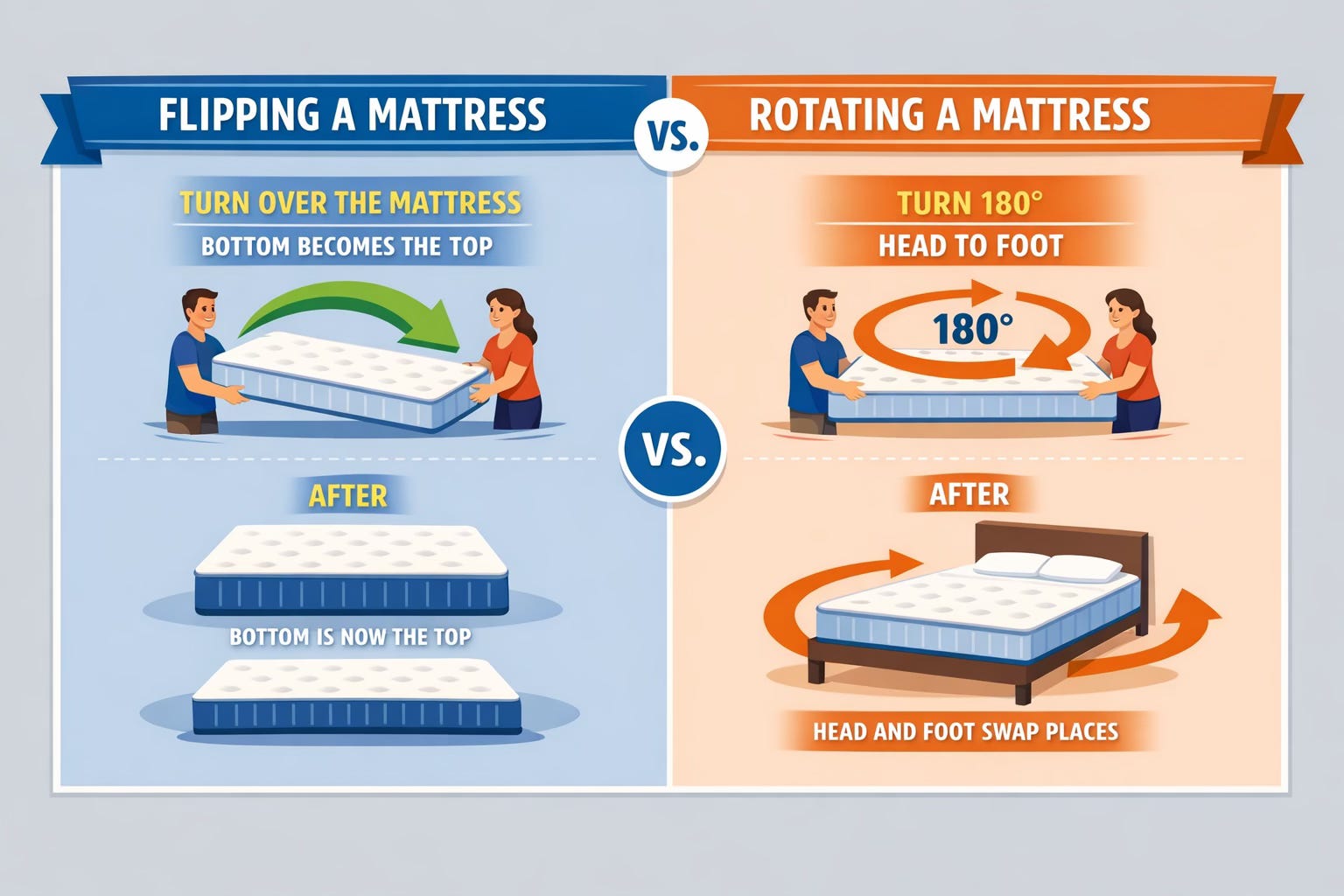
This is because most modern mattresses are built with a layered design. The upper section usually contains the comfort materials, such as memory foam, quilted layers, latex, or pillow-top materials. Under that is the support core, which may be made of dense foam, springs, or hybrid support layers. That structure is meant to work in a specific orientation. If you flip a mattress like that, you may end up sleeping on the firmer support layer rather than the comfort layer. That can make the bed feel awkward, less supportive, and less comfortable over time. Multiple mattress care sources now note that most modern mattresses should not be flipped unless the manufacturer specifically says the mattress is double-sided or flippable (Bensons for Beds, 2023; Sleep Foundation, 2025).
That said, there are still some mattresses that can and should be flipped. These are often referred to as two-sided, reversible, or flippable mattresses. They are built so both surfaces are intended to be slept on. In those cases, flipping can help distribute wear more evenly and may improve longevity. This is more common with certain traditional innerspring mattresses and some specialty mattress designs. If someone has a true double-sided mattress, flipping and rotating on a regular schedule may be helpful (The Original Mattress Factory, 2021).
For most people, however, rotation is the more relevant issue. Rotating a mattress helps distribute body weight over different sections of the surface over time. Without rotation, the same areas of the mattress are loaded night after night, especially under the hips, pelvis, shoulders, and trunk. This repeated pressure can lead to sagging, soft spots, body impressions, and uneven wear. Once that happens, the mattress may stop supporting the spine properly. That is often when people begin waking up stiff, sore, or unrested, even if they are spending enough hours in bed.
From a musculoskeletal perspective, that matters a great deal. A mattress that sags excessively can place the lower back, pelvis, or neck in a poor position for hours at a time. For side sleepers, a worn mattress may allow too much sinking at the shoulder or hip. For back sleepers, it may allow the pelvis to drop too deeply. For stomach sleepers, a surface that is too soft can place extra stress on the lumbar spine. These issues can aggravate existing pain and sometimes slow recovery from injuries. In other words, a mattress does not have to be the only cause of pain to still be an important contributor.
Most sources agree that regular rotation is beneficial for many mattresses, although recommendations differ on frequency. Some suggest rotating every three months, while others recommend every three to six months depending on the mattress type and age (GhostBed Canada, 2026; National Mattress, 2025; Sleep Foundation, 2025). Some retailers recommend more frequent rotation during the first few months of use as the materials settle and adapt to body weight, then moving to a monthly or seasonal routine afterward (Bensons for Beds, 2023). In practice, one of the easiest approaches is to rotate the mattress every season or at least two to four times per year, unless the manufacturer advises otherwise.
Mattress material also makes a difference. Memory foam and hybrid mattresses are usually one-sided and should generally be rotated, not flipped. Latex mattresses are also usually rotated rather than flipped. Traditional two-sided innerspring mattresses may benefit from both flipping and rotating, while many pillow-top and zoned-support mattresses should not be flipped and, in some cases, may not even be ideal to rotate if their support zones are designed for specific body regions (Polysleep, 2022; Sleep Foundation, 2025). This is why the best first step is always checking the manufacturer’s care instructions.
Patients also ask whether rotating a mattress really makes a meaningful difference. In many cases, yes. Even wear usually means more consistent support, fewer deep impressions, and a longer useful lifespan. Some retailers and mattress educators note that regular maintenance may help a mattress last longer and preserve comfort more evenly over time (National Mattress, 2025; The Original Mattress Factory, 2021). While that does not mean rotation can save a mattress that is already worn out, it can help delay premature breakdown.
There are also practical signs that a mattress may need attention. Visible sagging, lumpy areas, body impressions, feeling like you roll into one spot, waking with pain that eases once you get moving, or sleeping better in another bed are all clues that your mattress may no longer be supporting you well. Sometimes patients are surprised to find that their home exercise routine is helping, their treatments are helping, but they still wake up every morning with pain. In those situations, the bed itself deserves closer attention.
It is also worth remembering that rotating a mattress safely matters. Larger mattresses can be heavy and awkward to move. Many manufacturers recommend having help rather than trying to rotate or flip a large mattress alone. Bedding should be removed first, nearby breakable items cleared, and the movement done carefully to avoid injury or damage (The Original Mattress Factory, 2021). This is especially important for anyone who already has back pain, shoulder issues, or physical limitations.
The bottom line is simple. Most modern mattresses should be rotated regularly, but not flipped unless they are specifically designed to be flippable. Regular rotation can help distribute wear more evenly, maintain support, and potentially extend the life of the mattress. Flipping only makes sense for true two-sided models. If you are not sure which kind you have, check the manufacturer’s instructions before doing either.
At our clinic, we often remind patients that recovery does not only happen during treatment sessions. It also happens while you sleep. If your mattress is old, uneven, sagging, or poorly maintained, it may be making it harder for your body to rest and recover properly. Sometimes improving sleep support is one of the simplest changes you can make to help your neck, back, and joints feel better.
A good mattress does not need to be perfect. It just needs to support your body consistently, comfortably, and in a way that helps you wake up feeling restored rather than aggravated. And sometimes, something as simple as rotating it is a very good place to start.
References
Bensons for Beds. (2023, September 21). How often should you flip your mattress?
https://www.bensonsforbeds.co.uk
GhostBed Canada. (2026, March 20). How to flip or rotate your mattress (and why you should).
https://www.ghostbed.ca
National Mattress. (2025, December 18). How often should you flip or rotate your mattress: Expert guidelines for maximum longevity.
https://www.nationalmattress.ca
Polysleep. (2022, October 26). Are you supposed to flip or rotate your mattress or mattress topper?
https://polysleep.ca
Sleep Foundation. (2025, July 15). Should you flip or rotate your mattress?
https://www.sleepfoundation.org
The Original Mattress Factory. (2021, January 26). How to flip and rotate your mattress.
https://www.originalmattress.com
Disclaimer: This article is intended for general educational and informational purposes only and does not constitute medical advice, diagnosis, or treatment. Reading this article does not create a practitioner-patient relationship. If you are experiencing severe pain, numbness, weakness, worsening symptoms, or have concerns about your health or ability to drive safely, please seek assessment from a qualified healthcare professional.