


Many people have been told that cracking their knuckles will cause arthritis. It is one of those health warnings that gets repeated so often that many people assume it must be true. The sound can be loud, sharp, and uncomfortable for others to hear, so it is easy to imagine that something damaging must be happening inside the joint.
But what does the evidence actually show?
Based on the available research, gentle knuckle cracking does not appear to cause hand osteoarthritis for most people. It may sound dramatic, but the sound itself is not a sign that the joint is being damaged. That said, there are still situations where joint cracking deserves attention, especially when it is painful, forceful, associated with swelling, or involves the neck.
What Makes the Cracking Sound?
A joint is where two bones meet. Many joints, including the knuckles, are surrounded by synovial fluid. This fluid helps lubricate the joint so movement can occur more smoothly.
When you pull, bend, or distract a joint, the space inside the joint temporarily changes. This alters pressure within the joint. Gases within the synovial fluid can form bubbles, and the familiar “pop” or “crack” is related to a process called cavitation.
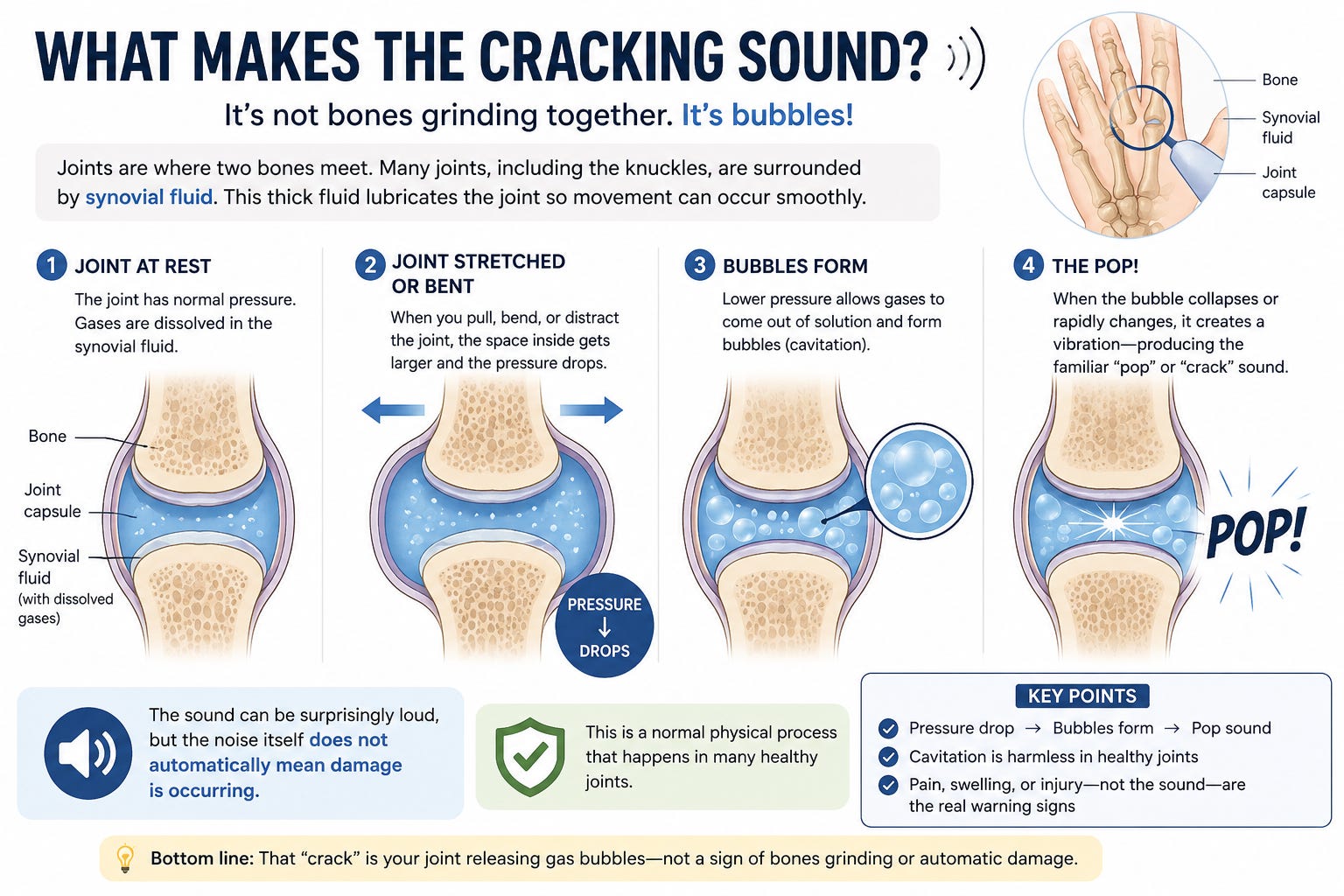
A BBC Future article described this process in simple terms, explaining that when a joint is pulled or bent, the pressure in the synovial fluid falls and gases can emerge as bubbles. The sound can be surprisingly loud, but the noise itself does not automatically mean damage is occurring.
Does Knuckle Cracking Cause Arthritis?
This is the biggest concern patients usually have.
The short answer is that habitual knuckle cracking does not appear to be a risk factor for hand osteoarthritis.
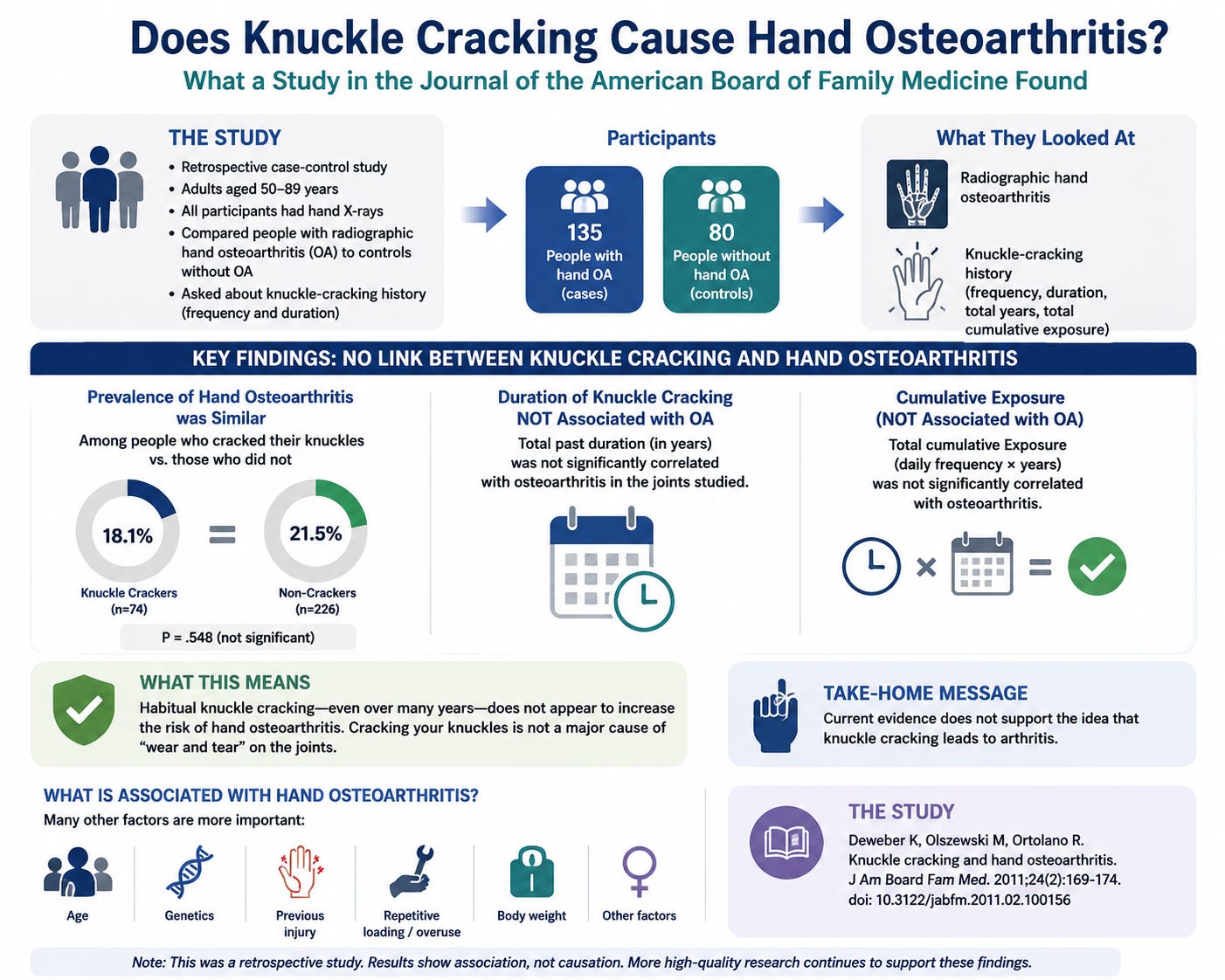
One study published in the Journal of the American Board of Family Medicine looked at adults between 50 and 89 years old who had hand X-rays. The researchers compared people with radiographic hand osteoarthritis to controls without osteoarthritis and asked about their knuckle-cracking history. The prevalence of osteoarthritis was similar between people who cracked their knuckles and those who did not. The researchers also found that the total duration and total cumulative exposure to knuckle cracking were not significantly associated with osteoarthritis in the joints studied.
This is important because many people worry that years of cracking will “wear out” the cartilage. Osteoarthritis is often associated with age, genetics, previous injury, repetitive loading, and other risk factors, but the evidence does not support knuckle cracking as a major cause.
What Did the Ultrasound Study Find?
A 2017 study published in Clinical Orthopaedics and Related Research looked more closely at what happens during knuckle cracking. Researchers studied 400 metacarpophalangeal joints in 40 asymptomatic adults. Thirty of the participants were habitual knuckle crackers, meaning they cracked their knuckles daily.
The researchers used physical examination and ultrasound imaging. Two orthopedic surgeons examined the participants while blinded to whether they were habitual knuckle crackers. They assessed swelling, grip strength, range of motion, and hand function. The study found no meaningful differences in QuickDASH disability scores, swelling, grip strength, or joint laxity between habitual knuckle crackers and non-crackers.
The study did find a small increase in range of motion immediately after a documented crack. In other words, some joints moved slightly more after cracking. This may help explain why people often describe a temporary feeling of relief or looseness after cracking a joint.
On ultrasound, the researchers observed a characteristic bright focus appearing dynamically in the joint during the cracking event. This supports the idea that the cracking sound is related to a joint cavitation event rather than bones grinding together.
Does Knuckle Cracking Weaken Your Grip?
Another common concern is that knuckle cracking may weaken the hands.
Older research raised the possibility that habitual knuckle crackers may have more hand swelling and weaker grip strength. However, later research did not support a clear relationship between knuckle cracking and reduced grip strength.
The 2017 ultrasound study found no significant difference in grip strength between habitual knuckle crackers and non-crackers. This suggests that, for most people, painless knuckle cracking is unlikely to be a major cause of hand weakness.
That said, if someone notices true weakness, reduced grip, swelling, pain, numbness, tingling, or difficulty using the hand, that should not be dismissed as “just cracking.” Those symptoms deserve a proper assessment.
Can Knuckle Cracking Ever Cause Injury?
Yes, but this appears to be uncommon and usually relates to force.
The concern is not gentle, painless knuckle cracking. The concern is aggressive pulling, twisting, or forcing a joint to crack. Case reports have described acute soft tissue injuries from attempts to force a knuckle to pop.
This is a useful distinction for patients. A gentle pop that happens easily and without pain is very different from yanking on a finger or repeatedly forcing a joint past its comfortable range just to hear a sound.
A joint should not need excessive force to move. If cracking causes pain, swelling, bruising, numbness, tingling, or reduced motion, stop and have it assessed.
Why Do People Crack Their Knuckles?
People crack their knuckles for different reasons. Some do it without thinking. Some do it when they are stressed, bored, or concentrating. Others do it because the joint feels stiff or full, and the crack gives a temporary feeling of relief.
The 2017 study found a small immediate increase in range of motion after cracking, which may help explain why some people feel looser afterward. However, that short-term relief does not necessarily mean the underlying reason for stiffness has been addressed.
For example, someone who works at a computer all day may crack their fingers because their hands feel stiff from typing, mouse use, gripping, or repetitive tasks. Someone else may crack their joints because of stress or habit. The sound may feel satisfying, but the bigger question is why the joint feels like it needs relief so often.
Knuckles Are Different From the Neck
Knuckle cracking and neck cracking should not be treated the same way.
The knuckles are smaller peripheral joints. Gentle cracking of the fingers is usually low risk. The neck is more complex. It contains the spinal cord, nerve roots, muscles, ligaments, and important blood vessels.
Forceful self-cracking of the neck is not recommended. Repeatedly twisting or forcing the neck to pop can irritate joints, muscles, ligaments, or nerves. In some cases, people may experience symptoms such as dizziness, tingling, radiating pain, headache, or worsening stiffness after forceful neck manipulation.
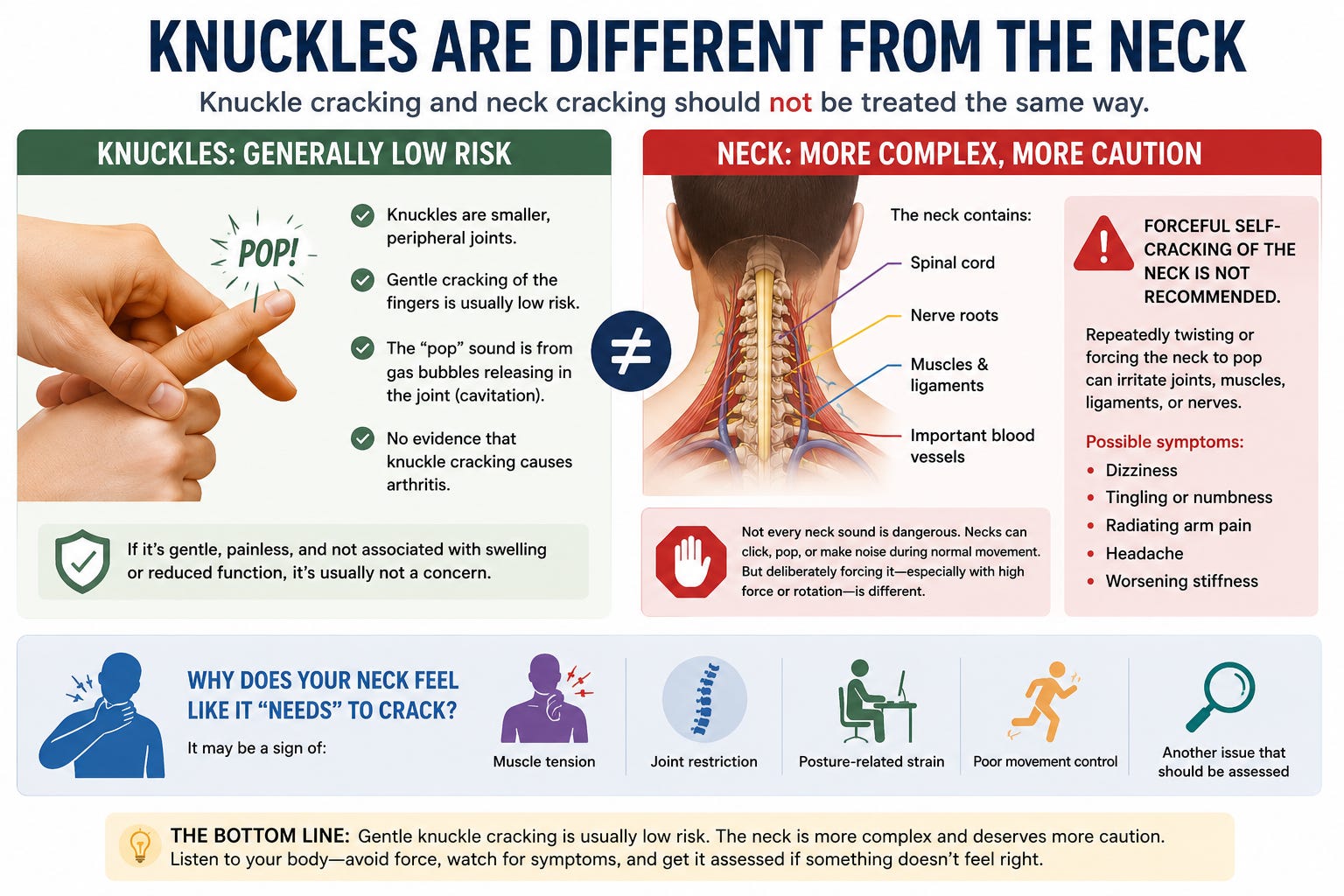
This does not mean every neck sound is dangerous. Necks can click, pop, or make noise during normal movement. But deliberately forcing the neck to crack, especially with high force or rotation, is different.
If your neck constantly feels like it “needs” to crack, it may be a sign of muscle tension, joint restriction, posture-related strain, poor movement control, or another issue that should be properly assessed.
When Should You Be Concerned About Joint Cracking?
Most painless joint cracking is not a problem. Many healthy joints make noise.
However, cracking should be assessed when it is associated with pain, swelling, redness, warmth, locking, catching, weakness, numbness, tingling, loss of grip strength, reduced range of motion, or a recent injury.
You should also seek care if the cracking begins suddenly after trauma, if the joint looks deformed, or if the area becomes painful afterward.
For the neck or back, be more cautious. Seek medical attention if cracking or manipulation is followed by dizziness, severe headache, visual changes, nausea, faintness, radiating arm or leg pain, weakness, numbness, tingling, balance problems, or difficulty walking.
Do You Need to Stop Cracking Your Knuckles?
For most people, no.
If your knuckle cracking is gentle, painless, and not associated with swelling or reduced function, the evidence does not suggest that it causes arthritis. The bigger issue may be whether the habit bothers you or the people around you.
If you want to stop, it may help to notice your triggers. Do you crack your knuckles when you are stressed, bored, tired, working, driving, studying, or sitting at a desk? Replacing the habit with another behaviour may help. You could try hand mobility exercises, a stress ball, a fidget tool, short movement breaks, or stretching the hands and forearms.
If you crack your hands because they feel stiff, sore, or tired, look at what your hands are doing throughout the day. Computer work, phone use, tools, gripping, sports, weight training, repetitive tasks, and poor ergonomics can all contribute to hand or wrist discomfort.
How Chiropractic Care May Help
At The Muscle and Joint Clinic, we often see patients who are worried about joint noises, cracking, popping, clicking, stiffness, or tension. Many people assume that a noisy joint must be unhealthy, but that is not always true. Joints can make noise and still be completely normal.
A proper assessment can help determine whether the sound is harmless joint cavitation, tendon movement, muscle tension, joint stiffness, irritation, or something that needs further attention.
For patients with hand, wrist, neck, shoulder, or back discomfort, care may include joint and movement assessment, soft tissue therapy, mobility work, strengthening exercises, ergonomic advice, posture education, and strategies to reduce repetitive strain.
The goal is not to make every joint silent. The goal is to help you move well, feel better, reduce irritation, and improve function.
The Bottom Line
Cracking your knuckles may sound dramatic, but the current evidence suggests that gentle, painless knuckle cracking does not appear to cause hand osteoarthritis.
Research has also shown no clear difference in hand disability, swelling, or grip strength between habitual knuckle crackers and non-crackers. Some people may experience a small temporary increase in range of motion after cracking, which may explain why it feels relieving.
The key message is that sound alone is not the problem. Pain, swelling, weakness, numbness, tingling, reduced movement, or forceful cracking are the warning signs.
Do not panic about harmless joint sounds, but do not ignore symptoms.
Disclaimer
This article is for general educational purposes only and is not a substitute for medical advice, diagnosis, or treatment. If you have persistent joint pain, swelling, weakness, numbness, tingling, reduced movement, dizziness, severe headache, or symptoms after forceful neck or back cracking, seek assessment from a qualified healthcare professional.
References
Boutin, R. D., Netto, A. P., Nakamura, D., Bateni, C., Szabo, R. M., Cronan, M., Foster, B., Barfield, W. R., Seibert, J. A., & Chaudhari, A. J. (2017). “Knuckle cracking”: Can blinded observers detect changes with physical examination and sonography? Clinical Orthopaedics and Related Research, 475(4), 1265–1271. https://doi.org/10.1007/s11999-016-5215-3
Deweber, K., Olszewski, M., & Ortolano, R. (2011). Knuckle cracking and hand osteoarthritis. Journal of the American Board of Family Medicine, 24(2), 169–174. https://doi.org/10.3122/jabfm.2011.02.100156
Ong, S. (2026, August 8). Should you stop cracking your knuckles? BBC Future.
Powers, T., Kelsberg, G., & Safranek, S. (2016). Does knuckle popping lead to arthritis? The Journal of Family Practice, 65(10), 725–726.