


Neck pain is one of the most common musculoskeletal complaints and a major cause of pain, disability, and reduced quality of life worldwide. For some people, neck pain is temporary and settles with movement, exercise, or activity modification. For others, it becomes chronic, affecting sleep, work, concentration, driving, exercise, and everyday activities.
Manual therapy is frequently included in the management of chronic mechanical neck pain. Two commonly used techniques are spinal manipulation and spinal mobilization. Although these treatments are sometimes grouped together under the general term “manual therapy,” they are performed differently and may produce different responses in the body.

A 2026 study published in Chiropractic & Manual Therapies compared the immediate clinical and neuromechanical effects of cervical spinal manipulation and cervical spinal mobilization in people with chronic neck pain. Its findings provide useful insight into how the body responds to each treatment and how clinicians may select an approach based on an individual patient’s needs and preferences.
What Is Chronic Mechanical Neck Pain?
Mechanical neck pain generally refers to pain arising from structures in and around the cervical spine, including the joints, muscles, connective tissues, and surrounding soft tissues. Symptoms may be influenced by movement, sustained posture, physical activity, muscle tension, or joint stiffness.
Common symptoms can include neck aching, stiffness, restricted movement, discomfort when turning the head, and pain extending into the upper shoulders or shoulder-blade region. Some people may also experience headaches associated with the neck.
“Chronic” neck pain typically means that symptoms have been present for at least 12 weeks. Chronic pain is not always a sign of ongoing tissue damage. It can involve a combination of joint and muscle dysfunction, reduced activity tolerance, altered pain processing, occupational demands, sleep, stress, and other individual factors.
Because chronic neck pain can have several contributing factors, treatment is generally most effective when it is individualized rather than based on a single technique.
What Is Cervical Spinal Manipulation?
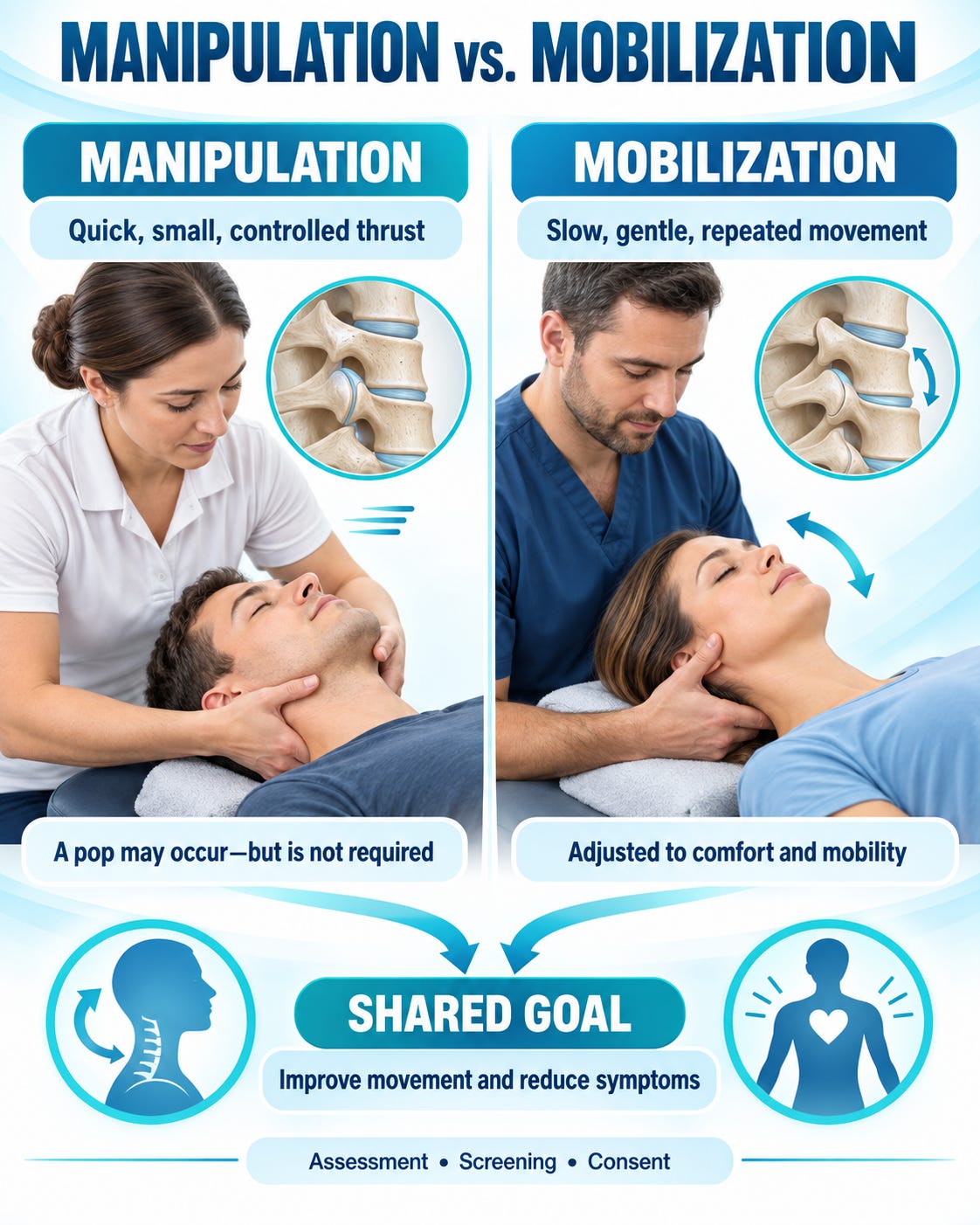
Cervical spinal manipulation is a manual therapy technique involving a controlled, high-velocity, low-amplitude thrust directed toward a specific cervical joint. The movement is quick but small and is performed within the joint’s available range.
Patients may hear a popping or clicking sound during manipulation. This sound is generally associated with a rapid pressure change within the joint and is not the sound of bones moving back into place. A sound is also not required for the treatment to have an effect.
Manipulation is intended to influence joint mobility, muscle activity, movement, and pain processing. It should only be performed after an appropriate clinical assessment, screening for contraindications, informed consent, and a discussion of reasonable treatment alternatives.
What Is Cervical Spinal Mobilization?
Cervical mobilization is a gentler and generally slower manual therapy approach. Instead of delivering a rapid thrust, the clinician applies repeated or sustained movements to a joint. The speed, direction, force, and size of these movements may be adjusted according to the patient’s comfort, symptoms, and mobility.
Mobilization may be selected when a patient prefers a lower-velocity technique, is uncomfortable with manipulation, is particularly sensitive or guarded, or has clinical circumstances in which a more gradual approach is appropriate.
Both manipulation and mobilization aim to improve movement and reduce symptoms. The main difference is how the force is delivered—not necessarily the overall purpose of treatment.
How Was the Study Conducted?
The researchers recruited 89 adults between the ages of 18 and 65 who had experienced mechanical neck pain for at least 12 weeks. Recruitment occurred at research sites in Zurich, Switzerland, and Trois-Rivières, Quebec.
This was a randomized crossover trial. Each participant attended two sessions conducted 72 hours apart. During one session, the participant received cervical spinal manipulation. During the other, the same participant received cervical mobilization. The order of the interventions was randomized.
This design allowed researchers to compare how the same person responded to both techniques. It can reduce some of the variability that occurs when two completely separate groups are compared.
Before treatment, participants underwent a focused history and examination to identify contraindications or warning signs. The clinician then identified the most painful cervical level, and the same area was targeted during both study sessions.
The manipulation consisted of one controlled high-velocity, low-amplitude thrust. The mobilization consisted of repeated posterior-to-anterior joint movements performed for 30 seconds.
Researchers measured pain intensity, cervical range of motion, pressure-pain threshold and grip strength before and immediately after each treatment. They also recorded muscle activity during the procedures using surface electromyography.
Both Treatments Improved Neck Range of Motion
The study found that neck movement increased immediately after both manipulation and mobilization.
Combined cervical flexion and extension improved by an average of 4.6 degrees after manipulation and 3.7 degrees after mobilization. Both changes reached the study’s threshold for a clinically meaningful improvement.
Combined right and left lateral flexion improved by approximately 4 degrees after manipulation and 2.6 degrees after mobilization. The improvement following manipulation reached the clinical threshold used by the researchers, whereas the change following mobilization did not.
Combined cervical rotation improved by approximately 1.6 degrees after manipulation and 1.4 degrees after mobilization. Although rotation increased statistically over time, these changes were small and were not meaningfully different between treatments.
Overall, manipulation did not demonstrate a statistically significant advantage over mobilization for range of motion. Both approaches produced an immediate improvement, particularly in flexion and extension.
This finding is clinically relevant because it supports the idea that more than one manual therapy option may help a patient move more comfortably. A rapid thrust is not necessarily required to obtain an immediate mobility improvement.
Manipulation Produced Greater Immediate Pain Reduction
Pain intensity decreased after both treatments, but the reduction was greater following manipulation.
On a 0-to-10 numerical pain scale, pain decreased by an average of approximately 0.79 points after manipulation and 0.37 points after mobilization. The difference between treatments was about 0.41 points and was statistically significant.
The researchers identified a reduction of 1.3 points as the minimum clinically important difference for pain. Neither treatment reached that threshold after one session. Therefore, manipulation produced greater immediate pain relief than mobilization, but the average improvement was still relatively modest.
This does not mean the treatments were ineffective. It means that a single treatment, measured immediately afterward, did not produce a large average reduction in pain. Some individual participants may have responded more strongly, while others may have experienced little change.
Participants’ Overall Impression Slightly Favoured Manipulation
Following each treatment, participants completed a Patient Global Impression of Change questionnaire. The distribution of responses favoured manipulation, suggesting that participants generally perceived somewhat greater improvement after that intervention.
Participants could not be fully blinded because the two procedures felt noticeably different. A rapid manipulation is easily distinguished from slower, repeated mobilization. Expectations and previous experiences may therefore have influenced how participants perceived their response, even though their measured expectations before treatment were similar.
Manipulation Produced a Stronger Local Muscular Response
The researchers used electromyography to measure muscle activity during treatment. Electrodes were placed over the sternocleidomastoid, upper trapezius, and tibialis anterior muscles on both sides of the body.
Manipulation produced substantially greater activity in the sternocleidomastoid and upper trapezius muscles than mobilization. This was likely related to the faster rate at which force was applied during manipulation.
The rapid thrust may generate a stronger short-term sensory and neuromuscular response around the treated region. This helps researchers understand that manipulation and mobilization do not affect the body in exactly the same way, even when their immediate effects on movement are similar.
The lower-leg muscle showed a different pattern, with slightly greater activity during mobilization. The researchers did not identify a clear physiological explanation for this result, and the recorded response was very small.
Pressure-Pain Sensitivity Showed Mixed Results
Pressure-pain threshold measures how much pressure can be applied before the sensation begins to feel painful. A higher threshold suggests that the person is temporarily less sensitive to pressure.
The study found increased pressure-pain thresholds in portions of the neck and upper trapezius after treatment. Some measurements favoured manipulation, particularly in the right sternocleidomastoid. However, the changes were not consistent between the right and left sides or across all muscles tested.
Measurements taken at the tibialis anterior in the lower leg were also inconsistent. Some thresholds increased while others decreased.
Because the pattern was not consistently reproduced across both sides of the body, the authors cautioned that some statistically significant results could represent normal measurement variability or statistical noise rather than a dependable treatment effect.
These findings offer preliminary information about how manual therapy may temporarily influence pain processing, but they do not establish a consistent body-wide pain-relieving effect.
What Might Explain the Immediate Effects?
Manual therapy may affect symptoms through several interacting mechanisms.
Joint movement provides sensory information to the nervous system. This input may temporarily alter pain processing, muscle activity, movement confidence, and the way a person perceives stiffness. Treatment may also reduce protective muscle guarding and make movement feel easier.
Manipulation delivers force more rapidly than mobilization, which may explain its stronger muscular response and slightly greater immediate effect on pain. Mobilization provides slower, repeated input and may achieve similar movement improvements through a more gradual process.
These effects should not be reduced to the idea of a joint being “put back into place.” Modern research suggests that manual therapy works through a combination of mechanical, neurological, sensory, contextual, and psychological influences.
The interaction between the patient and clinician, expectations, reassurance, treatment preference, and confidence in movement may also contribute to the response.
Why Individual Treatment Selection Matters
Some patients enjoy manipulation and feel that it helps them move more comfortably. Others prefer the slower and gentler feeling of mobilization. Certain patients may begin with mobilization because of sensitivity, muscle guarding, anxiety, health considerations, or personal preference.
The treatment selected should depend on the patient’s history, clinical findings, goals, health status, comfort level, and response to care. If a patient does not want manipulation, mobilization remains a reasonable manual therapy option. Treatment should never be performed without the patient’s informed consent.
Clinicians can also modify the treatment plan over time. A patient may initially receive gentler mobilization and later progress to manipulation, or they may continue with mobilization if it provides the desired response.
Manual Therapy Works Best as Part of a Complete Plan
Chronic neck pain is rarely addressed by one treatment alone. Clinical guidelines generally support a multimodal approach combining appropriate manual therapy with active care.
A complete rehabilitation plan may include mobility exercises, strengthening of the neck and shoulder girdle, postural and ergonomic strategies, activity modification, education, and a gradual return to normal movement.
Manual therapy may help reduce pain or stiffness sufficiently for a patient to participate more comfortably in exercise and daily activity. Exercise and self-management strategies can then help build capacity, confidence, strength, and longer-term resilience.
The goal should not simply be to create a temporary change on the treatment table. It should be to help the patient move better, function more confidently, and become less dependent on passive care.
The Bottom Line
This 2026 randomized crossover study found that both cervical manipulation and mobilization improved neck range of motion immediately after treatment.
Manipulation produced a slightly greater reduction in pain and a stronger response in local neck and upper-trapezius muscles. However, the difference in pain relief did not reach the threshold considered clinically meaningful. Neither intervention produced a meaningful improvement in grip strength, and changes in pressure-pain sensitivity were inconsistent.
The study supports both manipulation and mobilization as potentially useful components of care, but it does not prove that either technique is superior over the long term. Treatment should be individualized and ideally combined with exercise, education, and strategies that address the factors contributing to persistent neck pain.
At The Muscle & Joint Clinic, our physiotherapists and chiropractor provide both spinal mobilization and manipulation when clinically appropriate. Following an assessment, they can discuss the differences between the techniques, consider your health history and preferences, and determine which approach may be most suitable for you. These treatments can also be combined with personalized exercises, soft-tissue therapy, education, and other rehabilitation strategies to create a comprehensive plan for your neck pain.
This article is intended for general educational purposes and is not a substitute for an individualized assessment, diagnosis, or medical advice.
Study reviewed: Bouqartacha S, Conconi D, Schwendenmann Y, et al. “Immediate clinical and neuromechanical effects of cervical spine manipulation compared to cervical spine mobilization among individuals with chronic neck pain: a randomized mechanistic cross-over trial.” Chiropractic & Manual Therapies. 2026;34:49. Read the published study.