

Back pain is often thought of as an adult problem, something that develops after years of working at a desk, lifting, driving, or simply getting older. But that assumption is increasingly outdated. Children and teenagers can experience back pain too, and research suggests that spinal pain becomes progressively more common as children move through school and adolescence.
At The Muscle & Joint Clinic, we often see families surprised when a child or teenager begins complaining of back, neck, or shoulder pain. Parents may initially assume that the discomfort is temporary, related to a growth spurt, or simply the result of carrying a school bag. Sometimes that is part of the picture, but usually there is more going on.
The broader reality is that student back pain is often multifactorial. School-aged children spend long periods sitting, use laptops and tablets for hours, carry school supplies, participate in sports, go through rapid periods of growth, and often move between very sedentary school days and intense recreational or athletic activity. All of these factors can influence how the spine and surrounding muscles are loaded.
Research published in JAMA Pediatrics has shown that low back pain is uncommon in very young children but becomes progressively more prevalent with age. By late adolescence, the prevalence begins to resemble what is seen in adults (MacDonald et al., 2017). That alone should change the way we think about back pain in children. It is not necessarily rare, and it should not always be dismissed as something a child will simply “grow out of.”
A Canadian prospective study published in Scientific Reports followed children between the ages of 6 and 12 for eight months. Among the children who completed follow-up, almost half reported at least one episode of back pain during that period (Henriot-Jéhel et al., 2022). That is a remarkably high number for an age group many people assume should be essentially pain-free.
Back Pain in Children Is Usually Musculoskeletal
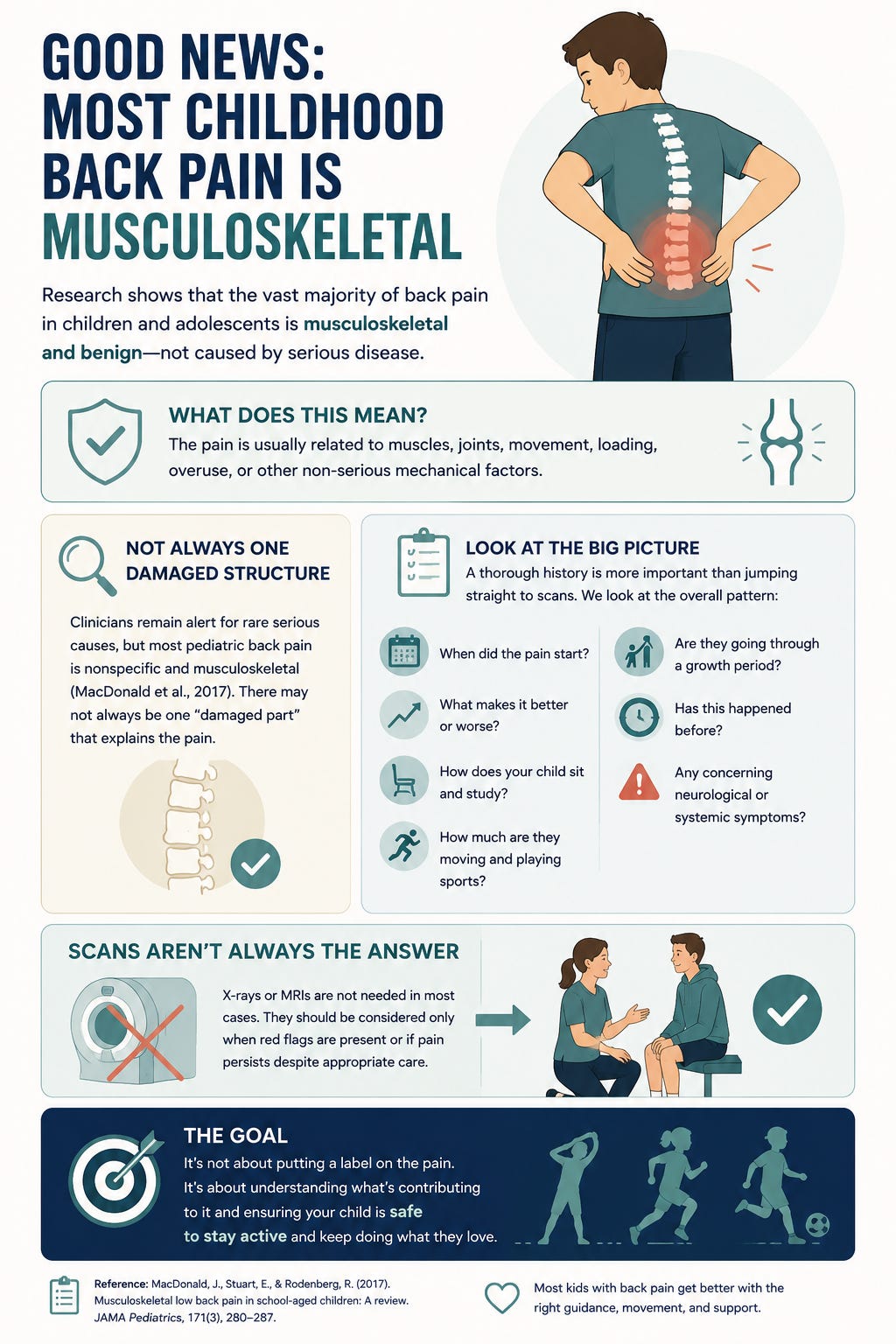
The reassuring part is that most back pain in school-aged children and adolescents is musculoskeletal and benign in nature. In other words, the pain is usually related to muscles, joints, movement, loading, overuse, or other non-serious mechanical factors rather than a dangerous underlying disease.
MacDonald and colleagues noted that although clinicians must remain alert for more serious causes of pediatric back pain, the majority of cases are nonspecific and musculoskeletal in nature (MacDonald et al., 2017). That means there may not always be one damaged structure that explains the pain
.
This is important because parents often feel that every episode of back pain requires an X-ray, MRI, or a highly specific diagnosis. In many cases, the better approach is to understand the overall pattern: when the pain started, what makes it worse, how the child sits, how much they are moving, whether they participate in sports, whether they are going through a growth period, whether the pain has occurred before, and whether there are any concerning neurological or systemic symptoms.
The objective is not simply to put a label on the pain. It is to understand what is contributing to it and whether the child is safe to remain active.
Why Are More Students Complaining About Their Backs?
There is unlikely to be one universal explanation, but modern student life places children in a very different physical environment than previous generations.
A typical student may sit for several hours during the school day, travel home by car or bus, sit again to complete homework, then spend additional time on a laptop, tablet, phone, or gaming device. Even children who participate in sports can spend a large portion of the rest of their day relatively sedentary.
Prolonged sitting itself is not automatically harmful, but spending hours in one position without movement can contribute to stiffness, fatigue, and discomfort. The human body tends to tolerate movement and variation better than staying in one fixed position for long periods.
We therefore try not to teach students that there is one “perfect posture” they must hold all day. That message can actually create unnecessary fear around normal posture. A much more useful principle is postural variety.
Students should be encouraged to move regularly, change positions, stand up between homework sessions, walk around, stretch, and avoid remaining in one position for hours at a time. The body generally does better when it has the opportunity to change load rather than continuously tolerating the same one.
The Backpack Gets Blamed for Almost Everything
Every September, backpacks become one of the most discussed causes of student back pain. It makes sense. A student may leave home carrying textbooks, a laptop, a lunch bag, a water bottle, sports equipment, and several items they probably did not need to bring in the first place.

When the bag becomes too heavy or poorly fitted, children may respond by leaning forward, shrugging their shoulders, or changing the way they walk. They may complain of shoulder pressure, neck fatigue, or back discomfort by the end of the day.
However, it is important to separate what seems intuitive from what the research can actually prove.
There is not strong evidence showing that backpack weight by itself is a consistent cause of chronic back pain or spinal deformity in children. The relationship appears more complicated. Backpack use can certainly contribute to discomfort, especially when combined with long walking distances, poor fit, fatigue, or an already sensitive back, but it should be considered one factor rather than the entire explanation.
That said, common-sense backpack habits are still worthwhile.
A student should generally use both shoulder straps rather than carrying a backpack over one shoulder. The straps should be adjusted so that the bag sits relatively close to the body instead of hanging low and pulling backward. Heavier items should be positioned closer to the child’s back where possible, and unnecessary items should be removed regularly.
One of the simplest things parents can do is actually empty the backpack once a week. It is surprising how quickly backpacks accumulate extra books, old worksheets, sports equipment, electronics, water bottles, and other unnecessary weight.
The goal is not to make children afraid of carrying a backpack. The goal is simply to reduce avoidable load.
Growth Changes the Equation
Another factor that often gets overlooked is growth.
Children do not grow evenly. Adolescence in particular can involve periods of rapid height change over relatively short periods of time. Bones, muscles, tendons, coordination, and strength are all adapting at once.
Research suggests that pubertal development and periods of rapid growth may be associated with an increased likelihood of spinal pain (Hebert et al., 2019).
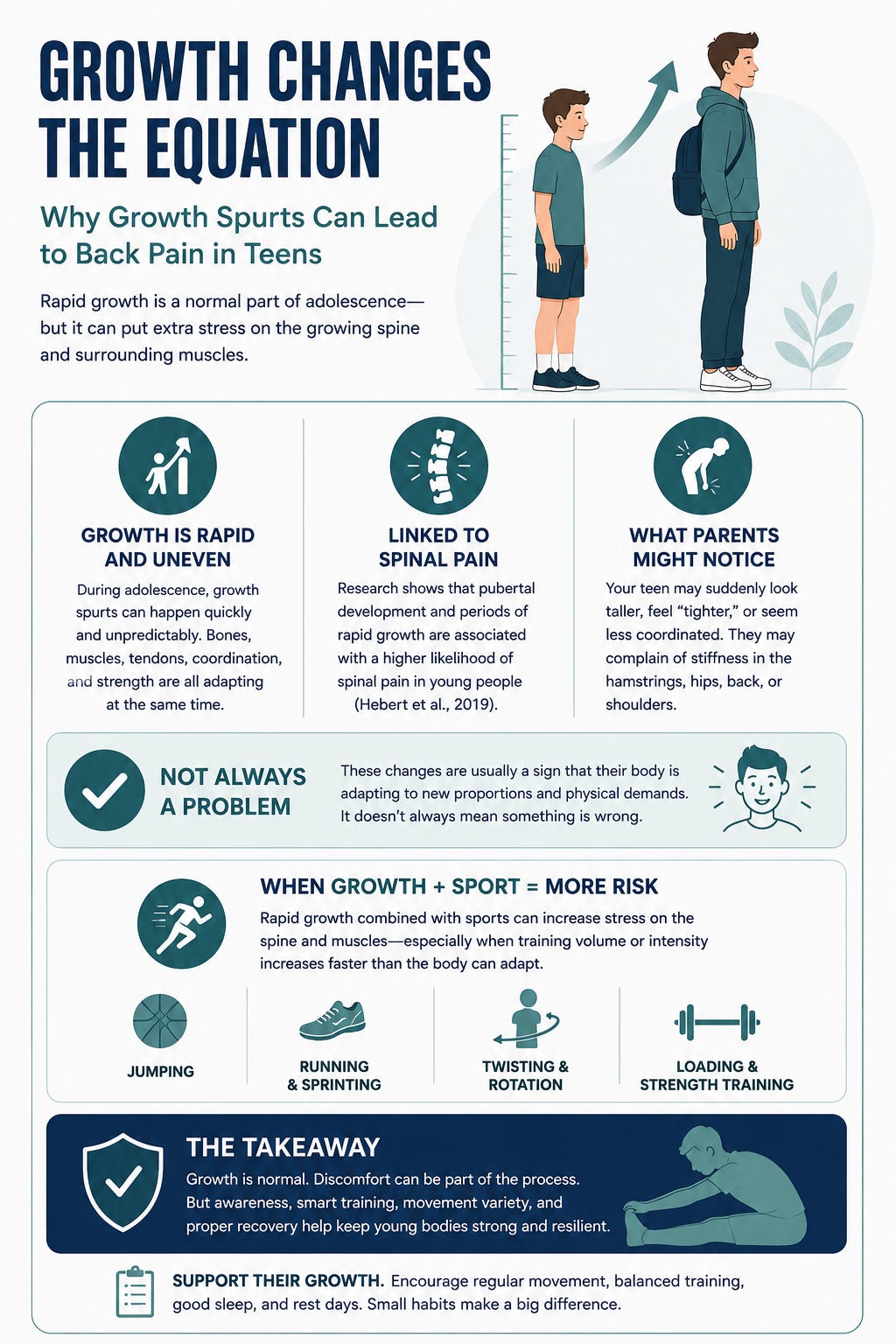
Parents sometimes describe this phase by saying that their teenager suddenly looks taller, tighter, or less coordinated. A student who was moving comfortably several months earlier may suddenly feel stiff through the hamstrings, hips, back, or shoulders.
That does not necessarily mean something is wrong. It may simply mean their body is adapting to new proportions and new physical demands.
The issue becomes more important when rapid growth is combined with sport.
Student Athletes Have Their Own Set of Risks
Sports are generally good for children. We do not want parents interpreting back pain research as a reason to reduce activity unnecessarily.
Physical activity helps support cardiovascular health, bone strength, muscular development, coordination, mental health, and social development.
However, training load matters.
A teenager playing competitive soccer four days per week, attending weekend tournaments, doing strength training, and participating in school sports is experiencing very different physical demands than a student who exercises casually a few times a week.
Back pain can emerge when training volume or intensity increases faster than the body adapts. This is especially relevant in sports involving repeated extension, rotation, impact, sprinting, jumping, or heavy loading.
Gymnastics, football, hockey, dance, soccer, diving, track, and weight training can all place different demands on the spine.
One of the more important structural conditions clinicians consider in adolescent athletes with persistent back pain is spondylolysis, a stress injury involving part of the vertebra called the pars interarticularis. It is particularly important to consider when back pain is aggravated by extension or repetitive athletic activity.
This does not mean every athletic teenager with back pain needs imaging. It means persistent, focal, or activity-related pain deserves a proper examination rather than being dismissed.
Previous Back Pain Matters More Than Most Parents Realize
One of the most interesting findings in pediatric back pain research is the importance of previous symptoms.
In the Canadian prospective study by Henriot-Jéhel and colleagues, children with a previous history of back pain were substantially more likely to experience another episode during follow-up. The reported odds were more than six times higher compared with children without a prior history (Henriot-Jéhel et al., 2022).
This matters because parents often think of each episode as an isolated event.
A child may complain of back pain for several days, improve, return to normal activity, and then experience another episode several months later. If this pattern keeps repeating, it may be more useful to think about the underlying contributors rather than treating each flare as something completely new.
Movement habits, training load, sleep, strength, stress, recovery, school ergonomics, and previous injury can all influence recurrence.
That does not mean a child with back pain is destined to have chronic pain as an adult. It simply means that recurring symptoms deserve attention.
What About Phones, Tablets and “Tech Neck”?
Parents frequently ask whether screens are damaging their child’s spine.
The phrase “tech neck” is commonly used, but it can sometimes create unnecessary fear. Looking down at a phone does not automatically damage the neck.
The more relevant issue is duration.
A student who spends two or three hours continuously looking at a phone, tablet, or laptop may experience muscular fatigue and stiffness simply because the neck and upper back have been held in a relatively static position.
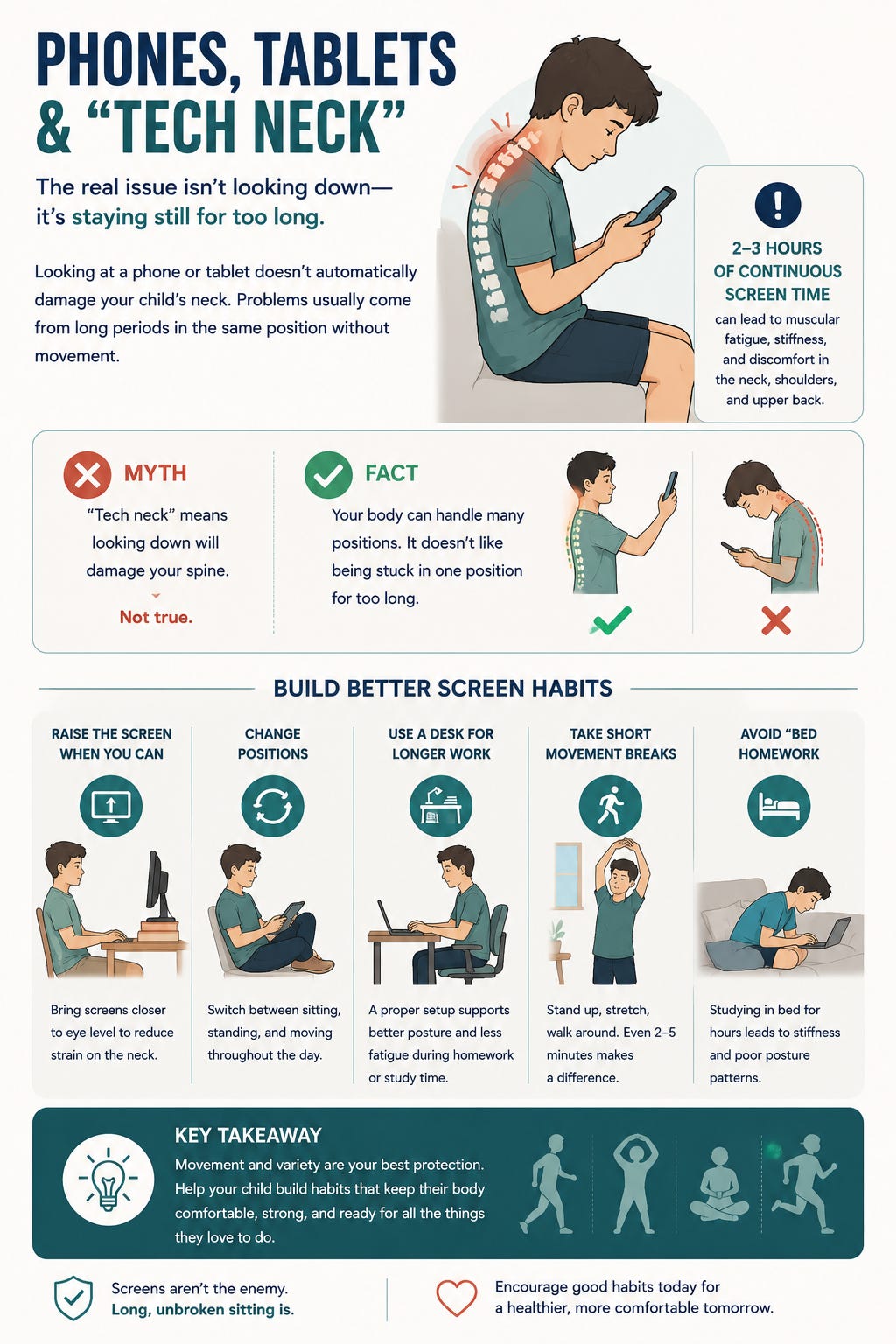
Instead of telling children that looking down is dangerous, we recommend helping them build better movement habits.
Raise the screen when practical. Change positions. Use a desk when doing longer periods of schoolwork. Take short movement breaks. Avoid doing homework curled up on a bed for three hours without moving.
The body generally tolerates many different postures. It simply does not like being stuck in one posture forever.
Stress and Sleep Can Influence Pain Too
Student back pain is not purely mechanical.
Pain is influenced by the nervous system, sleep, mood, stress, physical activity, expectations, and a number of psychosocial factors.
Students today may be balancing school demands, extracurricular activities, competitive sports, social pressures, and increasingly high levels of screen exposure. Older students may also be managing exams, university applications, part-time work, or significant academic pressure.
A student who is sleeping poorly and feeling stressed may become more sensitive to physical discomfort.
That does not mean the pain is “in their head.” Pain is real. It simply means that pain is influenced by more than muscles and joints alone.
A complete approach should therefore consider the student’s overall routine, not just what their spine looks like.
When Should Parents Be Concerned?
Most student back pain is not dangerous, but certain patterns deserve closer attention.
Pain that is mild, short-lived, and clearly linked to an unusual activity may simply settle with time and normal movement.
Persistent pain is different.
Parents should consider having their child assessed when back pain lasts for several weeks, keeps returning, interferes with sport or normal activity, leads the child to avoid movement, follows a significant injury, or is associated with pain travelling into an arm or leg.
Numbness, tingling, weakness, significant changes in coordination, or progressive neurological symptoms should also be evaluated.
More urgent medical assessment may be required when back pain is accompanied by significant neurological deficits, bowel or bladder changes, unexplained fever, unexplained weight loss, major trauma, or persistent severe night pain.
These presentations are uncommon, but they are exactly why a proper clinical history and physical examination are important.
Imaging Is Not Always the First Step
Parents often assume that back pain means an MRI should be ordered immediately.
In many musculoskeletal presentations without concerning features, imaging is not necessary at the beginning.
A detailed history and physical examination can often provide enough information to determine whether conservative care is appropriate.
Imaging becomes more important when there is significant trauma, neurological involvement, persistent pain that is not responding as expected, suspected stress injury, suspected inflammatory disease, or another clinical reason to investigate further.
The decision should be based on the presentation rather than fear.
What We Look at During an Assessment
At The Muscle & Joint Clinic, our goal is not simply to identify where a student hurts.
We want to understand the entire context.
We may ask about when the pain started, whether there was an injury, which movements aggravate it, how much time the student spends sitting, how they use their backpack, which sports they participate in, whether training volume has changed, whether they recently went through a growth spurt, how well they sleep, and whether the problem has happened before.
The physical examination may include spinal movement, joint mobility, strength, flexibility, neurological screening, movement patterns, balance, and other tests depending on the presentation.
The purpose of the assessment is to determine whether the symptoms appear musculoskeletal and suitable for conservative care or whether further medical assessment is needed.
Treatment Should Be More Than “Fixing Posture”
One of the biggest mistakes in treating student back pain is focusing exclusively on posture.
There is rarely one posture that causes every problem, and there is no perfect position that protects the spine from pain.
A more useful treatment plan often focuses on movement, strength, confidence, and gradually returning to normal activity.
Depending on the student, management may include education, activity modification, mobility work, strengthening exercises, rehabilitation, changes to study habits, temporary adjustments to sports training, and manual therapy when appropriate.
The objective should be to help the student become more capable, not more fearful.
Children and teenagers should generally be encouraged to stay active rather than being told that their spine is fragile.
Where Chiropractic Care Can Fit
Chiropractic care can be one part of a conservative approach for appropriately selected children and adolescents with musculoskeletal back pain.
It is important, however, to describe chiropractic care accurately.
Good chiropractic care for a student should not simply involve repeatedly manipulating the spine and sending the patient home.
An evidence-informed approach may include clinical assessment, education, exercise, movement rehabilitation, activity modification, mobility work, and manual therapy where appropriate.
Research specifically examining spinal manipulation in adolescents is still developing and is not as extensive as the adult literature.
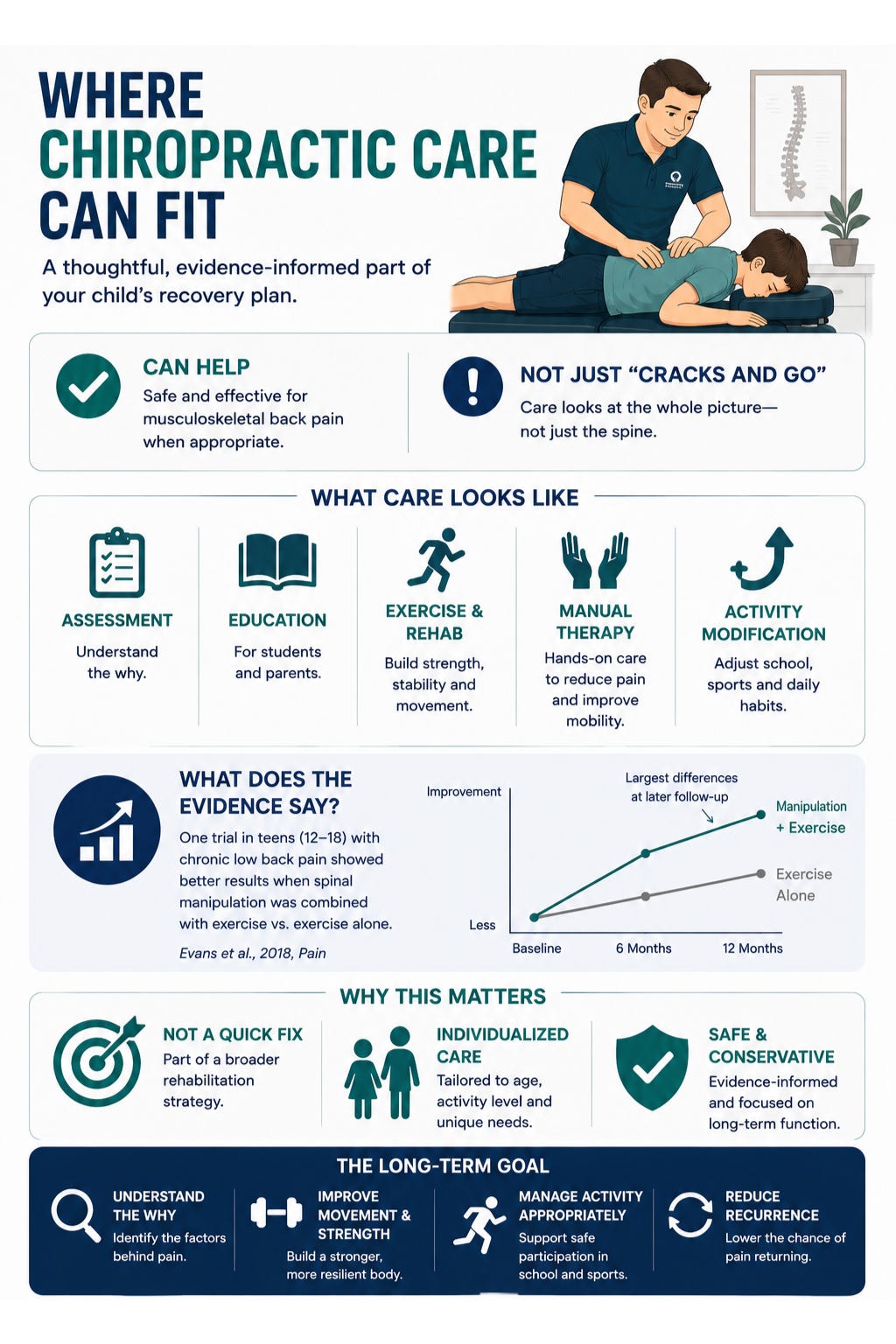
One randomized trial published in Pain examined adolescents between the ages of 12 and 18 with chronic low back pain. The study found that combining spinal manipulation with exercise therapy produced greater improvement in pain compared with exercise alone over the study period, with the largest differences appearing later in follow-up (Evans et al., 2018).
Chiropractic care is most useful when it forms part of a broader rehabilitation strategy rather than being viewed as a standalone “fix.”
For many students, the long-term goal is to understand why the symptoms developed, improve movement and strength where needed, manage activity appropriately, and reduce the chance that the same pattern keeps returning.
What Parents Can Do at Home
Parents do not need to redesign their child’s entire life to support spinal health.
Small changes can make a meaningful difference.
Encourage regular movement throughout the day. Avoid having a child sit for hours without interruption. Keep backpacks reasonably organized and properly fitted. Make sure students are getting enough sleep. Watch for sudden jumps in sports training volume. Encourage activity rather than unnecessary rest.
For homework, a simple rhythm can help: work for a period, then stand up, walk around, stretch, or change position before returning.
Even two or three minutes of movement between study blocks can break up long periods of sitting.
The goal is not perfection.
The goal is variety.
The Bigger Picture
Student back pain should not be treated as an adult problem occurring in a smaller body.
Children and adolescents are growing, adapting, learning movement, participating in sports, sitting through long school days, and navigating changing physical and psychological demands.
The best approach is therefore rarely one-dimensional.
A heavy backpack may contribute, but it is rarely the whole story.
Posture may play a role, but there is no perfect posture.
Sports may aggravate symptoms, but physical activity remains essential.
Growth may contribute to stiffness and changing movement patterns, but growth itself is not a disease.
The key is recognizing when discomfort is becoming persistent, recurrent, or limiting.
Back pain during childhood is common enough that parents should take it seriously, but not fear it.
Most cases are manageable.
The more useful question is not simply, “Why does my child’s back hurt?”
It is:
What factors in this student’s day, movement, growth, training, recovery, or previous history may be contributing to the problem, and what can we do to improve them?
At The Muscle & Joint Clinic, we take that broader approach when assessing students with back, neck, and musculoskeletal pain. When chiropractic care is appropriate, we combine it with education, exercise, rehabilitation, and practical strategies designed to help students remain active and confident in their bodies.
Thanks for reading!
References
Evans, R., Haas, M., Schulz, C., Leininger, B., Hanson, L., Bronfort, G., et al. (2018). Spinal manipulation and exercise for low back pain in adolescents: A randomized trial. Pain, 159(7), 1297–1307.
Hebert, J. J., Leboeuf-Yde, C., Franz, C., Lardon, A., Hestbaek, L., Manson, N., & Wedderkopp, N. (2019). Pubertal development and growth are prospectively associated with spinal pain in young people: The CHAMPS Study-DK. European Spine Journal, 28, 1565–1571.
Henriot-Jéhel, C., Lemire, J., Teulier, C., Bussières, A., & Lardon, A. (2022). Factors associated with back pain in children aged 6 to 12 years of age, an eight months prospective study. Scientific Reports, 12, 603. https://doi.org/10.1038/s41598-021-04060-7
MacDonald, J., Stuart, E., & Rodenberg, R. (2017). Musculoskeletal low back pain in school-aged children: A review. JAMA Pediatrics, 171(3), 280–287. https://doi.org/10.1001/jamapediatrics.2016.3334