

When people think about jaw pain, headaches, facial tension, or even tooth discomfort, they usually think something must be wrong with the teeth, the jaw joint, or maybe the neck. What many people do not realize is that there is a small but important muscle under the jaw called the digastric muscle, and when it becomes irritated or dysfunctional, it can contribute to a surprising range of symptoms.
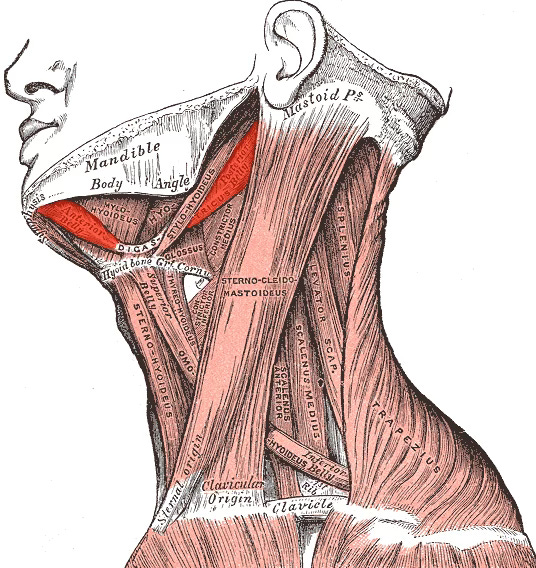
The digastric muscle is part of a group of muscles often called the suprahyoid muscles. It sits beneath the lower jaw and helps connect the jaw, the hyoid bone in the neck, and the structures involved in swallowing and speaking. The name “digastric” means “two bellies,” because the muscle has an anterior belly at the front and a posterior belly at the back, connected by an intermediate tendon. Although it is not a large muscle, it plays an important role in everyday functions such as opening the mouth, stabilizing the hyoid bone, swallowing, speaking, and coordinating normal jaw movement.
Because of its location and function, the digastric muscle is constantly involved in daily life. Every time a person talks, chews, yawns, swallows, clenches, or opens the mouth widely, this muscle may be active. When it becomes overloaded, strained, tight, or develops trigger points, it can create symptoms that feel confusing and sometimes even misleading. In some cases, discomfort from the anterior digastric muscle may feel like pain in the lower front teeth, even when the teeth themselves are healthy. That is important, because not all tooth pain is truly dental in origin.
The digastric muscle sits underneath your jaw and connects the lower jaw to a small bone in the upper part of the neck. One part of the muscle is closer to the chin, and the other part extends farther back under the jaw toward the base of the skull. Its job is to help open the mouth, support swallowing, and help the jaw, throat, and neck work together smoothly. Because this muscle sits in an area where the jaw, throat, and neck all meet, irritation in it can sometimes cause pain or tension in more than one area at the same time.
When the digastric muscle is irritated, patients may describe symptoms such as pain under the chin, tenderness beneath the jaw, discomfort with wide opening, pain when chewing, throat tightness, a pulling sensation in the front of the neck, or even odd sensations that seem to travel into the jaw or lower teeth. Some people notice discomfort when swallowing or speaking for long periods. Others report that their symptoms seem worse after clenching, poor posture, stress, long hours at a desk, sleeping awkwardly, or after dental work that required prolonged mouth opening. In clinical practice, this can sometimes lead to confusion, because the symptoms may mimic dental pain, temporomandibular dysfunction, or even generalized neck tension.
This is one reason a careful assessment matters. In a recent case report, the anterior digastric muscle was identified as a source of referred pain that mimicked toothache in the lower front teeth. That type of presentation reminds us that pain is not always felt exactly where the problem begins. Muscles can refer pain to nearby or even somewhat distant areas, and if that possibility is missed, patients may undergo unnecessary treatment directed at the wrong structure.
The digastric muscle does not work alone. It is part of a bigger system that includes the jaw muscles, tongue, throat, and neck. Studies show that when the neck muscles are tight or irritated, they can affect how the jaw muscles work. In the study you shared, people with trigger points in the upper trapezius muscle had uneven activity in some of their jaw muscles. This suggests that neck pain and jaw problems can be connected. Put simply, when one area is not working properly, the other area may have to work harder to make up for it.
This connection matters because jaw symptoms are not always caused by the jaw alone. Things like poor posture, a forward head position, too much phone or computer use, ongoing neck tightness, stress-related clenching, and overworked muscles can all affect how the jaw and nearby muscles function. The study also suggested that neck muscle pain may contribute to imbalance in the chewing muscles. That is why it is often important to look at both the jaw and the neck, rather than focusing on just one area.
At the Muscle and Joint Clinic, this is why a full muscle and joint assessment can be so helpful. When someone has jaw pain, tension under the chin, headaches, tooth-like pain, or neck tightness, the goal is not just to find where the pain is, it is to figure out what is causing it. A proper assessment may include checking how the jaw moves, feeling the muscles around the jaw and under the chin, looking at posture, examining the neck and upper shoulders, and seeing whether tight muscles or restricted movement may be part of the problem.
Treatment depends on the person, but it often involves a mix of different approaches. Hands-on treatment may help reduce muscle tension and improve movement. Specific exercises can help the muscles work better together and reduce strain. Posture may also need to be addressed, especially if forward head posture or neck tension is adding to the problem. Patients may also be given advice on avoiding clenching, changing habits that make symptoms worse, improving desk or phone setup, and doing gentle home exercises to help restore normal function. In some cases, care may involve more than one type of practitioner, especially when symptoms overlap with dental, TMJ, or throat-related concerns.
The good news is that once the real source of the pain is identified, treatment can often be much more effective. Many patients feel relieved just knowing that their symptoms may be coming from muscles rather than something more serious. When the digastric muscle or nearby tissues are part of the problem, treating those areas directly can help reduce pain, improve jaw comfort, and make everyday activities feel easier again.
The main message is simple: the digastric muscle is small, but it plays an important role. When it becomes irritated, it can cause symptoms that are easy to misunderstand. Pain under the jaw, strange tooth-like discomfort, throat tension, or pain when opening the mouth does not always mean there is a problem with the teeth or jaw joint. Sometimes the muscles under the jaw are a big part of the issue. And because the jaw and neck work closely together, it is often important to assess both.
If you have been dealing with jaw tension, pain under the chin, headaches, neck tightness, or symptoms that do not seem to make sense, a thorough musculoskeletal assessment may help uncover the real cause. Understanding the role of muscles like the digastric can be the first step toward the right treatment and longer-lasting relief.
References
Ginszt, M., Szkutnik, J., Zieliński, G., Bakalczuk, M., Stodółkiewicz, M., Litko-Rola, M., Ginszt, A., Rahnama, M., & Majcher, P. (2022). Cervical myofascial pain is associated with an imbalance of masticatory muscle activity. International Journal of Environmental Research and Public Health, 19(3), 1577. https://doi.org/10.3390/ijerph19031577
Kalladka, M., Thondebhavi, M., Ananthan, S., Kalladka, G., & Khan, J. (2020). Myofascial pain with referral from the anterior digastric muscle mimicking a toothache in the mandibular anterior teeth: A case report. Quintessence International, 51(1), 56–62. https://doi.org/10.3290/j.qi.a43615
Shah, J. P., Thaker, N., Heimur, J., Aredo, J. V., Sikdar, S., & Gerber, L. (2015). Myofascial trigger points then and now: A historical and scientific perspective. PM&R, 7(7), 746–761. https://doi.org/10.1016/j.pmrj.2015.01.024