


Shoulder instability can be frustrating because it often does not start with a dramatic injury. For many people, it begins as a feeling that the shoulder is loose, shifts too easily, clicks, or cannot be trusted during lifting, reaching, or overhead activity. In multidirectional instability, the shoulder is symptomatic in more than one direction, meaning the humeral head is not being adequately stabilized within the glenoid during movement (Karasuyama et al., 2023). This can interfere with daily activities, work demands, exercise, and overall confidence in using the arm.
One of the reasons shoulder instability is so challenging is that it is often multifactorial. According to Karasuyama et al. (2023), multidirectional instability may be related to ligament and capsular laxity, dysfunction of the dynamic stabilizers such as the rotator cuff, and abnormal scapular motion. Some individuals also have generalized joint laxity, which can further reduce shoulder stability. In addition, scapular malposition has been reported in many people with multidirectional instability, and this can limit proper upward rotation and glenoid positioning during arm elevation (Karasuyama et al., 2023). In practical terms, this means the issue is not always just weakness. It may involve a combination of lax tissues, poor muscular control, and altered movement patterns.
Exercise therapy is commonly recommended as a first-line conservative treatment for multidirectional shoulder instability. The goal of exercise is to improve active control of the joint by strengthening the rotator cuff and deltoid, improving scapular mechanics, and enhancing neuromuscular control (Karasuyama et al., 2023). Treatment programs may include isometric and isotonic exercises, periscapular strengthening, proprioceptive work, and perturbation training. These approaches are designed to improve congruity between the humeral head and glenoid, normalize scapular motion, and help the shoulder respond better to movement demands (Karasuyama et al., 2023).
Check Out Our Exercise Video Here
An important point for patients and clinicians alike is that the evidence base is still developing. The Cochrane paper provided is a protocol, which means it outlines the plan for a systematic review rather than presenting completed results. Its purpose is to assess the benefits and harms of exercise therapy for multidirectional instability of the shoulder through a structured review of randomized controlled trials (Karasuyama et al., 2023). The authors note that previous reviews found limited high-quality evidence and that the effectiveness of exercise therapy alone has not yet been clearly established through strong randomized trial data. At the same time, exercise remains the most commonly recommended non-operative option and is widely used in clinical practice as an initial management strategy (Karasuyama et al., 2023).
This is important because it reminds us to be thoughtful in how we talk about treatment. Exercise for shoulder instability should not be presented as a guaranteed fix, but it does have a strong clinical rationale. If stability problems are partly driven by poor muscular control, altered scapular mechanics, and reduced neuromuscular responsiveness, then a well-designed rehabilitation program makes sense as a conservative starting point. Karasuyama et al. (2023) describe exercise therapy as potentially beneficial in improving shoulder stability and active control, particularly in cases where capsular laxity and scapulothoracic dysfunction contribute to symptoms.
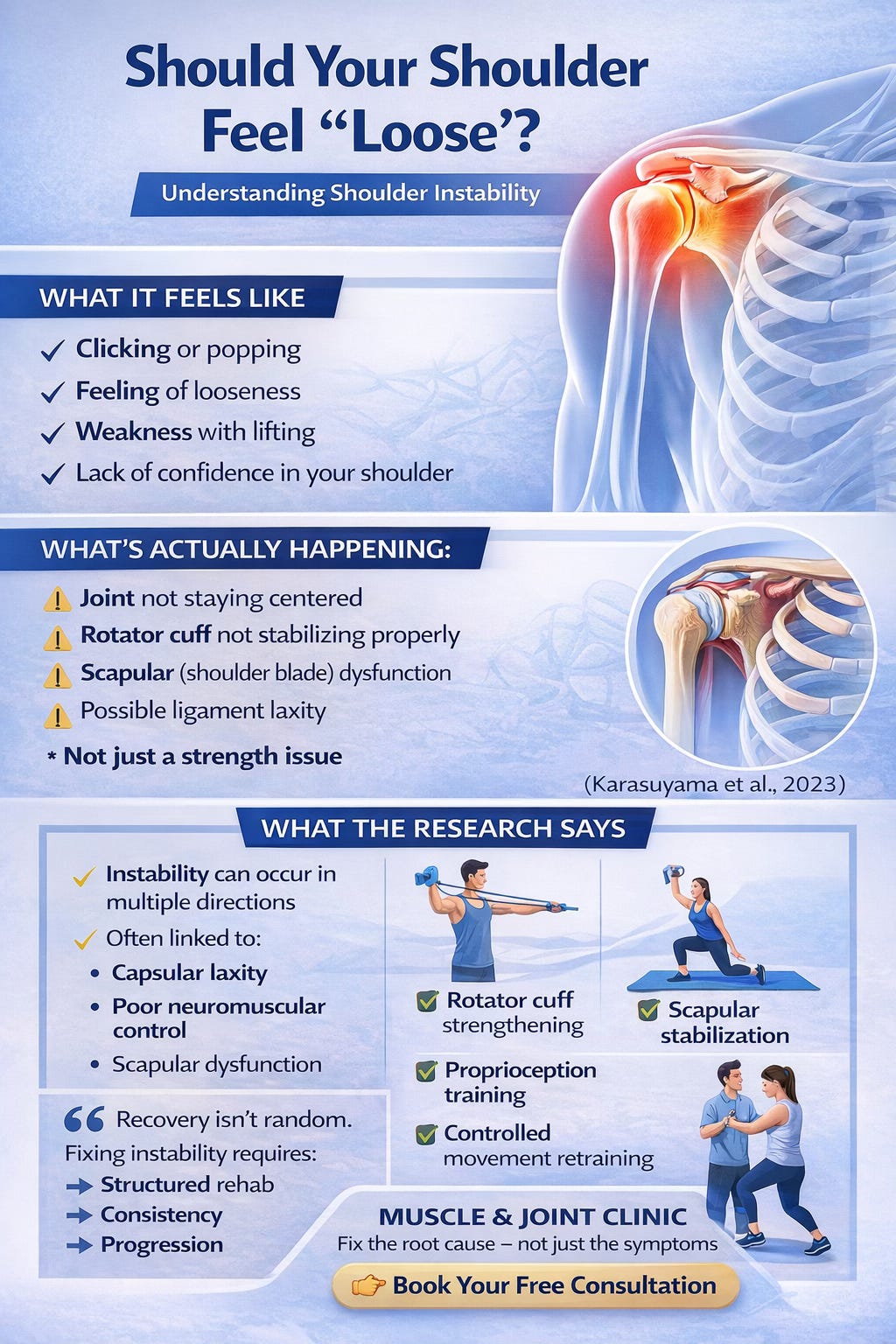
For patients, this means rehabilitation should be specific, progressive, and consistent. Shoulder instability is not usually something that improves with random strengthening alone. It often requires a focused program aimed at the rotator cuff, scapular stabilizers, proprioception, and controlled movement retraining. It also means that recovery may look different from person to person depending on age, activity level, adherence to exercise, and whether the instability is traumatic or non-traumatic in nature (Karasuyama et al., 2023).
At Muscle and Joint Clinic, the goal is to look beyond the symptom of pain and understand how the shoulder is functioning as a whole. When someone reports that their shoulder feels loose, shifts during movement, or lacks confidence under load, that should not be ignored. These are often early signs that the shoulder needs more support, better control, and a structured plan. While research continues to evolve, current evidence supports the importance of individualized assessment and targeted rehabilitation when addressing shoulder instability.
Reference
Karasuyama, M., Imai, T., Gotoh, M., Kawakami, J., Ariie, T., & Yamamoto, S. (2023). Exercise for multidirectional instability of the shoulder (Protocol). Cochrane Database of Systematic Reviews, 2023(12), Article CD015450. https://doi.org/10.1002/14651858.CD015450