


When fans hear that an athlete has a Grade 1 hamstring strain, it can sound like good news compared with a more serious tear. And in many ways, it is. A Grade 1 strain is the mildest type of muscle strain. But “mild” does not mean meaningless. Even a low-grade hamstring injury can affect speed, power, movement confidence, and performance, especially in a sport like basketball where sprinting, stopping, jumping, and changing direction happen constantly.
That is why the recent report about Oklahoma City Thunder forward Jalen Williams being ruled week-to-week with a Grade 1 left hamstring strain is so relevant. According to the report, Williams suffered the injury during Game 2 of the Thunder’s first-round playoff series after appearing to grab the back of his leg and signal toward the bench. He will miss at least the next few games and be reevaluated weekly. For a high-level athlete in the middle of the playoffs, even a Grade 1 hamstring strain is enough to force a pause.
So what exactly does that diagnosis mean?
The hamstrings are a group of muscles located at the back of the thigh. They play a major role in bending the knee, extending the hip, decelerating the leg during running, and helping the body produce explosive movement. In basketball, the hamstrings are heavily involved when an athlete accelerates on a fast break, plants to change direction, elevates for a layup, or suddenly slows down. Because of this, they are especially vulnerable when there is a rapid or forceful stretch while the muscle is under load.
A Grade 1 hamstring strain usually means there has been mild damage to a small number of muscle fibres. The muscle is irritated and injured, but not significantly torn. People with this type of strain often notice tightness, tenderness, pain when sprinting or lengthening the leg, and sometimes a feeling that something “grabbed” in the back of the thigh. They may still be able to walk, but explosive activity typically becomes painful or unsafe. In athletes, this is often enough to take them out of competition because even a slight hamstring issue can reduce performance and increase the risk of making the injury worse.
That last point is important. One reason teams are cautious with hamstring injuries is that they are known for being easy to aggravate if an athlete returns too soon. In the report on Williams, it was also noted that he had previously missed time because of a right hamstring strain earlier in the season. While this new injury was reported as being on the leftside, any recent history of hamstring problems tends to make medical staff more conservative. That is because hamstring strains can recur if the tissue has not fully recovered or if the athlete returns before strength, control, and tolerance to high-speed movement are restored.
For the average person, a Grade 1 hamstring strain may happen during sprinting, slipping, lunging, sudden stretching, sports, or even workouts involving deadlifts or kicking movements. Symptoms can range from mild discomfort to a sharper pulling sensation. There may be pain with walking fast, climbing stairs, or bending forward. Usually there is little to no bruising with a Grade 1 injury, and function is only mildly reduced compared with more severe strains.
Recovery depends on the individual, the exact location of the strain, and how quickly the person reduces aggravating activities and begins an appropriate rehab plan. In general, a Grade 1 hamstring strain often improves more quickly than a Grade 2 or Grade 3 injury, but that does not mean it should simply be ignored. Early management often includes relative rest, avoiding painful sprinting or explosive movement, and gradually reintroducing strengthening and mobility work as tolerated. The goal is not just to feel less pain. The real goal is to restore the muscle’s ability to handle load again.
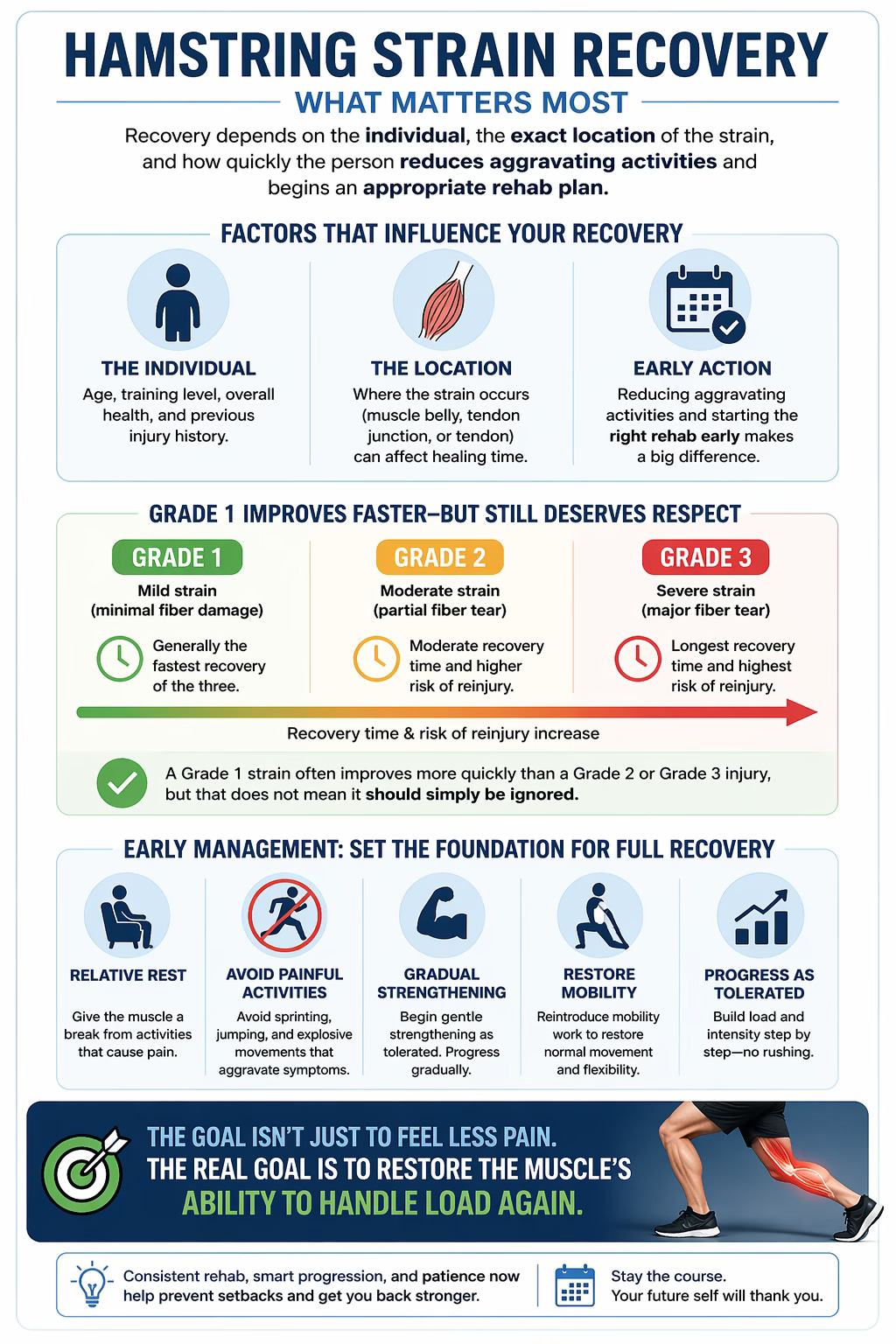
This is where rehab matters. A hamstring that feels “mostly better” in daily life may still not be ready for full-speed running, jumping, or sport. That gap between feeling better and actually being ready is where reinjuries often happen. A proper recovery plan usually focuses on pain-guided progression, restoring range of motion, improving hamstring strength, and retraining movement patterns so the muscle can tolerate the demands of activity again. For athletes, that often includes a gradual return to higher-speed running and sport-specific drills.
Jalen Williams’ situation is a great example of why these injuries are taken seriously even when they are called Grade 1. He was reportedly playing very well before leaving the game, but in elite sport the medical question is not only, “Can he play?” It is also, “Can he play effectively and safely without making this worse?” In the playoffs, with repeated high-intensity efforts and limited recovery time between games, that question becomes even more important.
For patients, there is a useful takeaway here: the word “mild” should never be confused with “nothing.” A Grade 1 hamstring strain is often very manageable, but it still deserves attention. If the hamstring is repeatedly tightened, overloaded, or rushed back into sport or exercise, recovery can drag on and the risk of re-strain can increase.
At our clinic, when someone presents with a hamstring strain, the focus is not just on the sore spot itself. It is also on the bigger picture: how the injury happened, what loads the person needs to return to, whether there are contributing mobility or strength issues, and how to build them back up without doing too much too soon. That can include hands-on care where appropriate, guided exercise, progressive strengthening, and practical advice for returning to walking, running, the gym, or sport.
A Grade 1 hamstring strain may be the mildest category, but for an NBA player it can change a playoff series. And for everyone else, it can still interfere with work, exercise, and daily movement if it is not managed well. The good news is that with the right plan, most mild hamstring strains improve well. The key is respecting the injury early and rebuilding properly instead of trying to push through it.
If a pulling pain in the back of the thigh has been lingering, keeps coming back, or is limiting activity, it is worth getting assessed.
Not sure if it’s just tightness or an actual strain? Book an assessment with our team and let’s help you figure out the next step.
References
Chu, S. K., & Rho, M. E. (2016). Hamstring injuries in the athlete: Diagnosis, treatment, and return to play. Current Sports Medicine Reports, 15(3), 184–190.
Cross, K. M., Gurka, K. K., Conaway, M., Ingersoll, C. D., & Saliba, S. A. (2015). Days to return to participation after a hamstrings strain injury: A comparison of 3 clinical hamstring tests. Journal of Athletic Training, 50(3), 305–310.
Heiderscheit, B. C., Sherry, M. A., Silder, A., Chumanov, E. S., & Thelen, D. G. (2010). Hamstring strain injuries: Recommendations for diagnosis, rehabilitation, and injury prevention. Journal of Orthopaedic & Sports Physical Therapy, 40(2), 67–81.
Hickey, J., Shield, A. J., Williams, M. D., & Opar, D. A. (2017). Return-to-play clearance following hamstring strain injury: It is time to move beyond length of time? Sports Medicine, 47(6), 1189–1196.
Larson, J. H., Samani, A. L., & Beaulieu-Jones, B. R. (2023). Hamstring strains: Classification and management. Orthopedic Reviews, 15(2), Article 115293.
Paton, B. M., Maniar, N., Timmins, R. G., Bourne, M. N., Opar, D. A., Hickey, J. T., Hughes, C., Shield, A. J., Whiteley, R., & Buchheit, M. (2023). London International Consensus and Delphi study on hamstring muscle strain injury classification, rehabilitation, and return to sport. British Journal of Sports Medicine, 57(5), 278–289.
Pieters, D., Cingel, R. van, Krips, R., Tol, J. L., & Kerkhoffs, G. (2021). Return to play after a hamstring strain injury: It is time to consider natural healing. Sports Medicine, 51(10), 2127–2137.
Pollock, N., James, S. L. J., Lee, J. C., & Chakraverty, R. (2014). British athletics muscle injury classification: A new grading system. British Journal of Sports Medicine, 48(18), 1347–1351.
Silder, A., Sherry, M. A., Sanfilippo, J., Tuite, M. J., Hetzel, S. J., & Heiderscheit, B. C. (2013). Clinical and morphological changes following 2 rehabilitation programs for acute hamstring strain injuries: A randomized clinical trial. Journal of Orthopaedic & Sports Physical Therapy, 43(5), 284–299. This line of research is commonly used in hamstring rehab discussions, especially around progressive loading and function-based recovery.
Sherry, M. A., Best, T. M., Silder, A., Thelen, D. G., & Heiderscheit, B. C. (2011). Outcome of grade I and II hamstring injuries in intercollegiate athletes: A novel rehabilitation protocol. Sports Health, 3(6), 528–533.