


It can be alarming when the hand suddenly feels numb, weak, or uncoordinated, especially when it seems to happen without warning. Many people worry that this signals something serious or permanent. While sudden changes in hand function should always be assessed, one of the more common and often reversible causes is radial nerve compression. This condition can look dramatic, but in many cases, it responds well to appropriate care and time.
Understanding the Role of the Radial Nerve
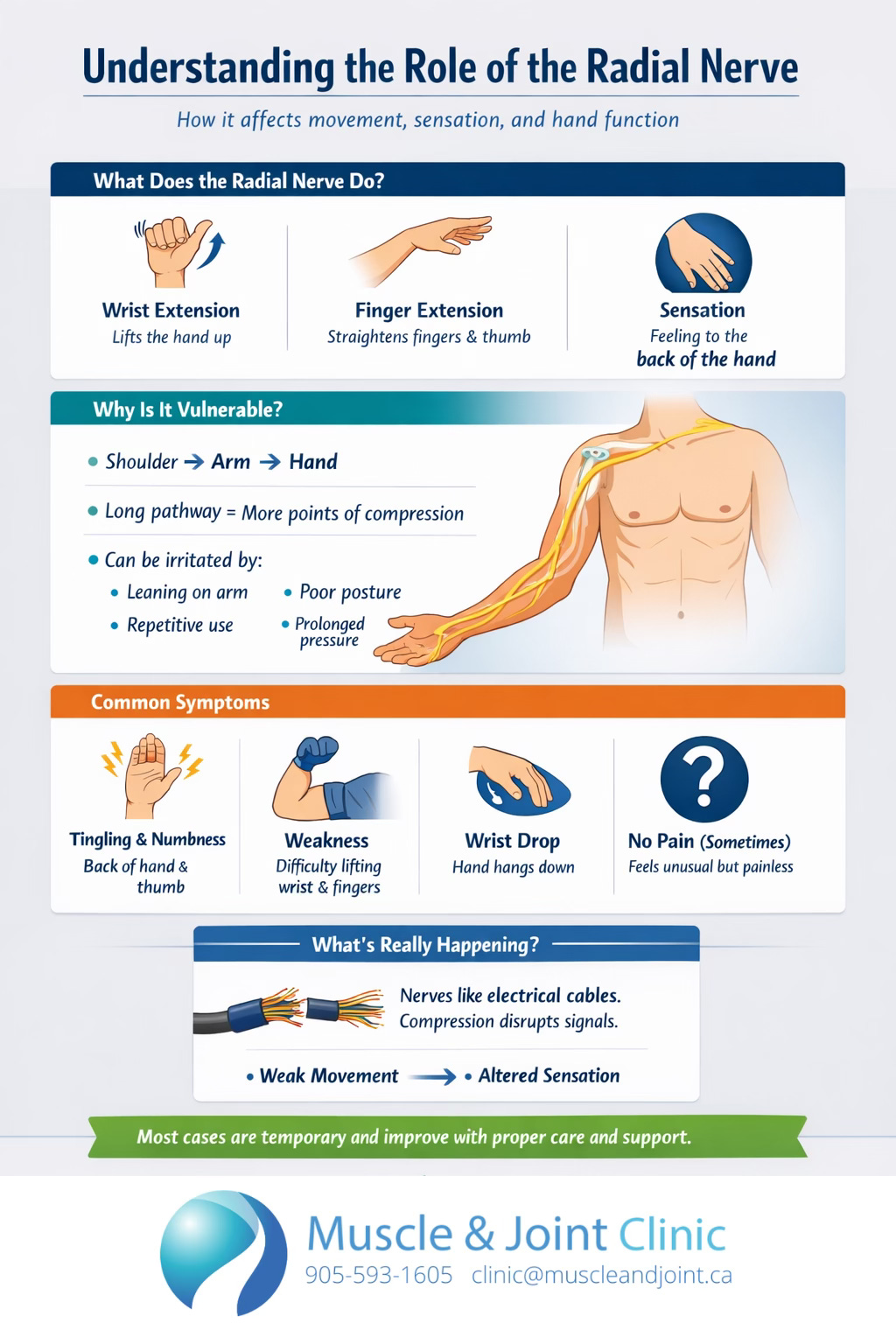
The radial nerve is responsible for extending the wrist and fingers and providing sensation to part of the back of the hand. Because of its long course from the shoulder down into the hand, it is particularly vulnerable to compression or irritation at multiple points along the arm. When affected, individuals may experience numbness or tingling over the back of the hand, weakness in lifting the wrist or fingers, and a characteristic “drooping” of the wrist known as wrist drop (Bumbasirevic et al., 2016; Laulan, 2019). Interestingly, pain is not always present, which can make the symptoms feel even more unusual.
Why Symptoms Can Appear Suddenly
Radial nerve compression often occurs from everyday positions rather than major trauma. Leaning on the arm, prolonged desk work, repetitive computer or phone use, or even sleeping in an awkward position can place sustained pressure on the nerve. This type of compression neuropathy is sometimes referred to as “Saturday night palsy,” reflecting how prolonged pressure alone can temporarily disrupt nerve function (Bumbasirevic et al., 2016). In other cases, muscle tightness or localized swelling can further increase pressure on the nerve and contribute to symptoms (Laulan, 2019).
Not All Nerve Injuries Are Permanent
One of the most reassuring aspects of radial nerve compression is that many cases are temporary. A mild injury, known as neuropraxia, involves a temporary disruption in nerve signaling without structural damage. In these cases, recovery often occurs gradually over time. More severe injuries involve deeper nerve damage and require closer monitoring, but even then, a significant proportion of cases recover without surgery. In fact, approximately 77% of radial nerve palsies improve with conservative (non-surgical) management (Silver et al., 2021; Ilyas et al., 2020).
What Early Management Looks Like
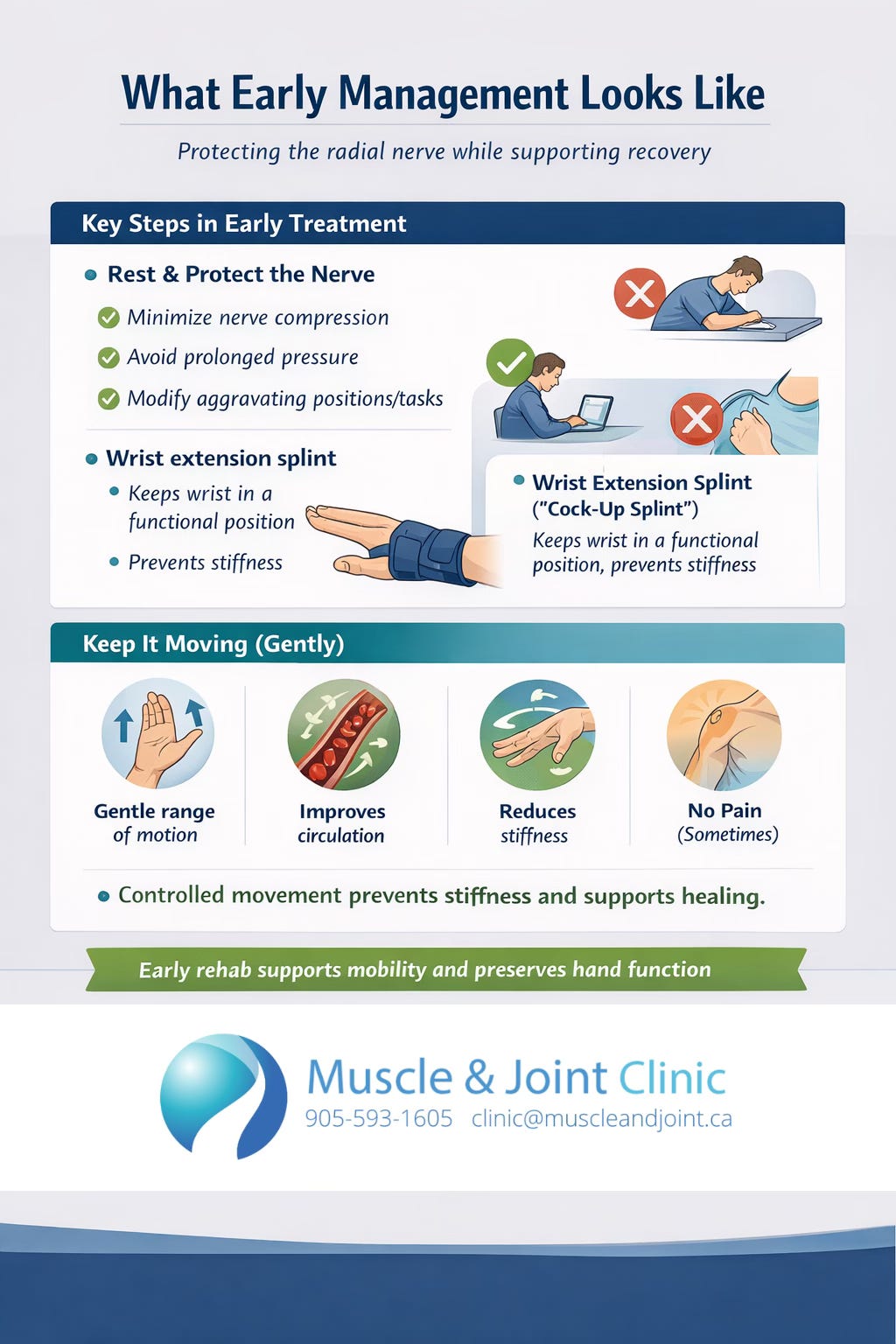
Initial treatment focuses on protecting the nerve and preventing further irritation. This includes modifying activities, avoiding positions that compress the nerve, and allowing relative rest rather than complete inactivity. A wrist extension splint, often called a “cock-up splint,” is a key part of early care. It supports the wrist in a functional position, prevents stiffness, and allows individuals to continue using their hand more effectively during recovery (Silver et al., 2021).
At the same time, maintaining movement is important. Gentle motion helps preserve joint mobility, improve circulation, and reduce stiffness. This reflects a broader shift in rehabilitation thinking, complete rest is rarely ideal, and controlled movement supports healing when applied appropriately.
The Role of Rehabilitation
Rehabilitation plays a central role in recovery. The goal is to maintain joint mobility, prevent muscle atrophy, and gradually restore strength and coordination as nerve function returns. Physical therapy programs typically include range-of-motion exercises, progressive strengthening, and functional retraining of the hand and wrist (Silver et al., 2021).
Evidence suggests that structured rehabilitation is highly effective. Observational data shows near-complete recovery rates at six months for certain types of radial nerve compression when appropriate therapy is followed (Silver et al., 2021). Emerging evidence also suggests that combining exercise with modalities such as electrical stimulation may further improve outcomes in some cases, enhancing nerve conduction and muscle recovery (Shi et al., 2024).
Other adjunctive treatments may include anti-inflammatory medications for symptom relief and, in select cases, targeted injections. Newer approaches such as ultrasound-guided dextrose injections are being explored, although more research is needed before they become standard care (Chen et al., 2018).
Monitoring Recovery and Timeline
Recovery from radial nerve compression typically occurs gradually. Initial signs of improvement may appear within several weeks, with more complete recovery occurring over a period of 3 to 24 weeks depending on the severity of the injury (Bumbasirevic et al., 2010; Silver et al., 2021). Regular follow-up is important to ensure progress is occurring as expected.
If there is no noticeable improvement after several months, further evaluation may be required. This can include electromyography (EMG) and nerve conduction studies, which help determine the location and severity of the nerve injury and guide next steps in care (Shah & Bhatti, 1983).
When Medical Involvement Is Important
Although many cases improve with conservative care, physician involvement is important in certain situations. Significant weakness, worsening symptoms, spreading numbness, or lack of improvement over time should prompt further investigation. Imaging, diagnostic testing, or referral to a specialist may be necessary to rule out more serious causes or to guide treatment.
Surgical intervention is typically reserved for cases where there is clear structural damage to the nerve or when there is no meaningful recovery after several months of conservative management (Carter & Weiss, 2015). Fortunately, these situations are less common, and most individuals recover without the need for surgery.
Reassurance and Next Steps
Experiencing sudden weakness or numbness in the hand can feel unsettling, but it does not always indicate permanent damage. In many cases, the cause is a temporary nerve compression that responds well to protection, splinting, and guided rehabilitation. Early assessment is key, not only to confirm the diagnosis but also to ensure the right plan is in place for recovery.
If your hand or arm suddenly is not functioning as it should, do not ignore it. Getting it assessed early provides clarity, reduces unnecessary worry, and gives you the best chance for a smooth and complete recovery.
References
Bumbasirevic, M., Palibrk, T., Lesic, A., & Atkinson, H. D. E. (2016). Radial nerve palsy. EFORT Open Reviews, 1(8), 286–294. https://doi.org/10.1302/2058-5241.1.000028
Bumbasirević, M., Lesić, A., Bumbasirević, V., et al. (2010). The management of humeral shaft fractures with associated radial nerve palsy. Archives of Orthopaedic and Trauma Surgery.
Carter, G. T., & Weiss, M. D. (2015). Diagnosis and treatment of work-related proximal median and radial nerve entrapment. Physical Medicine and Rehabilitation Clinics of North America.
Chen, S. R., Shen, Y. P., Ho, T. Y., Chen, L. C., & Wu, Y. T. (2018). Ultrasound-guided perineural injection with dextrose for radial nerve palsy: A case report. Medicine.
Ilyas, A. M., Mangan, J. J., & Graham, J. (2020). Radial nerve palsy recovery with fractures of the humerus: An updated systematic review. Journal of the American Academy of Orthopaedic Surgeons.
Laulan, J. (2019). High radial nerve palsy. Hand Surgery and Rehabilitation, 38(1), 2–13.
Shah, J. J., & Bhatti, N. A. (1983). Radial nerve paralysis associated with fractures of the humerus. Clinical Orthopaedics and Related Research.
Shi, S., Ou, X., & Du, X. (2024). Enhanced nerve function recovery in radial nerve palsy patients with humerus shaft fracture. Frontiers in Neurology.
Silver, S., Ledford, C. C., Vogel, K. J., & Arnold, J. J. (2021). Peripheral nerve entrapment and injury in the upper extremity. American Family Physician.