


Low back pain is one of the most common health concerns worldwide and remains a leading cause of disability across all age groups. It is estimated that up to 80% of individuals will experience low back pain at some point in their lives, and for many, it becomes a recurring or persistent issue that affects not only physical health but also sleep, work productivity, mental well-being, and overall quality of life (Hartvigsen et al., 2018). Rather than being a simple structural problem, low back pain is now widely understood as a complex condition influenced by physical, neurological, psychological, and lifestyle factors, which is why modern treatment approaches must go beyond symptom relief alone.
A recent study by Shannon et al. (2026) explored this broader perspective by examining active-duty U.S. military personnel with low back pain who received either usual medical care or usual care combined with chiropractic treatment. Importantly, the researchers were not only interested in whether patients improved, but also in identifying what factors actually drove that improvement over time. Outcomes were assessed at both 12 weeks and 52 weeks and included pain intensity, disability, fatigue, sleep disturbance, and social functioning. This type of research is particularly valuable because it helps clinicians understand not just whether a treatment works, but how and why it works.
One of the most important findings from this study was that early improvements in pain and disability played a central role in long-term recovery. Patients who experienced reductions in pain intensity and improvements in functional ability early in their care were significantly more likely to report better sleep, reduced fatigue, and improved participation in daily activities later on (Shannon et al., 2026). In practical terms, this means that when patients begin to move better and feel less limited early in the process, it creates a positive ripple effect across multiple aspects of their health.
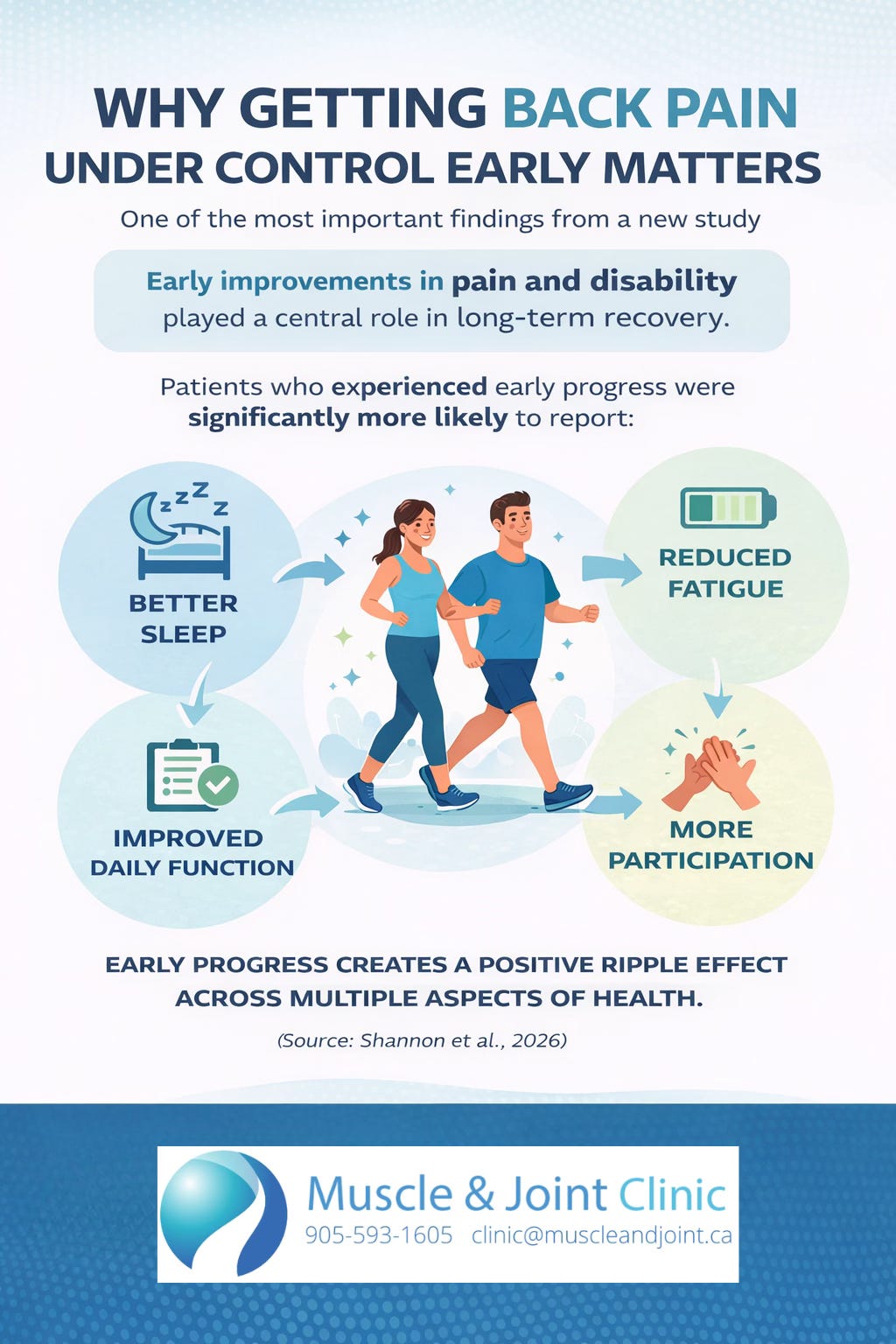
Interestingly, the reverse relationship was much weaker. Improvements in sleep, fatigue, or general well-being alone did not significantly predict reductions in long-term pain. This suggests that while sleep and recovery are important, they are not the primary drivers of improvement. Instead, addressing the underlying mechanical and functional contributors to pain, such as movement patterns, joint mobility, and muscular control, appears to be the key factor that initiates meaningful recovery (Shannon et al., 2026).
These findings strongly reinforce what has already been established in broader low back pain research. Clinical guidelines consistently recommend early, active, and conservative management approaches, including manual therapy, exercise, and patient education, as first-line treatment for most cases of low back pain (Qaseem et al., 2017; Foster et al., 2018). Delaying treatment or relying solely on passive strategies such as rest or medication can allow pain patterns to become more persistent and harder to resolve. Over time, this can lead to deconditioning, reduced mobility, increased sensitivity of the nervous system, and greater disruption to sleep and daily function.
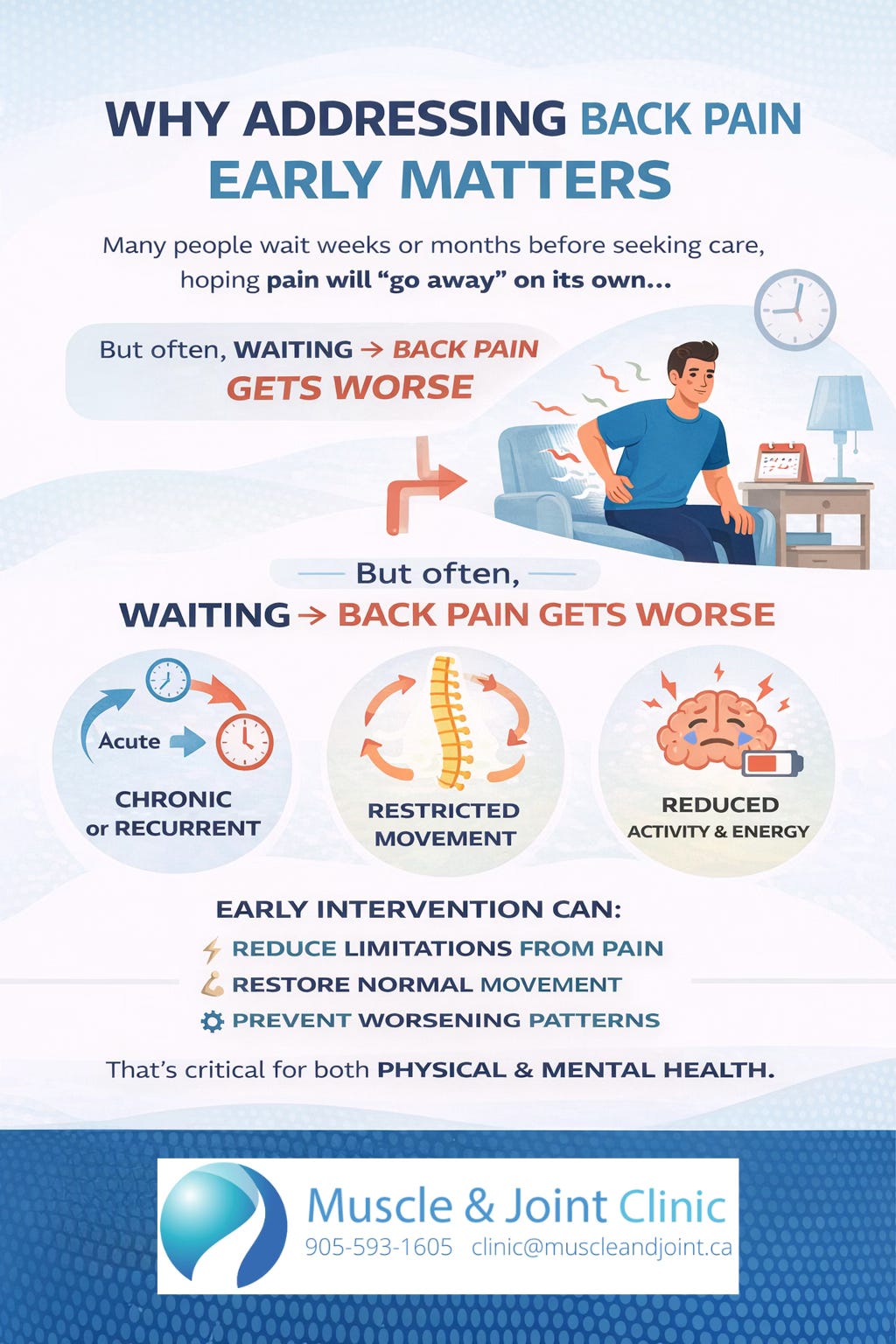
For the average person, this has very real implications. Many individuals wait weeks or even months before seeking care, often hoping the pain will resolve on its own. While some cases do improve spontaneously, others evolve into chronic or recurrent conditions that are significantly more difficult to manage. Early intervention helps break this cycle by reducing pain-related limitations, restoring normal movement, and preventing compensatory patterns from developing. It also helps maintain activity levels, which is critical for both physical and mental health.
At Muscle & Joint Clinic, this approach is central to how we manage low back pain. Treatment is not focused solely on reducing symptoms, but on improving how the body functions as a whole. This includes addressing mobility restrictions, strengthening key stabilizing muscles, improving movement patterns, and providing education around posture, ergonomics, and daily habits. By targeting the root contributors to pain early, patients are more likely to experience not only pain relief, but also improvements in sleep, energy levels, and overall quality of life.
Ultimately, the message is clear: low back pain should not be ignored or simply “waited out,” especially when it begins to interfere with daily function. Early, targeted treatment can significantly influence the trajectory of recovery, helping patients return to normal activity sooner and reducing the risk of long-term complications. When pain and function improve early, the benefits extend far beyond the back itself—supporting better sleep, better movement, and a healthier, more active life.
References (APA Style)
Foster, N. E., Anema, J. R., Cherkin, D., Chou, R., Cohen, S. P., Gross, D. P., Ferreira, P. H., Fritz, J. M., Koes, B. W., Peul, W., Turner, J. A., & Maher, C. G. (2018). Prevention and treatment of low back pain: Evidence, challenges, and promising directions. The Lancet, 391(10137), 2368–2383. https://www.thelancet.com/journals/lancet/article/PIIS0140-6736(18)30489-6/abstract
Hartvigsen, J., Hancock, M. J., Kongsted, A., Louw, Q., Ferreira, M. L., Genevay, S., Hoy, D., Karppinen, J., Pransky, G., Sieper, J., Smeets, R. J., & Underwood, M. (2018). What low back pain is and why we need to pay attention. The Lancet, 391(10137), 2356–2367. https://www.thelancet.com/journals/lancet/article/PIIS0140-6736(18)30480-X/abstract
Qaseem, A., Wilt, T. J., McLean, R. M., & Forciea, M. A. (2017). Noninvasive treatments for acute, subacute, and chronic low back pain: A clinical practice guideline from the American College of Physicians. Annals of Internal Medicine, 166(7), 514–530. https://www.acpjournals.org/doi/10.7326/M16-2367
Shannon, Z. K., Long, C. R., Vining, R. D., Walter, J. A., Coulter, I. D., & Goertz, C. M. (2026). Mediators of the effect of chiropractic care on 12- and 52-week outcomes for U.S. active-duty military personnel with low back pain: Secondary analysis of a clinical trial. Chiropractic & Manual Therapies, 34, 12. https://link.springer.com/article/10.1186/s12998-026-00628-0